
CONTROL LINE COMBAT
Iskandar Taib, 517 Tulip Tree, Bloomington IN 47406
Overview
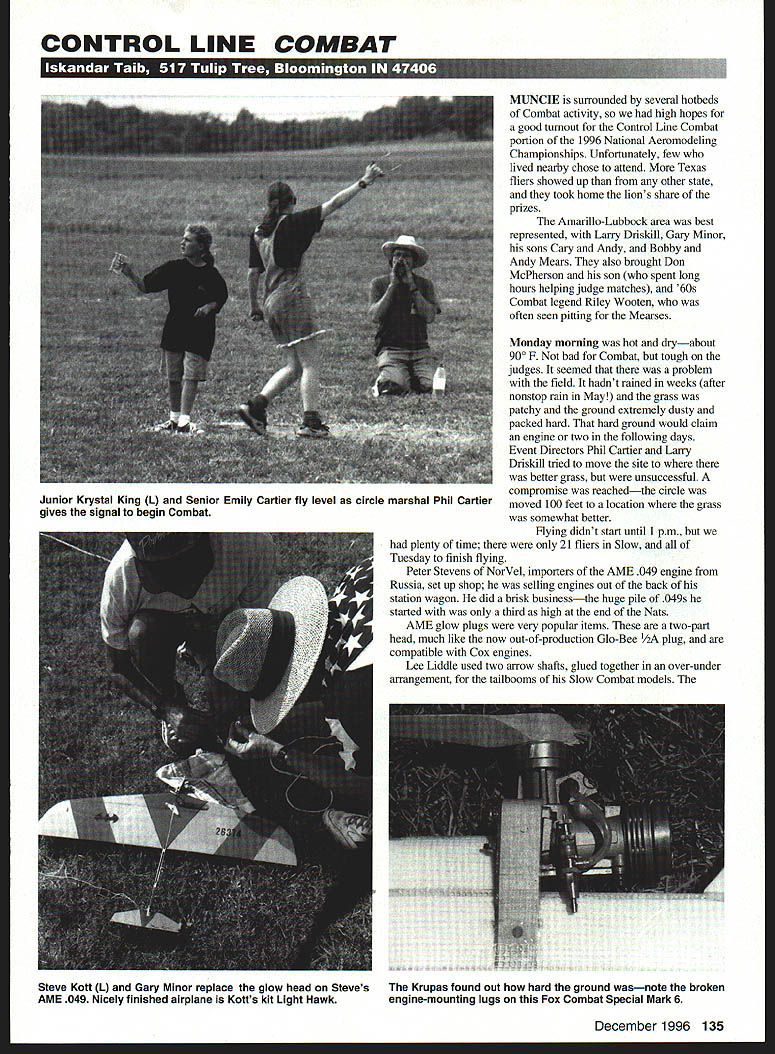
Muncie is surrounded by several hotbeds of Combat activity, so we had high hopes for a good turnout for the Control Line Combat portion of the 1996 National Aeromodeling Championships. Unfortunately, few who lived nearby chose to attend. More Texas fliers showed up than from any other state, and they took home the lion's share of the prizes.
Notable attendees
- Amarillo–Lubbock area: Larry Driskill, Gary Minor, Cary and Andy Minor, Bobby and Andy Mears
- Others from Texas: Don McPherson (and his son), Riley Wooten (’60s Combat legend)
- Several Czech-built model users, including many ready-to-fly (RTF) designs
Field and Weather
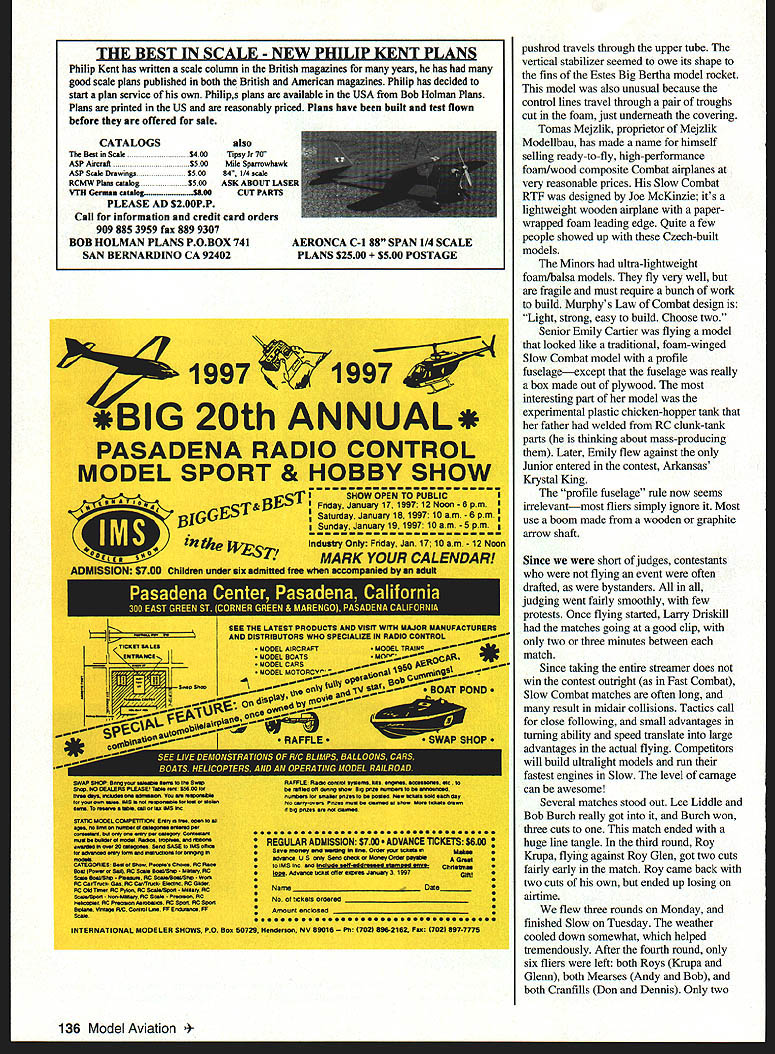
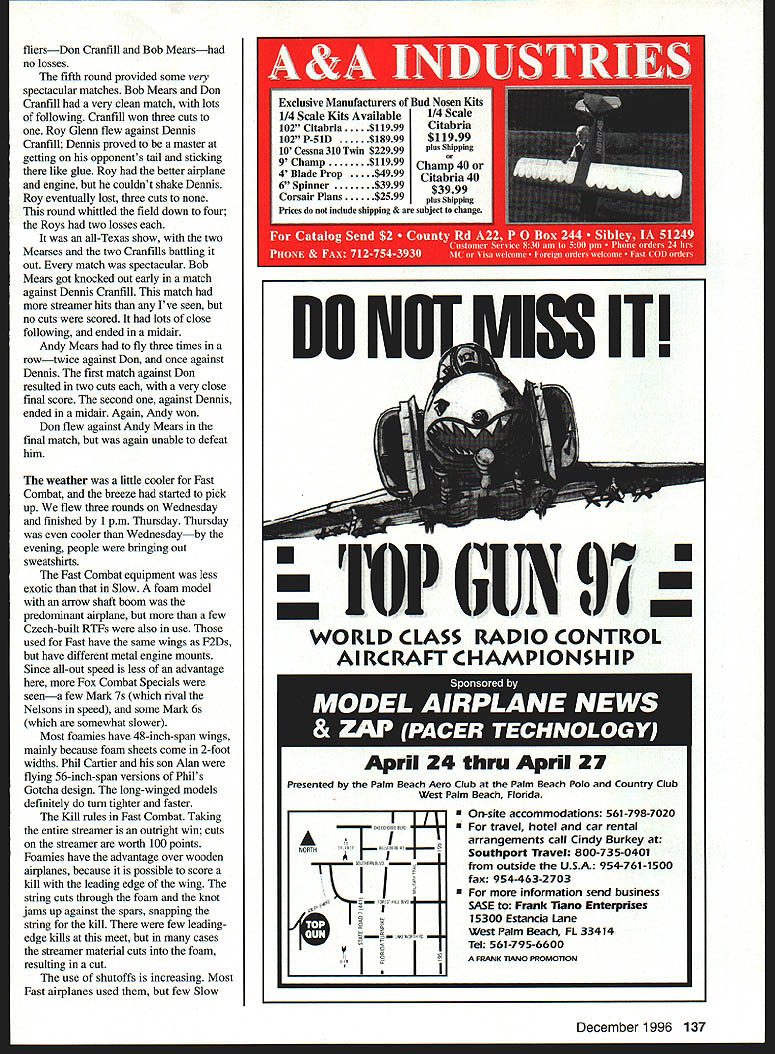
Monday morning was hot and dry—about 90°F. The field had problems: weeks without rain left the grass patchy and the ground dusty and packed hard. That hard ground would claim an engine or two in the following days.
Event Directors Phil Cartier and Larry Driskill tried to move the site to better grass, but were unsuccessful. A compromise was reached—the circle was moved 100 feet to a location where the grass was somewhat better.
Flying didn’t start until 1 p.m. There were only 21 fliers in Slow Combat, so there was plenty of time to finish by Tuesday. The weather cooled somewhat later in the week, which helped, and by Thursday evening people were bringing out sweatshirts.
Vendors and Parts
- Peter Stevens of NorVel sold the AME .049 engines from the back of his station wagon; stock was substantially depleted by the end of the Nats.
- AME glow plugs (two-part head, similar to the old Glo-Bee 1/2A plug) were popular and compatible with Cox engines.
- Reworked VAs with Jeff Rein cranks were among the fastest engines seen in some events.
Equipment and Models
General trends
- The profile fuselage rule is largely ignored; most fliers use booms made from wooden or graphite arrow shafts (often two arrow shafts glued over-under).
- Foam/wood composite RTF Combat designs, notably from Tomas Mejzlik (Mejzlik Modellbau), were common. These are lightweight, with paper-wrapped foam leading edges and robust construction.
- Czech-built RTFs were numerous; the Minors’ ultra-lightweight foam/balsa models fly very well but are fragile.
- Many pilots wrapped joints with Kevlar string and paid close attention to airframe strengthening.
Specific designs and innovations
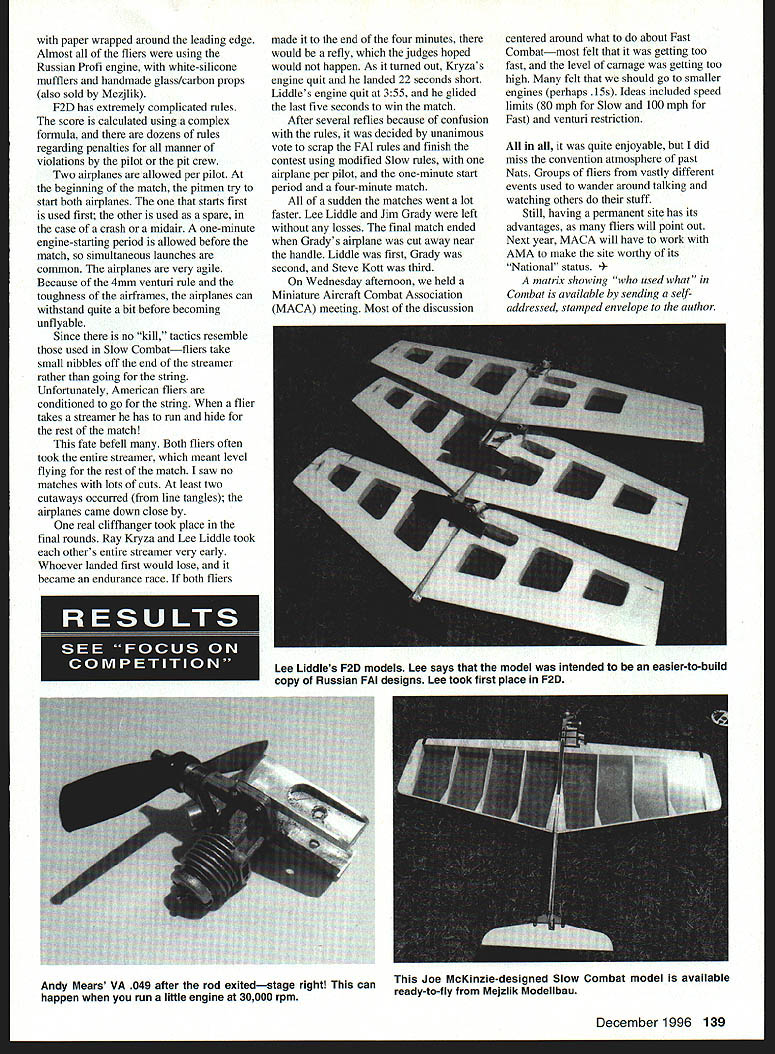
- Lee Liddle: used twin arrow shafts glued over-under for tailbooms; in some models the pushrod travels through the upper tube. Also flew a foam copy of a Russian FAI model with control lines routed through troughs in the foam.
- Phil Cartier (and son Alan): flew 56-inch-span versions of Phil’s Gato design (low-wing versions turn tighter and faster).
- Larry Driskill: Light Hawk design (swept leading edge, long carbon boom); Larry also sells kits.
- Senior Emily Cartier: flew a model with a plywood box fuselage resembling a foam-profile fuselage; her model used an experimental plastic “chicken-hopper” tank welded from RC clunk-tank parts (potential for production).
Engines and shutdowns
- Shutoffs are increasingly common in Fast Combat; many designs use a bellcrank shutoff (Mears design) with an oval pivot hole and an O-ring to move the bellcrank when line tension is lost.
- Other shutoff types: swinging-arm with fuel dump or pinch-off.
- Some pilots experienced inadvertent shutoffs after takeoff (e.g., the Minors and Roy Glenn).
- Failures in shutoff design can produce slow, tight-looping aircraft that drift a long way downwind before recovery (one such model was retrieved a mile or so downwind).
Slow Combat
Format and tactics
- Slow Combat matches are often long and can result in midair collisions. Tactics emphasize close following; small advantages in turning and speed yield large in-match advantages.
- Competitors build ultralight models and run the fastest engines allowed in Slow.
- Taking the entire streamer wins the contest outright; otherwise, matches are scored by streamer cuts and airtime.
Progress of the contest
- Three rounds were flown on Monday; Slow was finished on Tuesday.
- After the fourth round, the last six fliers were: Roy Krupa, Roy Glenn, Andy Mears, Bob Mears, Don Cranfill, Dennis Cranfill.
- At that point Don Cranfill and Bob Mears had no losses.
Notable matches and outcomes
- Lee Liddle vs Bob Burch: Burch won 3 cuts to 1; the match ended with a large line tangle.
- Roy Krupa vs Roy Glenn: Krupa got two early cuts; Glenn came back with two cuts but eventually won on airtime.
- Fifth round highlights:
- Bob Mears vs Don Cranfill: Cranfill won 3 cuts to 1.
- Roy Glenn vs Dennis Cranfill: Dennis won 3–0, sticking closely to his opponent.
- Later rounds produced spectacular matches among the two Mearses and two Cranfills:
- Bob Mears was eliminated by Dennis Cranfill in a match with many streamer hits and a midair finish.
- Andy Mears flew multiple hard matches (two against Don, one against Dennis), ultimately prevailing in the final rounds.
- Final: Don Cranfill flew against Andy Mears in the final match but was unable to defeat him. Andy Mears emerged as the Slow Combat winner.
Fast Combat
Conditions and format
- Cooler weather and a breeze made conditions better for Fast Combat.
- Three rounds were flown on Wednesday; the event finished by 1 p.m. Thursday.
Typical equipment
- Predominantly foam models with arrow-shaft booms; several Czech RTFs were also used (these often share wings with F2D but have different metal engine mounts).
- Engines observed: Fox Combat Specials (Mark 6 and Mark 7) and Nelsons; some Mark 7s rival Nelsons in speed.
- Foamies commonly had 48-inch spans (foam sheets come in 2-foot widths), though some designs (e.g., Gato variants) used 56-inch spans and turned better.
Kill rules and tactics
- Taking the entire streamer is an outright win; cuts on the streamer are worth 100 points.
- Foamies can score leading-edge kills: the string cuts into the foam, jams against spars, and snaps the streamer for a kill. Two leading-edge kills were observed at this meet.
- Because all-out speed is less decisive in Fast than Slow, Fox Combat Specials remain popular.
Issues with shutoffs and engine reliability
- Most Fast airplanes used shutoffs; fewer Slow models did.
- Common shutoff failures: some had the up line break first, causing bellcranks to lock and prevent fuel cutoff, or shutoffs tripping unexpectedly causing relaunches.
- A few pilots suffered engine-starting issues, particularly later in the week when engines that ran earlier became difficult to start and blew glow heads.
Results
- Alan Cartier (the only Senior in Fast) and Roy Glenn reached Round Five.
- Final standings: Dennis Cranfill first, Don Cranfill second. Roy Glenn took third, Cary Minor fourth.
1/2A Combat
- The 1/2A event is growing in popularity, fueled by the availability of high-performance Russian engines (NorVel AMEs were numerous).
- The Minors’ AMEs were among the fastest.
- Reworked VAs with Jeff Rein cranks were also fast.
- Many pilots used Larry Driskill’s Light Hawk design.
- On Friday morning many engines that ran well earlier began refusing to start or blew glow heads; Larry Driskill seemed to avoid these troubles.
- Larry Driskill won the final match against Bobby Mears in a long chase.
F2D (FAI) Combat
Equipment and construction
- Most F2D fliers flew RTF airplanes from the Czech Republic (designs by Beileav, Faizov, or distributed by Mejzlik). Steve Kott flew Loet Wakkerman designs.
- These aircraft feature very stiff, tough foam leading edges covered with paper, with a lightweight balsa-and-spruce framework behind the spars and extensive strengthening (Kevlar wraps, tapered spars). They are light, tough, and difficult to build—hence the market for RTF models.
- Lee Liddle flew a distinctive foam FAI-style model with the pushrod running through an upper tube in the vertical stabilizer and control lines routed through foam troughs.
Rules and matches
- F2D rules are extremely complicated, with a complex scoring formula and many penalty rules relating to pilot and pit-crew violations.
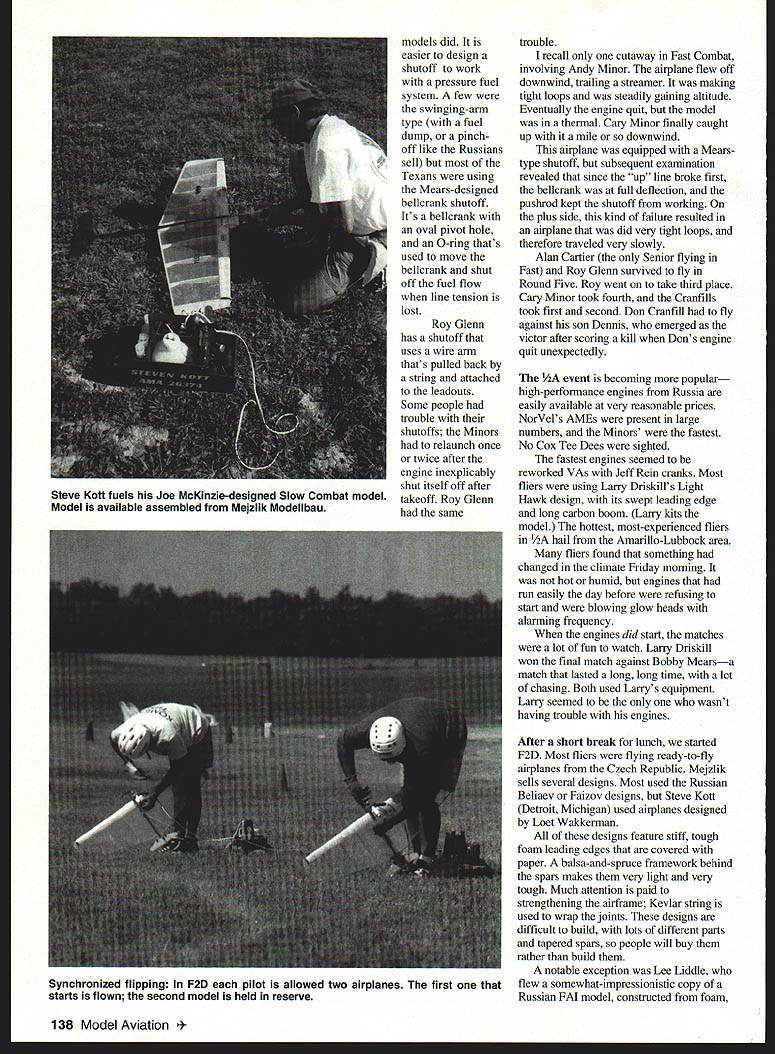
- Two airplanes are allowed per pilot; at the start, pit crews try to start both—whichever starts first is used first, the other serves as a spare. A one-minute engine-start period is allowed, so simultaneous launches are common.
- There is no “kill” in F2D; fliers nibble at streamers. American fliers, conditioned to go for the string, often took an entire streamer and then had to “hide” for the remainder of the match.
- Several cutaways occurred due to line tangles; two cutaways were observed.
Notable moments and outcomes
- A cliffhanger final: Ray Kryza and Lee Liddle each took the other's entire streamer very early. The match became an endurance race. Kryza’s engine quit and he landed 22 seconds short; Liddle’s engine quit at 3:55 but he glided the last five seconds to win.
- After several reflights and confusion over FAI rules, the competitors voted unanimously to abandon the FAI rules and finish the contest using modified Slow Combat rules: one airplane per pilot, a one-minute start period, and a four-minute match.
- With the modified rules the matches sped up. Final standings: Lee Liddle first, Jim Grady second, Steve Kott third.
MACA Meeting
On Wednesday afternoon the Miniature Aircraft Combat Association (MACA) held a meeting. Discussion focused on Fast Combat concerns:
- Fast Combat is getting too fast and the level of carnage is rising.
- Proposed ideas:
- Use smaller engines (perhaps .15s).
- Impose speed limits (suggested 80 mph for Slow, 100 mph for Fast).
- Venturi restrictions.
Conclusion and Notes
- The event was enjoyable but lacked the convention atmosphere of past Nats, when groups from different events mingled more.
- Having a permanent site has advantages, but MACA will need to work with the AMA to make the site worthy of National status.
- A matrix showing "who used what" in Combat is available by sending a self-addressed, stamped envelope to the author.
Transcribed from original scans by AI. Minor OCR errors may remain.

