
CONTROL LINE COMBAT
Rich von Lopez 8334 Colegio Drive, Los Angeles, CA 90045
Origins of MACA
The Miniature Aircraft Combat Association (MACA) had its origins in 1973 when a few combat enthusiasts formed a national organization. Neal White and Howard Rush helped found the venture. I still have one of the original green membership cards signed by Colonel Howard Rush.
The purpose of MACA was to promote the event throughout the country and around the world. We developed a method to recognize outstanding pilots in competition by initiating the Top 10 program (and later, the Top 20). At first we only considered Fast Combat results, then expanded to include Slow, FAI and 1/2A as well. These were the official rule-book events.
Top 20, Events, and WAM
There was also a provision to include events flown in Western Associated Modelers (WAM) sanctioned contests. In the 1970s, WAM was in its heyday, with huge numbers of fliers participating in four different combat events (1/2A, Class A, Slow, and Fast) broken down into three flier categories (Beginner, Advanced, and Expert). It was lots of fun and provided a consistent circuit of contests, well within Sunday-morning driving range for folks in Northern California.
Somehow MACA has added non-rule-book events to those that count for Top 20 standings. I guess I missed the vote on that one. It seems to be working, and nobody seems to mind, so I guess it's OK. I don't have much to complain about, since I have not volunteered to assist MACA in many years—marriage, family, and work will do that to you.
MACA and the AMA
MACA is the official advisory/Special Interest Group for the Academy of Model Aeronautics (AMA). That title means MACA can make recommendations to the AMA regarding rules, whether emergency safety measures or normal rules-cycle measures.
Debate: Engine Displacement and Speed
Some members have suggested changing the engine displacement for Fast Combat or imposing regulations to limit speed. Discussion has focused on dropping to .15 engines. Some argued at the 1996 MACA meeting at the AMA Nationals that the speed of Fast Combat is beyond the limit of all but the best pilots. Another argument is that using .15 engines would allow more pilots to fly two events with the same equipment.
If you want to know the latest on where this is going, join MACA by sending $15 to:
- Gene Berry
4610 89th St. Lubbock, TX 79424 Be sure to include your AMA number.
My Opinion on Changing AMA Fast Combat
Leave it alone, except add the fuel shutoff requirement. Fast Combat is what American combat is all about: fast and furious, with the only limitation on power being the capability of your .36 engine. This event made combat attractive to contest-goers and gives us that adrenaline rush some people never experience.
You have to practice to feel comfortable at the end of the handle of a Fast Combat model—just as proficient athletes or sportsmen practice their profession or pastime. I am talking about good Fast Combat models—not one of those .25-powered garbage scows seen over the skies of the Midwest.
If there is a concern that you can no longer keep up with your Fast models, perhaps it is time to look more seriously at 80 mph events, or if you have more serious reflex loss, Formula GX.
The other major argument concerns doing better at the World Championships by flying more FAI F2D at home. More FAI contests would help prepare the US team, but the World Champs happen only once every two years. If you truly want to prepare for that level, frequent trips to Europe would be in order so you can learn who the fliers are and what dirty or clean tricks they use.
I would be reluctant to estrange engine manufacturers who have supported Fast Combat by producing engines specifically for our event. Fox Combat Specials, Nelson Combat .36s, Wiley .36s and even Sels 5.8s would be tossed aside by pilots unwilling to commit the time and effort to maintain a high skill level. That would be a bad idea.
Fuel Shutoffs and Safety
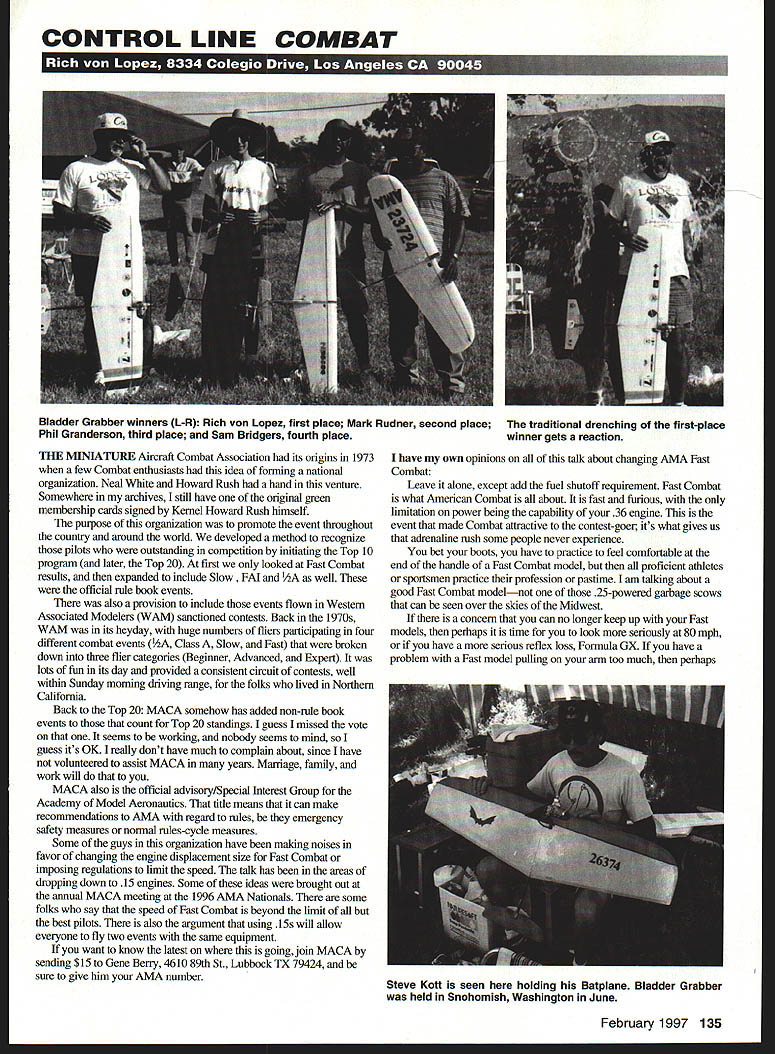
The Bladder Grabber returned during 1996 and was again sponsored by audio genius Bob Carver, now head of the Sunfire Corporation, which produces high-end power amplifiers. The Bladder Grabber has been held some 19 times, all sponsored by Bob Carver.
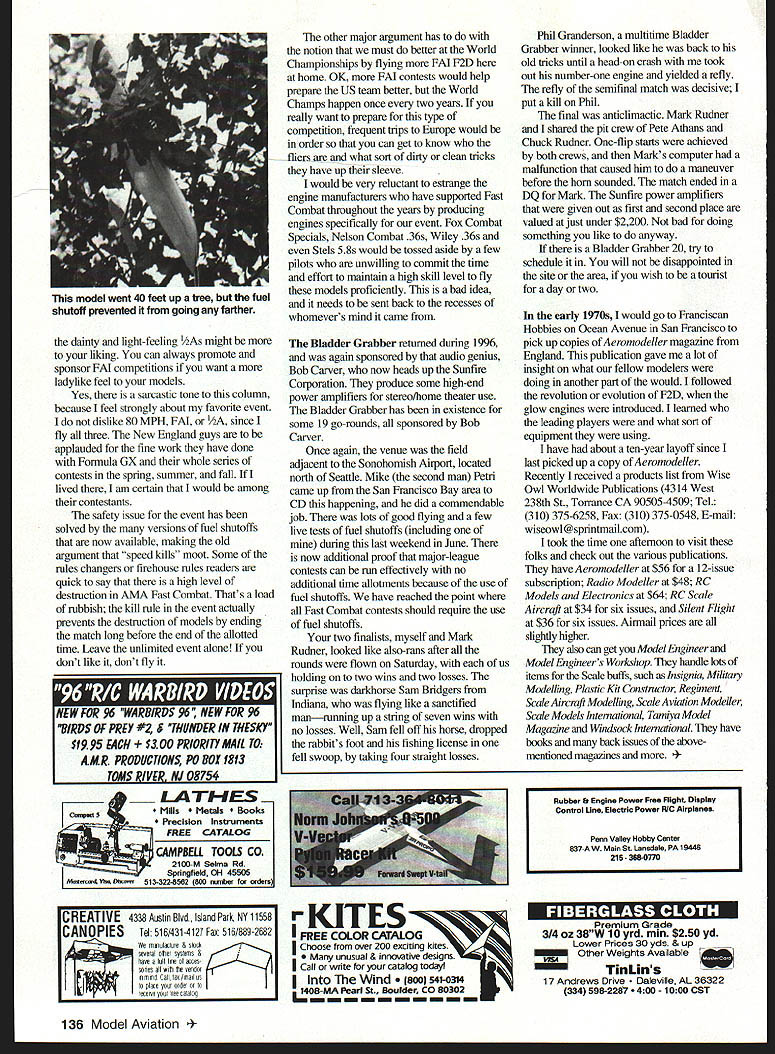
The venue was the field adjacent to the Snohomish Airport, north of Seattle. Mike Petri (the second man) came up from the San Francisco Bay area to CD the event, and he did a commendable job. There was lots of good flying and a few live tests of fuel shutoffs (including one on mine) during that last weekend in June. This shows that major-league contests can be run effectively with no additional time allotments because of the use of fuel shutoffs. We have reached the point where all Fast Combat contests should require fuel shutoffs.
Phil Granderson, a multi-time Bladder Grabber winner, looked like he was back to his old tricks until a head-on crash with me took out his number-one engine and yielded a refly. In the semifinal refly I put a kill on Phil.
The final was anticlimactic. Mark Rudner and I shared the pie crew of Pete Athans and Chuck Rudner. Both crews achieved one-flip starts, but then Mark's computer malfunctioned and caused him to maneuver before the horn sounded. The match ended in a DQ for Mark. The Sunfire power amplifiers given as first- and second-place awards were valued at just under $2,200. Not bad for doing something you like to do anyway.
If there is a Bladder Grabber 20, try to schedule it in—you will not be disappointed in the site or the area if you want to be a tourist for a day or two.
Publications and Subscriptions
In the early 1970s I would go to Franciscan Hobbies on Ocean Avenue in San Francisco to pick up copies of Aeromodeller from England. That publication gave me insight into what modelers were doing elsewhere. I followed the evolution of F2D when glow engines were introduced and learned who the leading players were and what equipment they used.
After about a ten-year layoff from Aeromodeller, I recently received a product list from Wise Owl Worldwide Publications:
- Address: 4314 West 238th St., Torrance, CA 90505-4590
- Tel: (310) 375-6258
- Fax: (310) 375-0548
Sample subscription prices:
- Aeromodeller: $56 for 12 issues
- Radio Modeller: $48
- RC Modeler: $42
- Scale Aircraft Modelling: $64
- RC Scale Aircraft: $34 for six issues
- Flight International: $36 for six issues
Airmail prices are slightly higher.
Wise Owl can also get you Model Engineer and Model Engineer's Workshop, and they handle many items for scale buffs such as Aircraft Modelling, Military Modelling, Plastic Kit Construction, Tamiya Model Magazine, and Windsock International. They have books and many back issues of the above magazines and more.
Transcribed from original scans by AI. Minor OCR errors may remain.

