
CONTROL LINE COMBAT
Rich von Lopez, 8334 Colegio Drive, Los Angeles CA 90045
Early days
CONTROL LINE COMBAT has evolved tremendously since its inception in the 1950s. In the early days, half the battle was trying to get the engine started and the model into the air. Simple things, such as starting batteries, caused immeasurable grief. Most modelers were using the tall dry‑cell 1.5‑volt battery used for doorbells; the high‑tech guys had two‑volt lead‑acid units with the little colored balls on the side that indicated when the battery was fully charged or when it needed charging. Pen bladders, pacifiers, and those metal hard tanks gave users fits when they burst or sprang a leak at a critical moment.
Doug Bias, a flying buddy, spent hours on a silk‑covered VooDoo that sprang a leak on its maiden flight, soaking the balsa structure. Doug was so angry that he stomped the beautiful model until nothing was salvageable—frustration got the best of this master builder.
Glow plugs were not as good as they are today, and often blew apart during flight. Adhesives were nowhere near the quality of today’s epoxies and cyanoacrylates. The use of 6‑32 bolts in Western Associated Modelers (WAM) competitions, along with the use of safety cables and dowels through the motor mounts, was a direct result of substandard adhesives on critical areas of the model.
Some modelers would slap a VooDoo kit together with only a thin layer of Ambroid, Testors, or white glue on the engine bearers. We saw several models jettison the engine with the bearers still attached during a flight. Sometimes the 4‑40 factory bolts were not secured well enough to withstand the vibration of a factory hopped‑up Johnson Combat Special with an unbalanced 9 x 8 prop. If you ran Johnsons, you became well acquainted with the fabric sleeve gaskets in the maintenance kit—these powerful engines were prone to blowing the gaskets out with alarming regularity. Needle valve systems were inferior to what is used today; most systems were too coarse and leaked a bit.
I mentioned a silk‑covered VooDoo, but neglected to mention the days of doping and drying required to get a nice (or just fuelproof) finish. Silkspan was a bit quicker, but not as strong. The fumes from butyrate dope were enough to take the fuzz off a peach, and responsible for my partial loss of RAM (Random Access Memory).
Modern reliability and ease of flying
These days, most serious Combat teams usually get into the air on one flip. Even the not‑so‑serious teams get into the air sometime during the match. A freak mechanical failure, such as a broken crankcase, might keep models out of the air, but this is the exception, not the rule.
Battery failures are a thing of the past. Most modelers use a GloBee fire plug or some sort of power panel driven by a battery that will go six months without a charge. These systems are capable of clearing a flooded engine in seconds and will tell you instantly if there is a problem with your glow plug.
Perhaps modelers are more sophisticated now and take more time to set the head clearances properly to match the nitro, so the glow plugs have a long life. I like to measure the head clearance before I run the engine, then add or subtract gaskets to get 0.018 inches for a .36‑size engine to be run on 25% nitro. Clearance can be dropped to 0.015 inches or less to run the engine on 10% nitro—I used this system for Fox Combat Specials. Nelson Combat Specials come from Henry Nelson at either 0.007 or 0.008 inches; at least they did on the four I own. Experiment to see what works best for you. The type of fuel will have an impact on engine run life. Glow plugs, given head clearance and rich/lean needle settings, might also influence glow‑plug life.
Too late for a holiday gift; although I am still thinking about shopping and have to write a column, consider asking for a set of digital calipers for a birthday, Father’s Day, anniversary, or other special occasion. Being able to measure accurately is paramount in engine work.
Fuel systems and bladders
Events except Slow Combat utilize some sort of bladder tank, using surgical tubing available in almost any diameter and wall thickness imaginable. I have had very good luck with tubing that Iskandar Taib advertised in the Miniature Aircraft Combat Association (MACA) newsletter long ago in a variety of sizes at minimal cost. Surgical bladders have become very reliable and very inexpensive. If you want a little insurance against the bladders bursting, put a balloon outside to hold the fuel after a break. Tomas Mejzlik uses a system he sells, about $150 ready‑to‑go. Keep a close eye on your bladder for signs of aneurysms or bulges and get rid of them.
Two to four ounces of fuel in the bladder will run a model; the cost for the bladder itself is minimal. Four ounces of 25% nitro fuel costs about $4.50; 50% nitro fuel costs about $6.00. Bladders will cost about $0.25. If a bladder breaks in a model, it will cause damage if it is not in a fuelproof rocket tube. I have seen and experienced damage that can be caused to a Russian or Czech model. Flying Combat causes enough damage without making matters worse.
Slow Combat tanks
Slow Combat guys have developed some very good large‑capacity tanks to get through a five‑minute match with no pit stops. They must still keep a close eye on the tanks for pinholes or broken solder joints after a crash. A good tank can be purchased and is ready to go without modifications.
Engines and mounts
The only engines I have recently seen flying off were from two models that were destroyed in a violent midair collision. Current epoxies and cyanoacrylates are so good that the material they hold together breaks before the bond does.
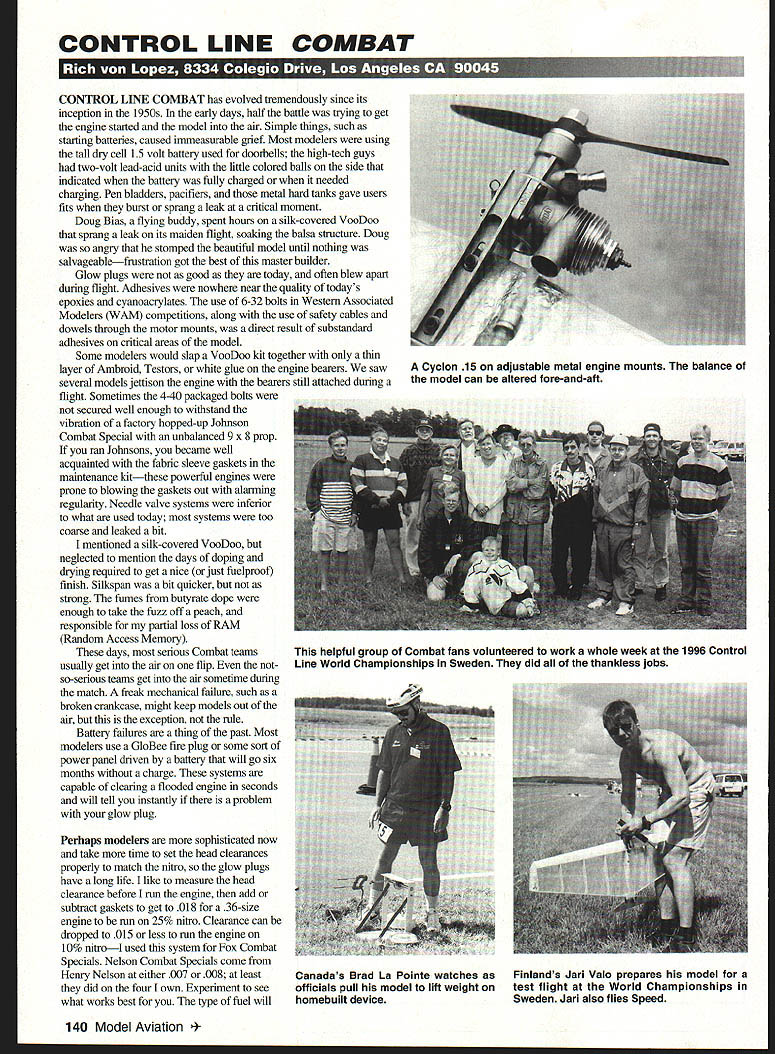
Metal engine mounts and hardened steel Allen bolts have reduced mount failures. Some of the early cast mounts did fail, but the newer machined units rarely do.
There are three systems to clamp the mounts to the center block:
- Use long bolts with nuts on the other side.
- Use bolts that thread into the lower member of the engine mounts.
- Use electrical standoffs that are threaded spacers between the two mounts, and bolt into them from the top and bottom mounts.
Each system works; the first and third have the advantage of being adjustable if the mounts use slotted holes. The second could actually be adjustable, but would require multiple holes in the mount block, which might weaken it.
Radial mounts and innovations
There are also a few creative souls out there experimenting with radial mounts. Howard Rush has been developing the revolutionary internal‑tapered carbon‑fiber‑spar Son of Short. This model works very well. Luckily, Howard is not likely to produce a substantial quantity to be used regularly, and he has a propensity to trash out models at a rate that would make the Argentine Air Force during the Falklands War seem conservative. If there is a Bladder Grabber ’97, look for Howard to be there with the fastest models ever, now that he has obtained a supply of the fastest Fast Combat props ever built.
Modern engines and tunability
Current Fast, Slow, and FAI Combat engines do not vibrate nearly as badly as engines of the 1950s, probably because of better metallurgy and much better ball bearings. Most stock needle valve assemblies (NVAs) and the O.S. Max RC units used to make remote NVAs are good quality with fine threads to make tuning easy (or at least not so hard). These modern engines with quality metals are easy on glow plugs, even at higher rpm. The Nelson Heavy Duty glow plugs seem to run forever in FAI engines, making them an inexpensive item, considering the number of runs you can get.
Equipment is much better and the reliability is far superior to that of the 1950s. Cost is reasonable, if not lower, when you take into account inflation and cost of living then vs. now. Models fly much better than those of days gone by, and you can buy them ready to fly.
Final thoughts
The next time you are at a contest, thank the contest organizers, judges, and officials (some will even go out and build a contraption to pull‑test models). They are not paid for the hard work, and a little recognition will go a long way to encourage the volunteers to continue—the supply is limited.
Transcribed from original scans by AI. Minor OCR errors may remain.

