

Control Line: Combat
Rich von Lopez
8334 Colegio Drive, Los Angeles CA 90045
World Championships and Engines
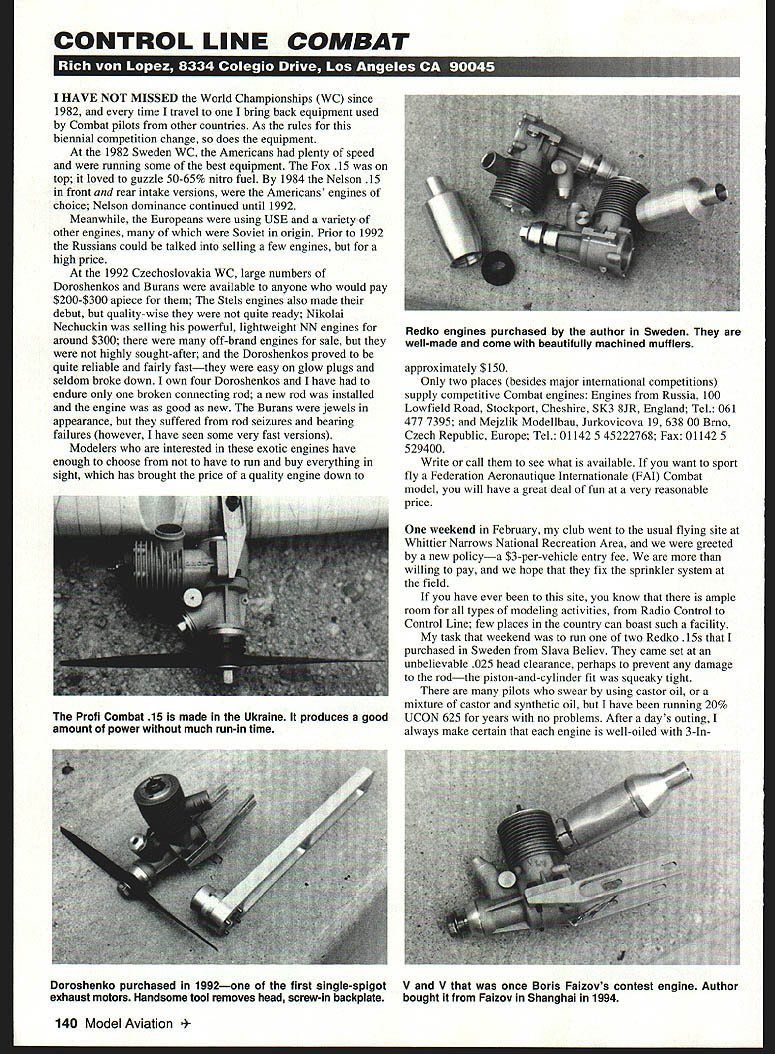
I have not missed the World Championships (WC) since 1982, and every time I travel to one I bring back equipment used by Combat pilots from other countries. As the rules for this biennial competition change, so does the equipment.
At the 1982 Sweden WC, the Americans had plenty of speed and were running some of the best equipment. The Fox .15 was on top; it loved to guzzle 50–65% nitro fuel. By 1984 the Nelson .15, in front- and rear-intake versions, was the Americans' engine of choice; Nelson dominance continued until 1992.
Meanwhile, the Europeans were using USE and a variety of other engines, many of which were Soviet in origin. Prior to 1992 the Russians could be talked into selling a few engines, but for a high price.
At the 1992 Czechoslovakia WC, large numbers of Doroshenkos and Burans were available to anyone who would pay $200–$300 apiece for them. The Stels engines made their debut but were not quite ready quality-wise. Nikolai Nechuckin was selling his powerful, lightweight NN engines for around $300. There were many off-brand engines for sale but they were not highly sought-after.
The Doroshenkos proved to be quite reliable and fairly fast — they were easy on glow plugs and seldom broke down. I own four Doroshenkos and have had to endure only one broken connecting rod; a new rod was installed and the engine was as good as new. The Burans were jewels in appearance, but they suffered from rod seizures and bearing failures (however, I have seen some very fast versions).
Modelers interested in these exotic engines have enough to choose from not to have to buy everything in sight, which has brought the price of a quality engine down to approximately $150.
Availability and Suppliers
Only two places (besides major international competitions) supply competitive Combat engines:
- Engines from Russia
100 Lowfield Road, Stockport, Cheshire, SK3 8JR, England Tel.: 061 477 7395
- Mejzlik Modellbau
Jurkovicova 19, 638 00 Brno, Czech Republic Europe: Tel.: 01142 5 45222768; Fax: 01142 5 529400
Write or call them to see what is available. If you want to sport-fly an FAI Combat model, you will have a great deal of fun at a very reasonable price.
Whittier Narrows Weekend
One weekend in February, my club went to our usual flying site at Whittier Narrows National Recreation Area and we were greeted by a new policy — a $3-per-vehicle entry fee. We were willing to pay, and we hope they fix the sprinkler system at the field.
If you have ever been to this site, you know there is ample room for all types of modeling activities, from radio control to control line; few places in the country can boast such a facility.
My task that weekend was to run one of two Redko .15s I purchased in Sweden from Slava Believ. They came set at an unbelievable .025" head clearance, perhaps to prevent any damage to the rod — the piston-and-cylinder fit was squeaky tight.
Engine Tuning and Maintenance
There are many pilots who swear by using castor oil, or a mixture of castor and synthetic oil, but I have been running 20% UCON 625 for years with no problems. After a day's outing, always make certain each engine is well-oiled with 3-in-One.
Have patience — don't push an engine too soon. Take time: give easy, rich runs before tuning the needle; never run equipment at peak setting. When you go to peak setting, pinch the fuel line for a fraction of a second; if the engine sags, it is too lean. Back off the setting until you can pinch the line and get the engine to rev up a little. You are better off with the needle setting on the rich side than on the lean side.
Keep a log book and record data on every engine you own as soon as you finish a flight. You can spend a tremendous amount of time tinkering with available equipment — make it count.
Redko .15 and Profi .15 — Performance Comparison
The Redko I tested started at .013" head clearance and a rich needle setting. Its first two runs led me to set the needle a bit leaner. On the third run I changed the prop but made no needle-setting change; on the fourth run the first prop produced a better time. I took a .003" head gasket out, backed the needle out just a tad, and the engine ran better. When I went back to the original prop, a slightly leaner setting resulted in a bit more speed. The seventh run was very steady and a bit faster than the previous run.
The Redko turned in a 19.5-second eight-lap time, speed 92.27 mph — about a second off the pace of the best competition engines. Its first runs were 20.7 seconds, 86.92 mph. I intend to play with head clearance a bit and experiment with various props; I am certain I will pick up speed. At $160 with muffler, the engine will give its owner a great deal of service. I ran the Redko twice at its original .025" head clearance and was quite disappointed in performance.
I also ran one of my two $139 Profi engines, and the speed was two-tenths of a second faster than the Redko — the Profi ran at 19.3 seconds, or 93.23 mph, with nothing done to it. I have never had it apart, and I have no idea where the head clearance is. All of the testing was done without mufflers.
The Redko is produced by one of the "V and V" engine people in St. Petersburg (the V's stand for the producers' first names). I purchased one from Boris Faizov in Shanghai in 1994. It is strictly a team-trials engine that did not need additional runs; it was fast when I took it out for a test drive prior to buying it. The Profi engines are produced in the Ukraine and delivered to Tomas Mejzlik for distribution.
One can see the V and V influence on the Redko design and in the case casting. The Redko uses a four-bolt backplate, whereas most other engine designers use screw-in-type backplates.
All Russian or Ukrainian engines come with head buttons for Nelson-type glow plugs. I prefer the heavy-duty version — it seems to last forever. The regular-version glow plug seems to run slightly faster, but it fails much sooner.
Mufflers and Glow Plugs
There are two schools of thought on muffler technology: use a hard-metal unit or use a rubber-type unit. The Redko came with a nicely machined aluminum muffler that used a specialized rubber connector. The Profi can be fitted with either the rubber type or an aluminum version. The Mejzlik catalog lists quite a few options.
Magic Lee in Taiwan was (or may still be) producing gold-plated Nelson-type glow plugs, but I did not like the threads in them — they seemed a bit off. They ran very well, but they did not fit well in the button.
Rules Proposals Affecting Combat
The March Model Aviation contains several rules proposals (at the end of page 168) that will affect the Combat event. One proposal is to allow the use of pressurized fuel systems in Slow Combat, coupled with a .20 venturi. The proposals of most interest are the two that require fuel shutoffs.
- Ken Burdick proposes that the device used stop the engine within three seconds.
- Larry Driskill proposes that the engine be shut off within one second after the model has been cut away.
- Bobby Mears added an attachment to Larry's proposal that would cause the contestant to forfeit a match if the device fails to stop the engine within one second.
These proposals would take effect in 1999. I like the idea of a mandatory rule for shutoffs, but one second might be a bit tough to police. There are devices that will pinch the line instantly, but the engine might run for two or three seconds, or it might be sputtering after one second. However, we do need to take this step.
Transcribed from original scans by AI. Minor OCR errors may remain.

