
CONTROL LINE: COMBAT
Rich von Lopez 8334 Colegio Drive, Los Angeles, CA 90045
Season Kickoff: Top Gun
The 1997 Combat season is off and running. The Top Gun contest in Tucson, Arizona signaled the traditional start of the season. Competitors from northern states welcomed the warmer climate in early March to shake off the cobwebs, try new Combat equipment, and renew friendships and rivalries.
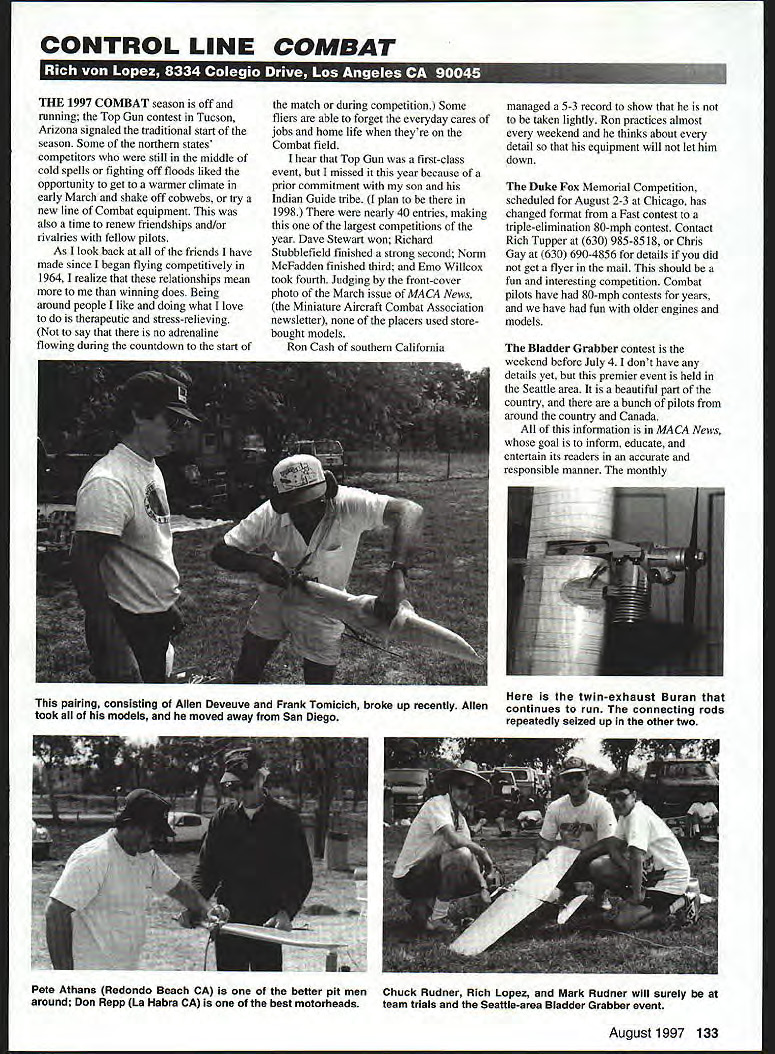
I missed Top Gun this year but heard it was a first-class event with nearly 40 entries. Dave Stewart won; Richard Stubblefield finished second; Norm McFadden was third; and Emo Wilcox took fourth. Judging by the photo on the cover of the March MACA News, none of the placers were flying store-bought models.
Ron Cash of southern California posted a 5-3 record, showing that his weekend practice and attention to equipment details pay off.
Upcoming Events
- Duke Fox Memorial Competition (Chicago) — originally a Fast contest, now changed to a triple-elimination 80-mph format. Scheduled for August 2–3. Contacts: Rich Tupper (630) 985-8518, Chris Gay (630) 690-4856.
- Bladder Grabber — the weekend before July 4 in the Seattle area. Premier event; details pending.
MACA News & Membership
MACA News aims to inform, educate, and entertain its readers and serves as a forum for letters, feature articles, airplane designs, and photographs. Contributions are welcomed and encouraged.
To join MACA:
- Send $15 to MACA, c/o Gene Berry, 4610 89th St., Lubbock, TX 79424.
The organization tracks Top Twenty competition pilots based on contest results and supports team selection for international championships.
Team Trials and Hosting Bids
1998 is a team selection year for the World Control Line Championships, rumored to be in Kiev, Ukraine. Bids to host U.S. team trials were submitted by:
- Detroit (August date) — Rouge Park site is adequate.
- Dallas (September date) — I have not visited the site.
If Detroit hosts, judges will need adequate training and knowledgeable, assertive center marshals. The current practice of requiring consensus among judges should be reviewed — competitors invest significant time and money and deserve accurate, fair calling.
Engine and Equipment Testing
Preparation for team trials has involved extensive testing of F2D (.15) engines currently available. The modern .15 is a capable engine: it turns 30,000+ rpm on the air, starts easily, offers long glow-plug life, and gives good fuel mileage. Propellers make a big difference, so thorough testing is important.
Notable equipment and observations:
- Profi Combat .15 (Tomas Mejzlik): Starts and runs well; produces roughly 19.2-second eight-lap times with fitted props. Prop selection significantly affects results.
- Mejzlik Modellbau 1997 catalog: lists a new Profi-built Kozjol ("Billy Goat"), designed by Michael Chikunov (mechanic for former world champion Boris Faizov). The Kozjol features a unique interlocking axle hub for custom axle length and durability. It is offered in:
- AAC configuration — 110 grams
- ABC configuration — 120 grams
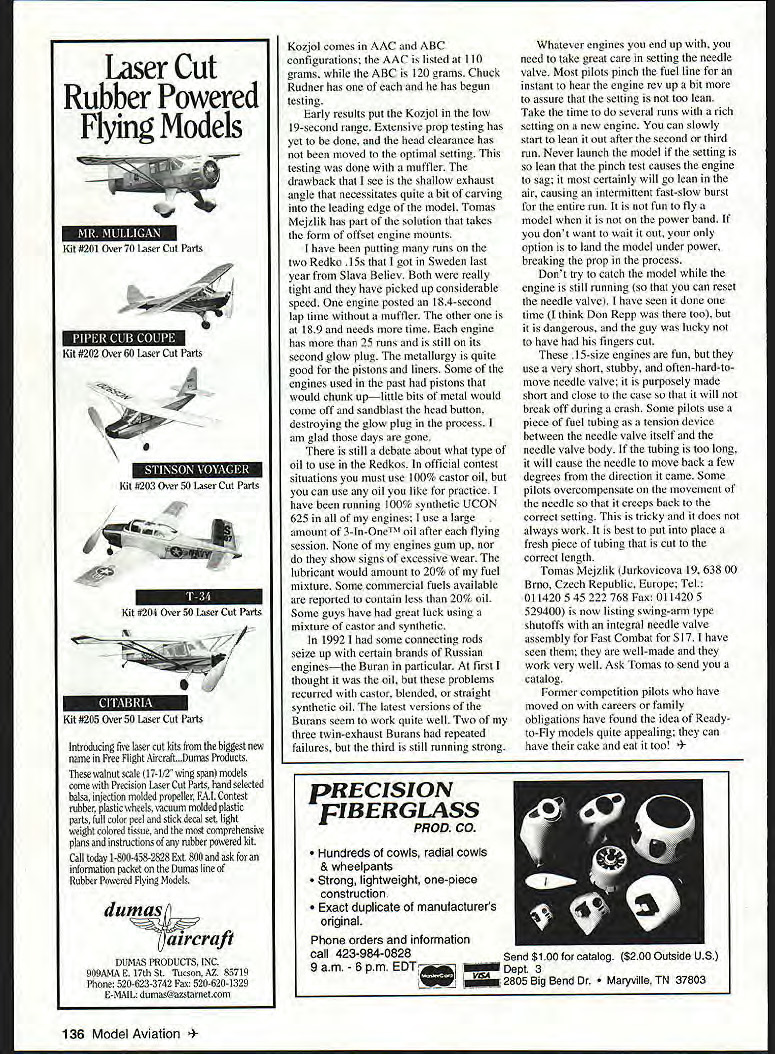
Early testing by Chuck Rudner shows low 19-second results; more prop and head-clearance tuning is underway. The shallow exhaust angle requires some leading-edge carving or offset engine mounts.
- Redko .15 engines (from Slava Believ, Sweden): After many runs, these engines tightened up and picked up speed. Example times: one engine at 18.4 seconds (no muffler), another at 18.9 seconds after additional running. Both have exceeded 25 runs and are still on their second glow plug. Piston and liner metallurgy appears improved over older Russian engines that suffered piston chunking and glow-plug damage.
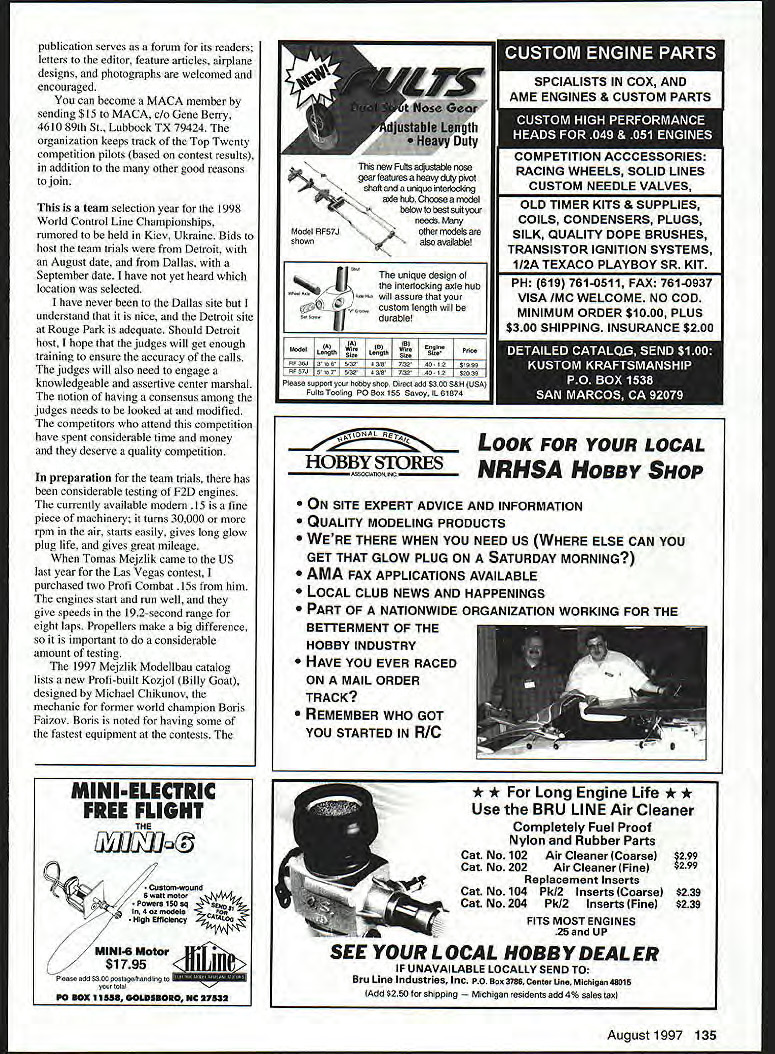
- Burans (Russian): Earlier versions had connecting-rod seizure problems in 1992. Failures occurred with castor, blended, and synthetic oils. Newer Burans appear to perform better, though some twin-exhaust versions had repeated failures while others remain reliable.
Fuel, Lubrication, and Needle Settings
- Official contest rules require 100% castor oil in fuel; practice sessions allow any oil.
- I run 100% synthetic UCON 625 in practice engines and apply a generous amount of 3-In-One™ oil after each flying session. My lubricant use equates to roughly 20% oil in the fuel mixture.
- Commercial fuels may contain less than 20% oil; some pilots use castor/synthetic blends successfully.
- Needle-valve setting is critical:
- On a new engine, do several runs with a rich setting, then slowly lean the mixture after a couple of runs.
- The common “pinch test” (pinching the fuel line briefly to listen for a slight rev) is useful: if the engine sags, the setting is too lean and will go leaner in the air, producing dangerous power surges.
- Never launch with a pinch-test sag; an in-air lean condition can force you to land under power and break a prop.
- Do not attempt to catch a model while the engine is running to reset the needle — it’s dangerous.
Many .15 engines use a short, stubby needle valve positioned close to the case to reduce breakage in crashes. Some pilots use a short piece of fuel tubing as a tensioner between the needle and valve body; it must be cut to the correct length to avoid needle creep.
Practical Tips and Accessories
- Use fresh, properly sized fuel tubing if employing a tensioning trick for needle valves.
- Tomas Mejzlik (Jurkovicova 19, 638 00 Brno, Czech Republic; Tel: +420 5 452 222 768; Fax: +420 5 529 400) now lists swing-arm throttles with integral needle-valve assemblies for Fast Combat .15T. They are well-made and effective — request a catalog.
- Ready-to-Fly models appeal to former competition pilots who need to balance careers or family obligations with flying.
Whatever equipment you choose, invest time in testing, prop selection, and reliable fuel/lubrication practices to achieve consistent, competitive performance.
Transcribed from original scans by AI. Minor OCR errors may remain.

