
CONTROL LINE COMBAT
Rich von Lopez 8334 Colegio Drive, Los Angeles, CA 90045
Overview
CONTROL LINE COMBAT is one of the most exciting events to watch. Its fast-and-furious action draws both modelers and non-modelers to the edge of the circle for a closer look.
Because of the fast pace, some action may be missed, and many people have attempted to capture the competition with video or still cameras. I have shot hundreds of rolls of film trying to catch the models as they gyrate across the sky, but the results have not been very good; a large percentage of the photos ended up in the trash can.
Filming Combat
Many people who have tried to tape Combat with video cameras have had mixed results. One problem is that you need to back away from the action in order to capture the models flying the entire hemisphere above the competition circle. An easier task is to film the pilots going through their motions in the center of the circle, which is both entertaining and educational—body positioning and repositioning are the critical areas to study.
If you try to film a few matches at a contest, you may experience some difficulties, but that is not to say you should not try. You could come up with a great deal of usable footage.
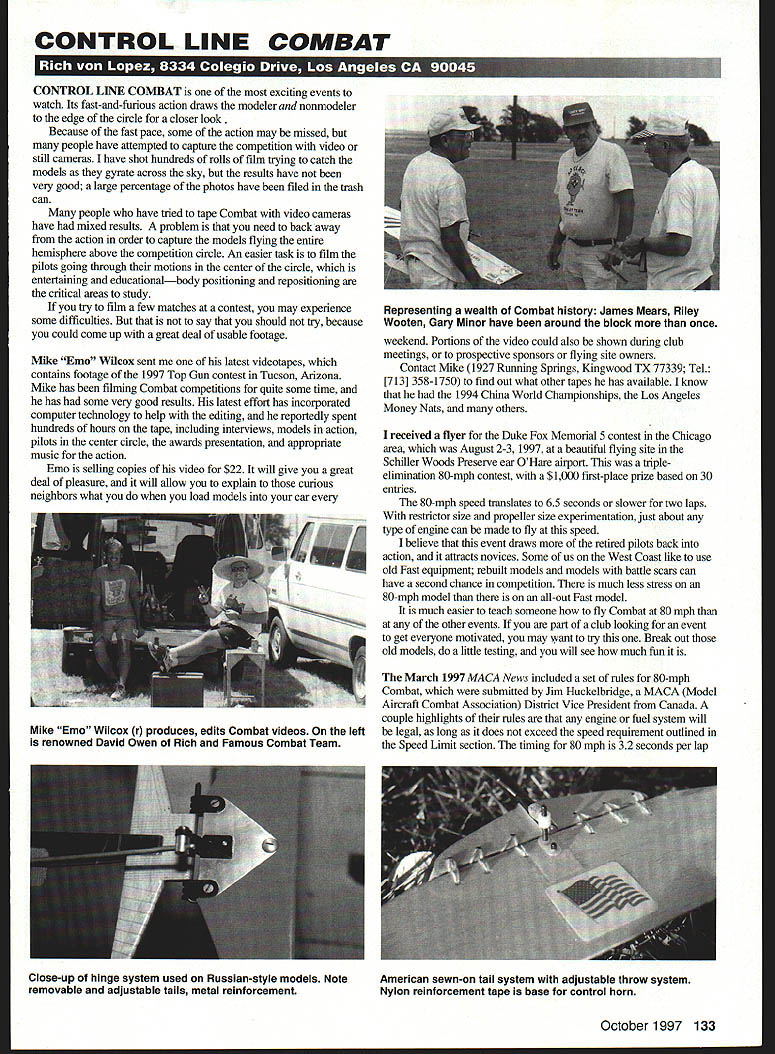
Mike "Emo" Wilcox sent me one of his latest videotapes, which contains footage of the 1997 Top Gun contest in Tucson, Arizona. Mike has been filming Combat competitions for quite some time and has had some very good results. His latest effort has incorporated computer technology to help with the editing; he reportedly spent hundreds of hours on the tape, including interviews, models in action, pilots in the center circle, the awards presentation, and appropriate music for the action.
- Price: $22 per copy.
- Uses: Pleasure viewing, showing curious neighbors, club meetings, prospective sponsors or flying site owners.
Contact Mike: 1927 Running Springs, Kingwood, TX 77339 Tel: (713) 358-1750
Mike has also produced tapes of the 1994 China World Championships, the Los Angeles Money Nats, and many others.
80-mph Combat
I received a flyer for the Duke Fox Memorial 5 contest in the Chicago area, held August 2–3, 1997, at a beautiful flying site in the Schiller Woods Preserve near O'Hare Airport. This was a triple-elimination 80-mph contest, with a $1,000 first-place prize based on 30 entries.
The 80-mph speed translates to 6.5 seconds or slower for two laps. With restrictor size and propeller size experimentation, just about any type of engine can be made to fly at this speed.
I believe this event draws more retired pilots back into action and attracts novices. Some of us on the West Coast like to use old Fast equipment; rebuilt models and models with battle scars can have a second chance in competition. There is much less stress on an 80-mph model than on an all-out Fast model.
It is much easier to teach someone how to fly Combat at 80 mph than at any of the other events. If your club is looking for an event to get everyone motivated, consider trying this one. Break out those old models, do a little testing, and you will see how much fun it is.
The March 1997 MACA News included a set of rules for 80-mph Combat, submitted by Jim Huckelbridge, a MACA (Model Aircraft Combat Association) District Vice President from Canada. A couple of highlights from their rules:
- Any engine or fuel system is legal, as long as it does not exceed the speed requirement outlined in the Speed Limit section.
- Timing for 80 mph is 3.2 seconds per lap.
These rules include a method to get all of the timing done at the start of the match, with a provision for a model that is too fast to land and slow down. Get a copy of the MACA News to see the rules as written.
Engines and Equipment
I seldom give out the address for Henry Nelson's Nelson Competition Engines, but his products and service reach many serious modelers.
Contact Henry Nelson: Nelson Competition Engines 121 Pebble Creek Lane, Zelienople, PA 16063 Tel: (412) 538-5282 Fax: (412) 538-4104
Henry manufactures what I consider the best Fast Combat .36 ever seen. The basic N36 Combat front-valve side-exhaust (AAC) sells for $260, with a needle valve costing an extra $10 and a radial mount costing an extra $15. The four N36s that I own were purchased without the needle valves because I prefer to use my tried-and-true .05 Max units mounted in a remote location.
To keep the fire lit in the combustion chamber, Henry provides a selection of glow plugs:
- One-piece standard coil glow plug: $2.85
- One-piece heavy-duty glow plug: $3.00
- Two-piece GloBee-type flat coil: $4.50
I have had excellent luck with the heavy-duty and standard units. I have not used the GloBee types since the days of open-intake, open-exhaust, unlimited Nitro Fédération Aéronautique Internationale (FAI) Combat. Those electric-range, heating-element-type units did provide some extra rpm, but you had to watch the "potatoes" that would grow on the edges of the coiled wire.
Henry developed his N36 specifically for Fast Combat. His product has proven superior to anything on the market, and its cost is reasonable. I calculated that I had upwards of $250 in my souped-up Fox Combat Specials, not counting my time and labor to set them up or the cost of the phone calls to get specialty aftermarket parts.
The Nelson 36s will give you plenty of power right out of the box, with easy handling characteristics. They are reliable and start easily. You will, however, need to take care of them: keep them clean and feed them lots of good oil after a day's outing. I consider my engines an investment and want to protect them so they will serve me well for many years.
My philosophy has always been to run engines carefully until they are broken in, then only run them once in a while, or only at contests. A contest-ready engine does not need many extra runs.
Henry still has N15s available as AAC or ABC versions, with front-intake rear-exhaust, front-intake side-exhaust, or rear-intake rear-exhaust. They sell in the $205–$235 range, depending on configuration.
Henry has a wealth of other non-Combat-related merchandise available; it is worth writing to him for a catalog and price list.
Engine fit and mounting
Some of the latest FAI .15s, such as the Koziol-Profi, come with a shallow-angle rear-exhaust spigot. In order to mount the muffler, you may need to trench out the leading edge of the model so it can fit. This trenching sometimes involves considerable cutting into the front spar and the top spar.
Ready-to-fly models from Mezjlik Modelbau can be ordered with a slightly higher center block to allow the engine to sit slightly higher. This option costs an extra dollar, as does a precut groove in the leading edge. The amount of cutting of the front spar depends on the model type: the FAI/Free designs use a vertical front spar, while the Believ types have horizontal front spars. The standard Profi engines have a step angle on their exhaust spigots, and that step on the engine will require the least amount of trenching.
One of the latest solutions is a unique set of engine mounts that angle the cylinder about 15°. This allows mounting engines without having to cut into the front spars. At $12.90 a set, these mounts are a bargain when you consider the amount of machining otherwise required.
Transcribed from original scans by AI. Minor OCR errors may remain.

