
Control Line: Combat
Iskandar Taib, 517 Tulip Tree Apartments, Bloomington IN 47408
Venue and attendance
The Nats Combat facilities were greatly improved this year. The Academy had graded and seeded a huge rectangle of ground 200 meters north of last year's site. The grass wasn't quite ready when I first saw it at the AMA Open House, but it had improved by the time of the Nats. It still needs another year or two to reach its prime, but there will be a very nice set of Combat circles.
Combat had the choice of any two of nine circles, so Event Director Roy Glenn chose the two in the southwest corner of the rectangle.
Attendance was disappointing this year, mainly because of the team trials, which were soon after the Nats. Some Detroit-area and Texas fliers were preparing for the trials and could not attend. Hopefully, word of the new site will attract more fliers next year.
While many faces were missed, some new ones were present. The Shoemaker family (Indianapolis, IN) brought four fliers—two adults and two Juniors. One of the Juniors was the next-door neighbor, who had first picked up a handle the previous week.
Judging and weather
Judging was handled through the week by an ever-changing set of volunteers—often nonflying fliers filling the constant time-manning stopwatches. The constant was Chief Judge Marlin McGee, AMA AVP from Oklahoma, who brought his black Labrador retriever, which provided constant entertainment. There would have been no Combat without judges; thanks to all who spent time manning stopwatches.
The weather cooperated for the most part; it was not hot and humid. Tuesday was hotter than usual, but that was a day off, so Combat fliers got to watch Windy Urtnowski fly his gorgeous Seafire, a few heats of Q-40 Pylon Racing, Carl Dodge fly F2A Speed, or all three.
Super Slow Combat (unofficial)
Fox Manufacturing sponsored an unofficial Super Slow Combat event on Sunday. With three Juniors and 18 entries, it was the biggest Combat event of the Nats; everyone flew at least five times. With the engine restriction (Fox .35 Stunt engines only) and speed restriction (70 mph), several people who normally would not have entered flew. Placings were decided by adding the points earned during each round, and to discourage midairs and overly aggressive flying, an extra 200 points was awarded for midair-free matches.
Two famous names not usually associated with Combat showed up Sunday: Henry Nelson, who makes a large percentage of engines used in Combat, and pylon racer Dave Shadel, who won second place. Both had participated in the event before. During flying, several of Dave's pylon-racing friends showed up to watch and cheer.
Equipment varied from old Ringmasters to Slow Combat airplanes to Czech-built Fast Combat airplanes to arrowshaft foamies. Bladder tanks were more reliable than hard tanks, but no single type of airplane ruled.
Winners:
- Super Slow Combat Junior and overall champion: Krystal King (Arkadelphia, AR). She received a trophy and an engine.
- Junior runners-up: James Miller and Mike Alston.
- Top three overall: Krystal King, Dave Shadel, Joe Kresnak Jr.
Slow Combat
Slow Combat began Monday morning with a disappointing eight Open entries; most of the flying was finished by evening. It was decided that the last three matches would be flown on Wednesday before 1/2A competitors would take Wednesday off.
I watched most of the action from the center of the circle since I was Center Marshal. One circle was used in the morning and the other in the afternoon to keep the sun out of the judges' eyes. A large digital clock was provided, which made judging and pitting much easier; at a glance anyone around the circle could see how much time was left in the match.
Equipment was similar across the board—arrowshaft foamies or Czech-built McKenzie hybrids equipped with GRW chicken-hopper uniflow tanks and very fast Nelson or Fox Mark 7 .36 engines. (Henry Nelson flew in the event.)
Larry Skelley attended with his son Skyler, who flew against Krystal King in a three-match series to decide the Junior category. Skyler won the first match and Krystal won the second. The deciding round took place before the Open third round; although Krystal scored a cut on Skyler, he won, having earned more than enough air time.
In the fourth round, Roy Krupa was pitted against Bobby Mears, and Roy got up first. After three minutes of nonstop chasing, Mears took the whole streamer. If Roy could get one cut within the next two minutes, he would win, since Bobby would have no chance to earn more points through cuts. Roy got his cut one minute later, and the two flew out the rest of the match flying level.
Incidentally, everyone thinks of the Texans as being prepared for everything, but during one match I observed a couple of pitmen frantically reaming props.
The last two Slow Combat matches were flown Wednesday morning before 1/2A. Andy Mears (no losses) flew against Larry Skelley (one loss). If Larry had lost he would have had to fly Roy Krupa for second place; if he had won he would have had to fly Andy again. Larry lost twice, finishing third.
1/2A Combat
1/2A was not the disaster it was last year, when most competitors (including experienced Minors) had problems with engines that would not start and glow plugs that would last only one run. This year there was more flying and less wrestling with engines.
The five members of the Backatit Racing Team brought Open entries up to 11. Krystal King and Skyler Skelley repeated the Slow Combat matchup as the two Juniors.
The streamers' strings were too strong for 1/2A, so few kills were scored; the knot would easily pull through a foam leading edge. Most matches were decided by cuts and air time, and engine-starting difficulties took their toll.
The availability of the inexpensive, very fast AME .049 and Larry Driskill's Light Hawk kit (the choice of about 90% of the fliers) has made getting into 1/2A Combat with the best equipment much easier than in the past, and has done much for the event's popularity. (Only Roger Morris, Peoria, IL, brought Tee Dees; after last year's fiasco he decided that easy-to-start engines were better than non-starting Russian engines.)
These small airplanes are easy to build, extremely tough, and make great practice platforms. The drawbacks are that the engines are harder to start and have very high angular velocities. From inside the circle, 1/2A is even faster than Fast Combat; the current crop of airplanes could easily handle 42-foot lines.
Winners:
- 1/2A Junior: Skyler Skelley.
- 1/2A Open: Bob Mears (first) and Larry Driskill (second), repeating last year's matchups. Bob eventually took first after multiple fly-offs; since they are practice partners, their matches were long and entertaining.
F2D (FAI) Combat
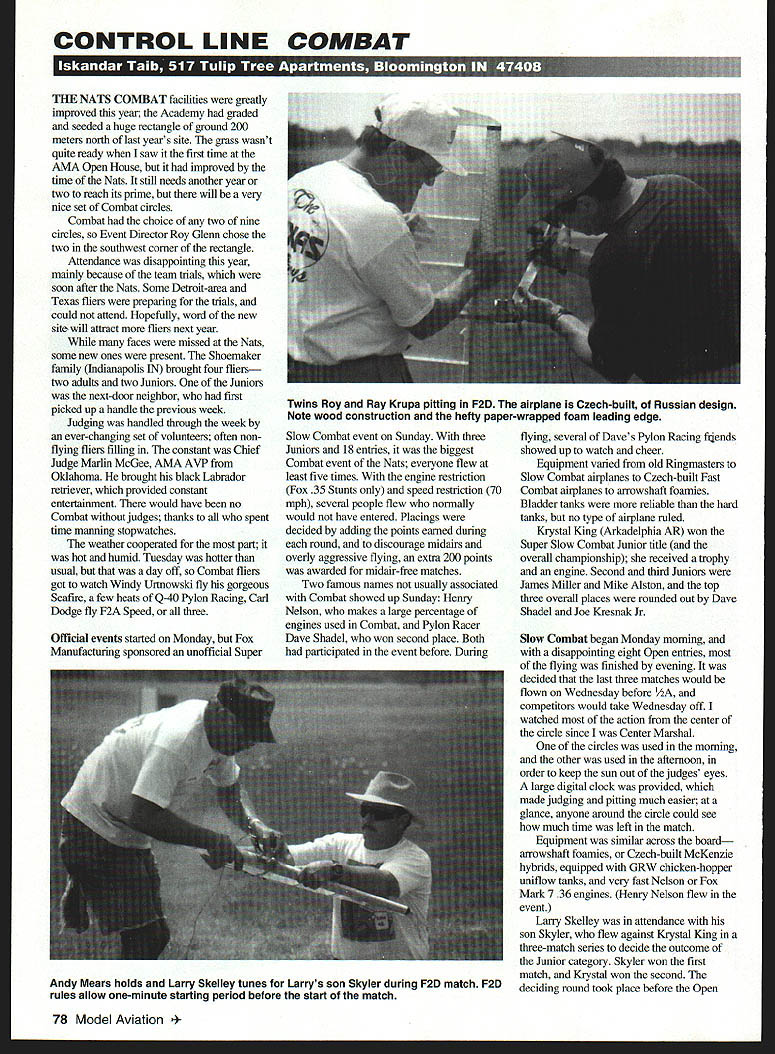
F2D (FAI Combat) started late on Thursday, but with four Open entries and one Junior—the majority of potential contestants were saving their equipment for the team trials—the event finished quickly. F2D is different from the North American forms of Combat: two airplanes are allowed per pilot, and pitting skills are much more important since the rules impose penalties for pitmen's mistakes. The airplanes turn extremely tight, and things happen very quickly.
Equipment was exclusively European: ready-to-fly wings built by Mejzlik Modellbau in the Czech Republic and engines from Russia or the Ukraine, including a couple of the new Profi Kodjol ("Billy Goat"). Two Cincinnati fliers did well.
Winners:
- 1st: Mike Evans.
- 2nd: Jim Grady.
- 3rd: Roy Krupa (Frisco, TX).
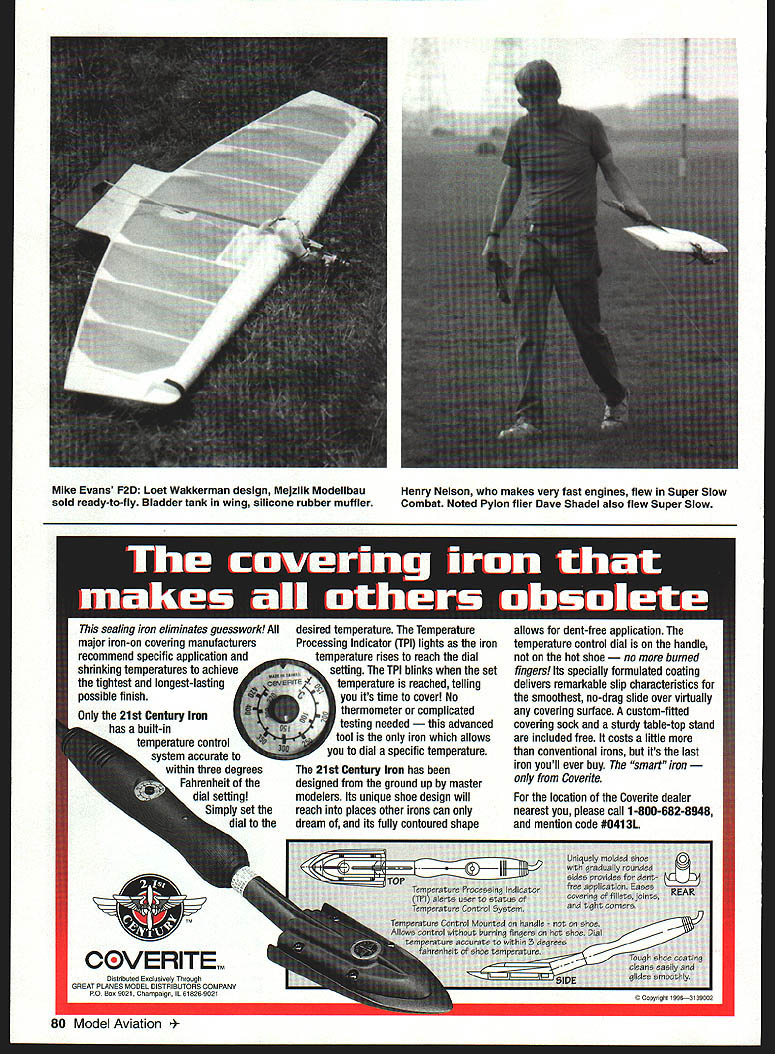
Note: Mike Evans' F2D airplane is a Loet Wakkerman design, sold ready-to-fly by Mejzlik Modellbau. It features a bladder tank in the wing and a silicone rubber muffler.
Fast Combat
Fast Combat drew 16 Open entries, one Junior, and one Senior (who flew against each other). Again, there were few surprises equipment-wise; most flew own-design arrowshaft boom foamies or Czech-built foam/wood flying wings. Most of the foamies were Aeroplane clones or derivatives. Phil Cartier flew his long-winged (54-inch span) Gotcha 550 design, which seemed to turn better than most. Fox Mark 7 Combat Specials and Nelson engines were the most common, with the odd Mark 6 Combat Special.
I was the only one using cheap Chinese engines; I had a Magnum .36 under testing. With its RC timing, it was very slow.
Early matches were marred by midairs and crashes, but things settled down after the second round and there were some good, clean matches ending with kills. I was a judge for most of Friday since I was knocked out early.
Notable incidents:
- In the second round, Bob Burch (Brookfield, IL) attacked Andy Mears' airplane, which had unexpectedly flamed out. Bob's streamer got tangled with Andy's model, and Bob lost the match.
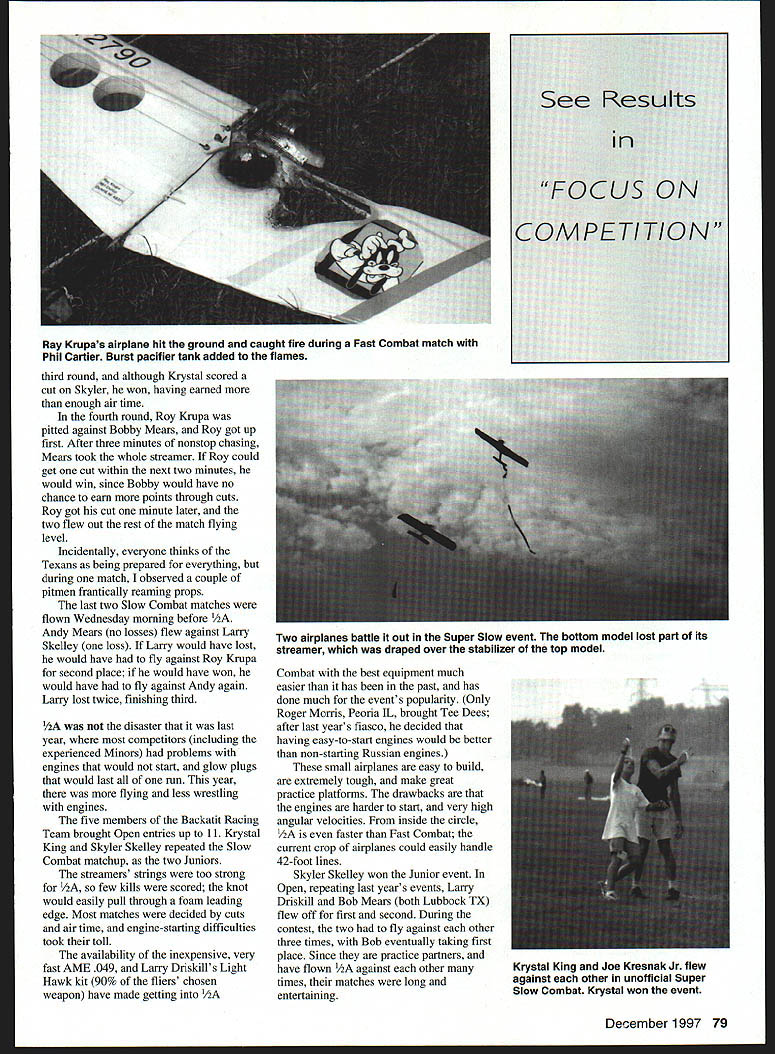
- In a late-round match between Phil Cartier and Ray Krupa, Ray's airplane crashed and caught fire (a burst pacifier tank added to the blaze). Fortunately, Roy Glenn knew where the fire extinguisher was.
Final placings:
- 1st: Bobby Mears.
- 2nd: Andy Mears.
- 3rd–5th: Phil Cartier (Hummelstown, PA) and twins Ray and Roy Krupa rounding out the top five.
Phil Cartier prevailed over Skyler Skelley to take first place in the Junior-Senior category.
Notes on notable participants
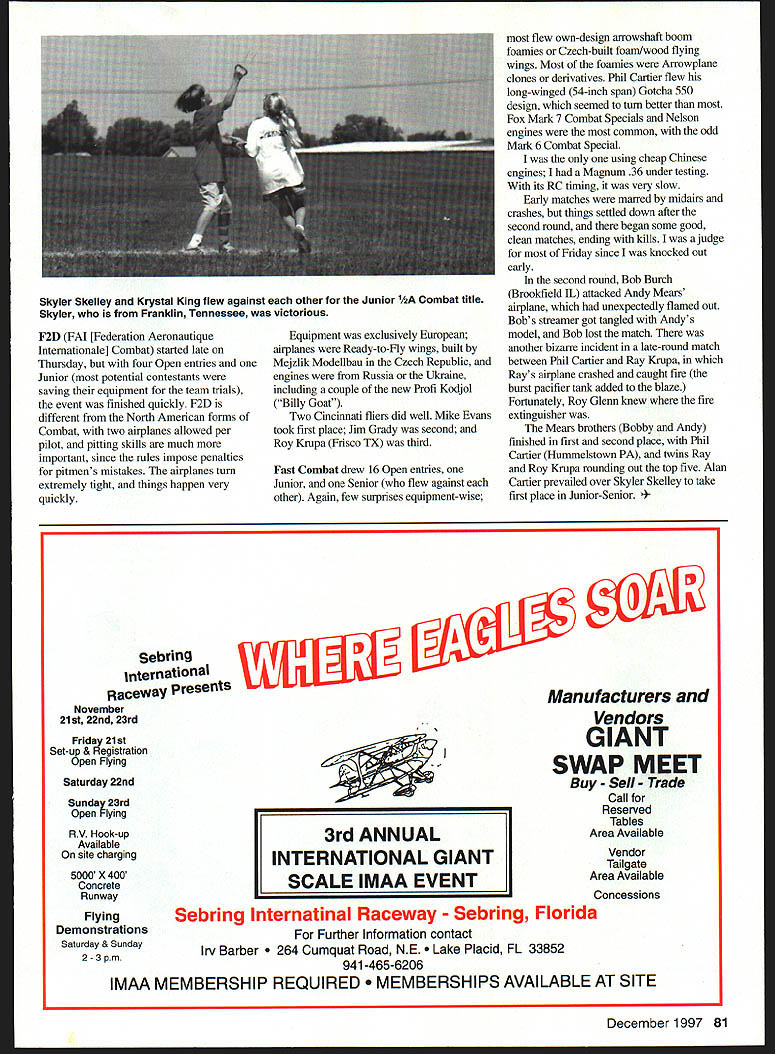
- Henry Nelson, maker of very fast engines, flew in Super Slow Combat.
- Dave Shadel, a noted pylon flier, also flew Super Slow.
- The Mears brothers provided much of the top-level excitement in Fast Combat, while younger pilots such as Krystal King and Skyler Skelley showed strong performances in the Junior ranks.
Transcribed from original scans by AI. Minor OCR errors may remain.

