

CONTROL LINE COMBAT
Rich von Lopez, 8334 Colegio Drive, Los Angeles, CA 90045
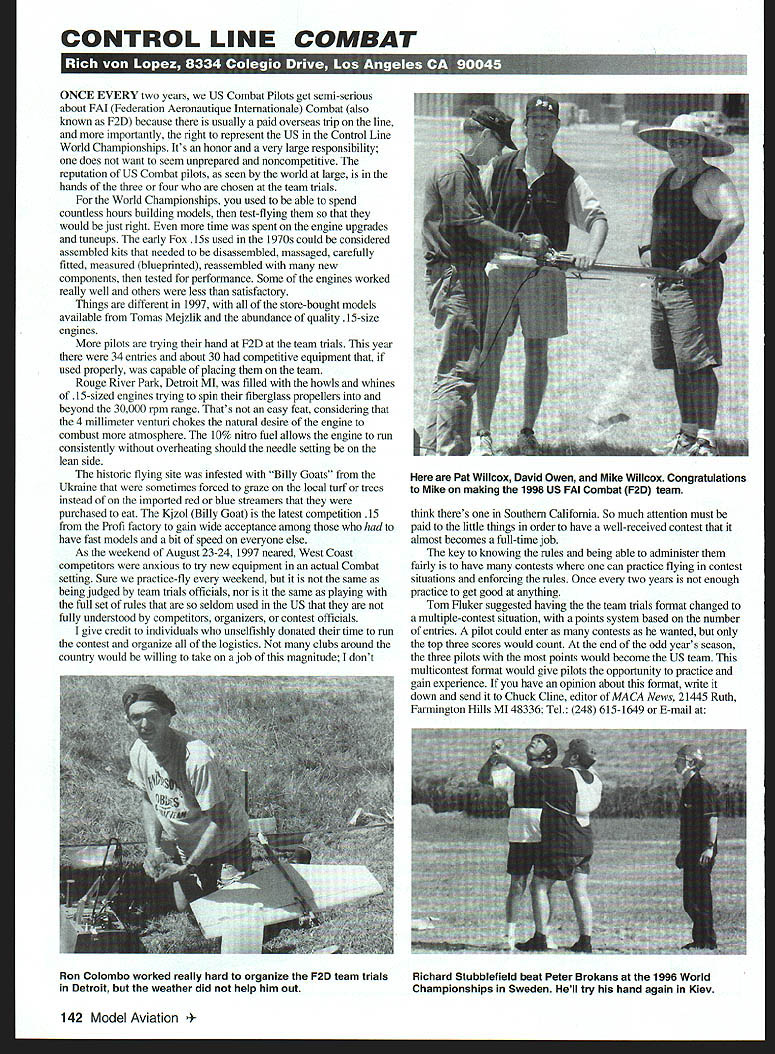
Once every two years, we US Combat pilots get semi-serious about FAI (Federation Aeronautique Internationale) Combat (also known as F2D) because there is usually a paid overseas trip on the line, and more importantly, the right to represent the US in the Control Line World Championships. It's an honor and a very large responsibility; one does not want to seem unprepared and noncompetitive. The reputation of US Combat pilots, as seen by the world at large, is in the hands of the three or four who are chosen at the team trials.
For the World Championships, you used to be able to spend countless hours building models, then test-flying them so that they would be just right. Even more time was spent on the engine upgrades and tuneups. The early Fox .15s used in the 1970s could be considered assembled kits that needed to be disassembled, massaged, carefully fitted, measured (blueprinted), reassembled with many new components, then tested for performance. Some of the engines worked really well and others were less satisfactory.
Things are different in 1997, with all of the store-bought models available from Tomas Mejzlik and the abundance of quality .15-size engines. More pilots are trying their hand at F2D at the team trials. This year there were 34 entries and about 30 had competitive equipment that, if used properly, was capable of placing them on the team.
Rouge River Park, Detroit, MI, was filled with the howls and whines of .15-sized engines trying to spin their fiberglass propellers into and beyond the 30,000 rpm range. That's not an easy feat, considering that the 4-millimeter venturi chokes the natural desire of the engine to combust more atmosphere. The 10% nitro fuel allows the engine to run consistently without overheating should the needle setting be on the lean side.
The historic flying site was infested with "Billy Goats" from the Ukraine that were sometimes forced to graze on the local turf or trees instead of on the imported red or blue streamers that they were purchased to eat. The Kjzol (Billy Goat) is the latest competition .15 from the Profi factory to gain wide acceptance among those who had to have fast models and a bit of speed on everyone else.
Team trials and preparation
As the weekend of August 23–24, 1997 neared, West Coast competitors were anxious to try new equipment in an actual Combat setting. Sure, we practice-fly every weekend, but it is not the same as being judged by team trials officials, nor is it the same as playing with the full set of rules that are so seldom used in the US that they are not fully understood by competitors, organizers, or contest officials.
I give credit to individuals who unselfishly donated their time to run the contest and organize all of the logistics. Not many clubs around the country would be willing to take on a job of this magnitude; I don't think there's one in Southern California. So much attention must be paid to the little things in order to have a well-received contest that almost becomes a full-time job.
The key to knowing the rules and being able to administer them fairly is to have many contests where one can practice flying in contest situations and enforcing the rules. Once every two years is not enough practice to get good at anything.
Tom Fluker suggested having the team trials format changed to a multiple-contest situation, with a points system based on the number of entries. A pilot could enter as many contests as he wanted, but only the top three scores would count. At the end of the odd year's season, the three pilots with the most points would become the US team. This multicontest format would give pilots the opportunity to practice and gain experience.
If you have an opinion about this format, write it down and send it to Chuck Cline, editor of MACA News, 21445 Ruth, Farmington Hills, MI 48336; Tel.: (248) 615-1649; E-mail: cline@e-mail.com.
The contest weekend
The team trials were full of interesting happenings, not to mention the uncooperative weather. The Friday practice session at Rouge River Park was a new experience for me, with the strong gusts of wind that blew on and off, over the hills, and around and through the trees. The turbulence was unpredictable and buffeted the models at various points around the circle. Those who were familiar with the tree line adjacent to one of the circles used it to hide their models for an instant.
As is the custom at these competitions, we start with a banquet at a restaurant where there is hand-shaking, kidding around, and plenty of tall stories to keep a person amused. Then to aid the digestion process, there is the mandatory rules discussion that includes all of the "what if" questions; some are relevant and others are best answered by anyone off the street.
There is also the numbers draw to determine the place in the matrix. It sounds simple enough—34 pilots, 34 numbers—but a couple more numbers were added that made it difficult to understand and more work for everyone. It's strange logic, but it was applied through oversight.
The weather forecast indicated rain on Sunday, but Saturday was supposed to be nice. I was told that we were to move as fast as we could on Saturday to get as much flying in as possible. The opposite happened, with a late start and a very leisurely pace coupled with a plethora of protests, including one of my own. We were not finished with the third round after a full day.
I figure that 34 competitors give 17 matches times 3, which equals 51 total matches. Give each match 10 minutes for a total of 510 minutes, then divide by 60 to get the number of hours; it should take 8 hours and 30 minutes by my calculations. Throw in an hour's worth of refiles and plan on 9–10 hours to get in 3 rounds. With an 8 a.m. start you would end at 6 p.m. A match every 8 minutes would give you time to probably finish the fourth round, given the amount of daylight in late August at this latitude.
The point of this calculation is to make the organizers aware of the need to push the contests along, especially with the threat of rain the next day. The rain did fall on Sunday and the contest did not get moving until about noon. The Monday rain day had to be used and the contest lasted until almost nightfall; however, I was not there to see the end of the competition since my flight back to Los Angeles left at 12:20 p.m. Monday, August 25.
Results and notable participants
There was excellent flying throughout the contest, and it was evident that the guys from Detroit had been doing much practicing and had sorted out the engines, models, and propellers. The US team selected at the trials:
- Ron Marchionni
- Richard "don't step on my toe" Stubblefield
- Mike Willcox
Mark Rudner joined the team as the Junior member; he has become an expert model builder and propeller carver. These guys will likely be well-prepared for the World Championships.
Thomas Mejzlik came all the way from the Czech Republic to view the competition and to sell some products. He had 15 new Kjzol engines when he arrived, and he sold them all. Tomas had a variety of products at the field, such as propellers, lines, engine mounts, mufflers, handles, tools, engines, and spare engine parts. Traveling from New Zealand was Bryce Gibson, who was contracted by Charlie Johnson as pit crew.
Personal notes and R&D
Pat Willcox is a captain on an EVA 747 that flies from Los Angeles to Taipei or some other long-distance route, and when he has layovers in Los Angeles, his company puts him up at a hotel two blocks from my house. When that happens, Pat comes over and takes some R and R in my garage workshop; he has a couple of 1/2A models that we flew at our secret beach site, and we got in a little streamer-chasing with the help of a makeshift model launcher.
My most recent research and development project involves the use of Magnum XL 36A engines for 80 mph Combat. They are made in China and are available through a variety of sources, including Hobby Shack, Tower Hobbies, and Sheldon's Hobbies. The ones I purchased were $49.99. They are well-made and are ABC type with two ball bearings. I will keep you posted on how they turn out; the initial two outings have looked good.
Transcribed from original scans by AI. Minor OCR errors may remain.

