
CONTROL LINE COMBAT
Rich von Lopez — 8334 Colegio Drive, Los Angeles, CA 90045
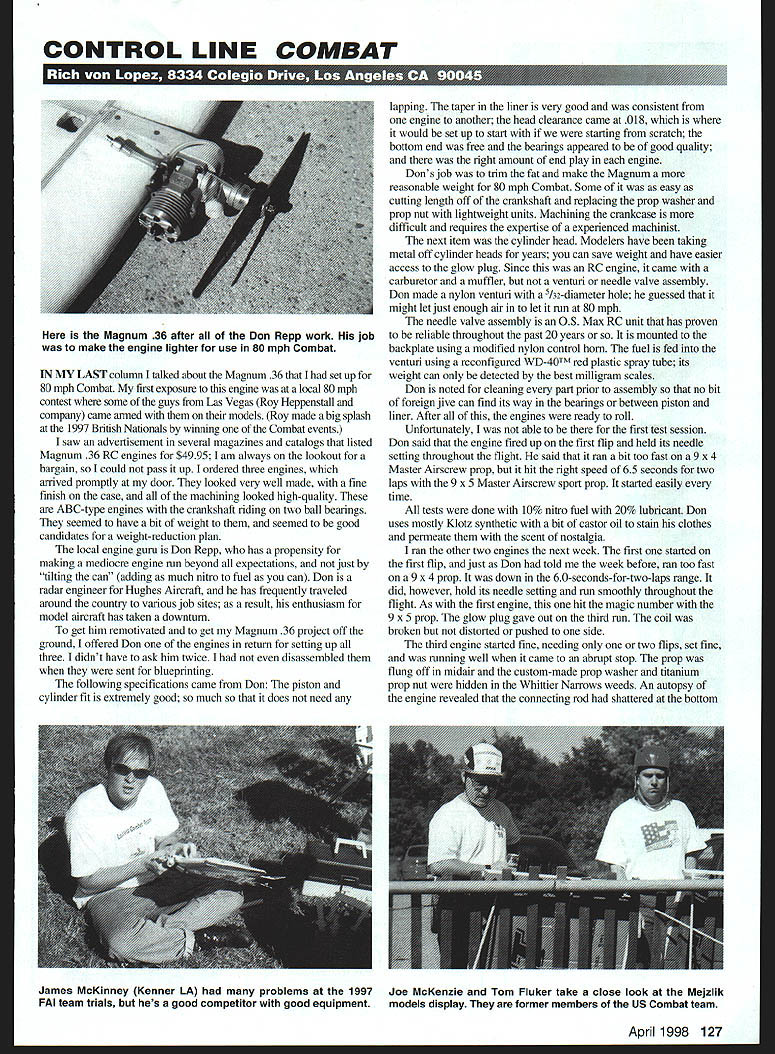
In my last column I talked about the Magnum .36 that I had set up for 80 mph Combat. My first exposure to this engine was at a local 80 mph contest where some of the guys from Las Vegas (Roy Heppenstall and company) came armed with them on their models. Roy made a big splash at the 1997 British Nationals by winning one of the Combat events.
I saw an advertisement in several magazines and catalogs that listed Magnum .36 RC engines for $49.95. I am always on the lookout for a bargain, so I could not pass it up. I ordered three engines, which arrived promptly at my door. They looked very well made, with a fine finish on the case, and all of the machining looked high quality. These are ABC-type engines with the crankshaft riding on two ball bearings. They seemed to have a bit of weight to them and were good candidates for a weight-reduction plan.
The local engine guru is Don Repp, who has a propensity for making a mediocre engine run beyond all expectations, and not just by "tilting the carb" (adding as much nitro to the fuel as you can). Don is a radar engineer for Hughes Aircraft and has frequently traveled around the country to various job sites; as a result, his enthusiasm for model aircraft had taken a downturn.
To remotivate him and to get my Magnum .36 project off the ground, I offered Don one of the engines in return for setting up all three. I didn't have to ask him twice. I had not even disassembled them when they were sent for blueprinting.
Blueprinting and initial findings
The following specifications came from Don: the piston and cylinder fit is extremely good, so much so that it does not need any lapping. The taper in the liner is very good and was consistent from one engine to another; the head clearance came at .018", which is where it would be set up to start with if we were starting from scratch. The bottom end was free and the bearings appeared to be of good quality, with the right amount of end play in each engine.
Don's job was to trim the fat and make the Magnum a more reasonable weight for 80 mph Combat. Some of it was as easy as cutting length off of the crankshaft and replacing the prop washer and prop nut with lightweight units. Machining the crankcase is more difficult and requires the expertise of an experienced machinist.
The next item was the cylinder head. Modelers have been taking metal off cylinder heads for years; you can save weight and have easier access to the glow plug. Since this was an RC engine, it came with a carburetor and a muffler, but no venturi or needle valve assembly. Don made a nylon venturi with a 5/32-inch-diameter hole; he guessed that it might let just enough air in to let it run at 80 mph.
The needle valve assembly is an O.S. Max RC unit that has proven reliable for the past 20 years or so. It is mounted on the backplate using a modified nylon control horn. The fuel is fed into the venturi using a reconfigured WD-40 red plastic spray tube; its weight can only be detected by the best milligram scales.
Don is noted for cleaning every part prior to assembly so that no bit of foreign jive can find its way into the bearings or between piston and liner. After all of this, the engines were ready to roll.
Testing and performance
I was not able to be there for the first test session. Don said that the engine fired up on the first flip and held its needle setting throughout the flight. He said that it ran a bit too fast on a 9x4 Master Airscrew prop, but hit the right speed of 6.5 seconds for two laps with the 9x5 Master Airscrew sport prop. It started easily every time.
All tests were done with 10% nitro fuel with 20% lubricant. Don uses mostly Klotz synthetic with a bit of castor in the oil to stain his clothes and permeate them with the scent of nostalgia.
I ran the other two engines the next week. The first one started on the first flip, and just as Don had told me, ran too fast on a 9x4 prop. It was down in the 6.0-seconds-for-two-laps range. It did, however, hold its needle setting and run smoothly throughout the flight. As with the first engine, this one hit the magic number with the 9x5 prop. The glow plug gave out on the third run; the coil was broken but not distorted or pushed to one side.
The third engine started fine, needing only one or two flips, set fine, and was running well when it came to an abrupt stop. The prop was flung off in midair and the custom-made prop washer and titanium prop nut were lost in the Whittier Narrows weeds. An autopsy of the engine revealed that the connecting rod had shattered at the bottom end, and the crankshaft bushing was still attached to the crankshaft. The surprise inside the engine was that the case was damaged — experience with this type of failure shows bits of aluminum can jam between the piston and liner, creating gouges that render the case useless. I purchased a replacement rod for $11, reassembled the engine, and testing the next week had it running fine. It handles like the other two.
If I had it to do again, I would make the venturi a tad smaller so that I could use the stock 9x4 props I already have. In fighting trim, the Magnum .36 weighs 236 grams, which converts to 8.32 ounces (using 28.35 grams per ounce).
The old K&B .35 that I was using weighed 257 grams, or 9.06 ounces. I liked the old K&Bs, but they were hard to start and impossible to restart without melting ice cubes on the case and head. They were bronze-bushing engines and utilized a Dykes ring on the aluminum piston.
I have to give the Chinese factory credit for coming up with a quality engine at a low price. I have not seen this Magnum advertised recently, so you may want to grab one if you see it. Don and I concur that it would be risky to try to use one of these engines for Fast Combat; the crankshaft is liable to break. It is happy in a detuned state, and I intend to keep these two for a long time.
Nostalgia Diesel Combat
Several Combat enthusiasts around the globe are seriously getting into Nostalgia Diesel Combat as it was done in the old days in England. At one time the event drew a huge number of entries whenever it was flown.
I looked forward to reading about the British Nationals and the antics of some proficient fliers. There were stories about competitors deliberately hitting the ground to avoid having a cut taken. The pit crews were always ready to toss the model back in the air with little or no loss of time; they seldom had to change a prop, and never had to carry a battery or fuel.
If you have run diesel models, you know that they can go a long way on a small amount of fuel. They were slow enough so that Sunday sport fliers could have a go without being behind the model. Many current and former Combat pilots are closing in on the senior citizen ranks but still like to fly Combat. The ferocity of Fast Combat and the other more-than-90-mph events has become too much, so a tamer event seems to be the answer.
I had a good look at what the Canadians were trying last June during the down time of the Bladder Grabber in Seattle. The models are the size of current 1/2A models and are nylon- or silk-covered wooden-structure designs. Many of the Canadians were using the PAW .15 engine with nylon props. They flew really slowly, and the pilots seemed to have plenty of time to plan their moves or change their mind in the middle of a maneuver. I can see the attraction to Nostalgia Diesel.
Some guys in Las Vegas have become so involved in this event that they have been putting out feelers for interest in a competition in their area. The Las Vegas Dust Devils club is led by Jim Wynhoff (4132 East New York Ave., Las Vegas, NV 89104), who is the contact person. His e-mail address is jwynhoff@aol.com. The original target date was January or February; he would probably appreciate any input.
I had one experience with Diesel Combat in 1982 in Peterborough, England using borrowed models that I had repaired, and I shared an Oliver Tiger with another competitor. I still have the first-place trophy on a wall in the garage.
Barry Baxter deals in classic control-line plans and may have a line on a few designs to look at. Contact him at 3292 Greenleaf Drive, Brea, CA 92621; Tel.: (714) 254-3805.
Membership and further reading
If you are not a member of the Miniature Aircraft Combat Association (MACA), give some serious thought to joining. So you don't forget, run your checkbook, write out a check for $15, and send it to:
- MACA, c/o Gene Berry, 4610 89th St., Lubbock, TX 79424
I read MACA News cover-to-cover every month to find out what is going on around the country and around the world. Try it for a year!
Transcribed from original scans by AI. Minor OCR errors may remain.

