
CONTROL LINE COMBAT
Rich von Lopez, 8334 Colegio Drive, Los Angeles CA 90045
Internet and timely communication
I have been doing a bit of Internet browsing, looking for Web pages related to control line (CL) models. It is fascinating to see information about the hobby come up on the little Macintosh laptop that I am using. I can see how this method of communication has the potential to be the normal way of doing business. Timely information about contests and events can be shared very quickly—which is good, since many tend to wait until the last minute to get contest notices out to potential contestants.
The listings in Model Aviation help tremendously when planning vacations around contests, or just to see what's happening around the country. The problem with the "Contest Calendar" is that if a club or individual decides to host a competition the following month, there is not enough lead time to get the information published in the magazine.
For instance, to get this column printed in the June 1998 issue, I am writing it in early February 1998. You will see it some time in early May. (If you have access to Internet service, you already know the possibilities for instant communication.) My suggestion to those who don't have Internet access is to find a neighbor or other friend who does, and spend a little time there. Trade some flying lessons for their computer time.
European scene and FAI rule proposals
I have been looking at Goran Olsson's (Stockholm, Sweden) Web page to stay on top of what is happening on the European scene. In addition to his page, he has an Internet CL newsletter, The Circulator. The latest edition contained information on proposed rule changes for the Fédération Aéronautique Internationale (FAI) events. I'll summarize those that will have an impact on F2D:
- Make mechanics full partners in the Combat event; they would receive the same awards as the pilots. This Russian proposal has merit.
- Eliminate the spare model and have one model per bout. This is another Russian proposal and one I need to think about.
- Give the circle marshal a little more latitude in determining when lines are hopelessly tangled and when to authorize launching spare models. The present rules require both fliers to agree that the tangle is hopeless. If both backup models are in reserve, there is no reason they should not be used immediately. The line tangle can be addressed later if another tangle or situation occurs. A flier who's ahead can win if he's busy trying to untangle the lines when he knows it is hopeless; this tactic could assure a win. It wouldn't be a bad rule to have in place.
Finding suppliers and engines
Another reason to look at the Internet is to get the names and addresses of equipment manufacturers and suppliers. In previous columns I mentioned Redko and Zorro engines, but I could not tell you where to get them. I have found that Jari Valo of Finland has those engines for sale, and he even has a price list for replacement parts. He can be found on Goran Olsson's Web page.
Russian speed flier Alexander Kalmykov (of Novosibirsk) has made a good name for himself by manufacturing quality engines. He is the man responsible for the Cyclon brand. The four that I own have been quite good; they start well, run fast, and are easy to tune.
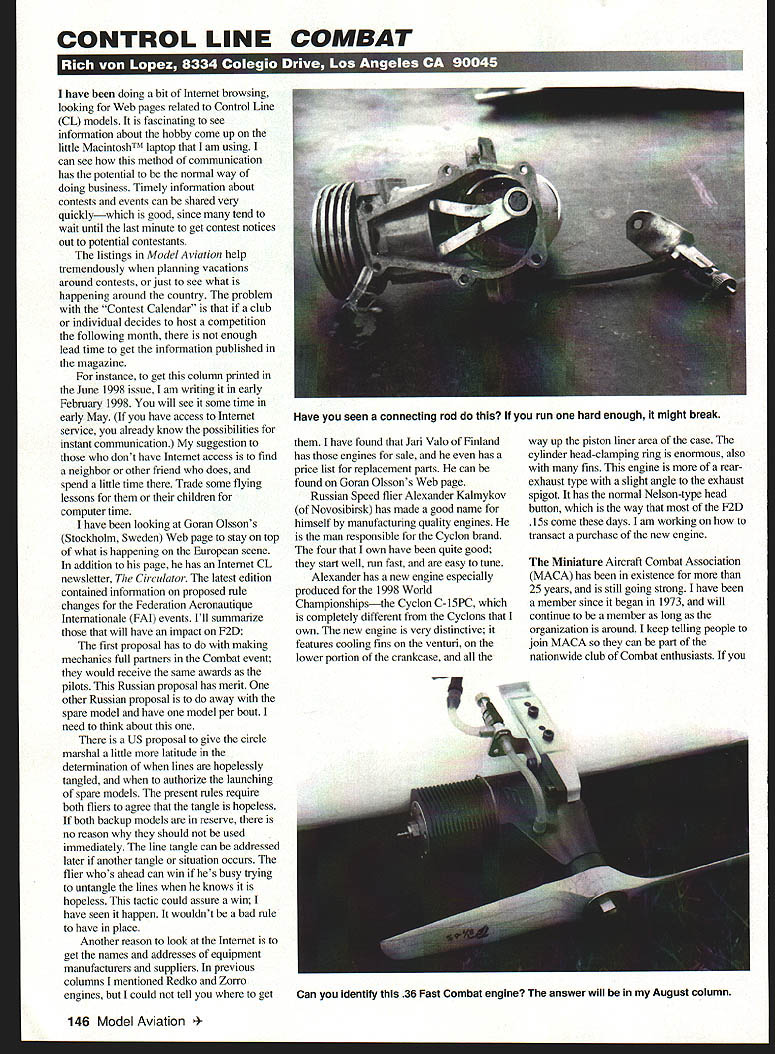
Alexander has a new engine especially produced for the 1998 World Championships—the Cyclon C-15PC—which is completely different from the Cyclons that I own. The new engine is very distinctive; it features cooling fins on the venturi, on the lower portion of the crankcase, and all the way up the piston liner area of the case. The cylinder head-clamping ring is enormous, also with many fins. This engine is more of a rear-exhaust type with a slight angle to the exhaust spigot. It has the normal Nelson-type head button, which is the way that most of the F2D .15s come these days. I am working on how to transact a purchase of the new engine.
MACA
The Miniature Aircraft Combat Association (MACA) has been in existence for more than 25 years, and is still going strong. I have been a member since it began in 1973, and will continue to be a member as long as the organization is around. I keep telling people to join MACA so they can be part of the nationwide club of combat enthusiasts.
Flying sites and Whittier Narrows
Sometimes much time is spent getting equipment together and we forget about the need for a good, reliable flying site. Models that have worked for the past 18 months have been experiencing problems. Southern California Parks and Recreation Department, park police, Caltrans people, and those in charge of highways and other public roads and groups have a say in what takes place.
Whittier Narrows National Recreation Area is a facility known to modelers around the country and around the world. The radio-control (RC) site has hosted competitions for years and will continue to do so. The tree-lined area next to the flying field provides some shade during those hot summer months. The CL area boasts three asphalt circles with painted lines, and one of the circles has a racing cage built around it with a permanent tower for the judges. The racing, speed, and stunt pilots are well taken care of and have a nice surface on which to practice or compete.
On the other hand, the grass areas for carrier and combat have been plagued throughout the years by gophers, broken irrigation systems, and neglect. The non-paved areas are covered with wild grasses, as opposed to the preferred seeded turf. The fliers have learned to compensate for the flying site's shortfalls (we catch our models after each flight to avoid getting any dirt or grit in the engines); however, it would be nice to have the option of a ground landing. When this area dries out in the summer, you can expect to get a good, healthy layer of grit on yourself and on your equipment.
There is some sort of underground irrigation system, but it has been broken for some time. The park people do not appear to be in any hurry to repair it, but they have found the time to build a toll booth at the entrance of the park, from which they can collect $3 per car.
To be fair to the park people, they did make a parking lot from used shooting-range stuff (clay pigeons), specifically for the CL guys. It was great until the Caltrans people put up a gate to keep people out of the storm drain area that is located some distance beyond the flying area parking lot. When we drive around the gate some other way, the park police come by to kick us out.
The gate could be moved, but they don't want us driving on the bike path to get to the parking lot. We have begun a letter-writing campaign to the park superintendent seeking support to alleviate this situation, and the tone is very cordial and respectful. We even offer to mobilize the clubs to assist however we can to solve the problem. During the last two years, all of the minor annoyances have added up and caused sport flier participation to drop markedly; fewer people go out each weekend. I will keep you posted on how we do with our letters.
Public relations and parks cooperation
It is important to get to know your parks-and-recreation people, and be nice to them. Keeping your area clean is also helpful in promoting the image of the wholesome hobbyist. It only takes a couple of minutes to pick up the broken props, streamer debris, and other trash. A public-relations effort will pay off in the long run with a well-maintained flying site.
Let the parks people know that young people are involved in your activity, and that you are willing to help anyone who is interested. Give them some literature that tells them when you have your club meetings and who they can contact for more information; make sure that they have enough copies to pass on to people who have questions. A listing of local hobby shops would also help. We need to let the people who run the parks know that we are alive and well.
Transcribed from original scans by AI. Minor OCR errors may remain.

