
CONTROL LINE COMBAT
Rich von Lopez — 8334 Colegio Drive, Los Angeles, CA 90045
Top Gun Triple Elimination Fast Combat Contest
The opening of the Combat season has traditionally been in March in Tucson, Arizona with the Top Gun Triple Elimination Fast Combat Contest. This year 44 competitors from across the U.S. tried their hand at winning the $1,000 top prize. Other contests may take place before the Top Gun event, but it's the first of the big-money contests.
In some parts of the country, pilots spend all winter building and are anxious to test new projects and designs in the contest arena. The Arizona event provides a good opportunity to test models and engines under fire.
The field was loaded Friday afternoon, with most pilots doing last-minute tuning and trimming, and a bunch of guys getting practice matches in with 1/2A models. The beautiful weather and site conditions added to the pleasure of the contest. All matches were flown without anyone feeling pressured or rushed, and there was even enough time to take a one-hour lunch break. As usual, the host club, the Cholla Choppers, had a homemade lunch available to the competitors.
Engines and props
This year Henry Nelson himself was in Tucson; he is the brains and talent behind the now-dominant Nelson Combat .36. Henry developed the engine several years ago and has essentially taken over the Fast and Slow Combat market. His engines are reliable and make "Mogombo" power. (Mogombo is a word that engine guru Don Repp uses to mean "huge amounts.")
Roughly 75% of the pilots at Top Gun used Nelsons; the rest were various versions of Foxes, with one pilot daring to use a Stels .36. Most of the propellers were carved-on Rev-Ups, Master Airscrew scimitars, APCs, or glass copies of the APCs.
It looks as if the AME .049 is the engine of choice for many serious pilots. Larry Driskill has the engines available with a few modifications to make them more user-friendly. I purchased one from him that looked really good and will be giving it a go soon. Larry let me fly his .049 on one of his Lite Hawk models, and the performance was quite good. This combination makes for a rocksteady model with lots of power. Jerry Capuano's son also had a Lite Hawk, but with an AME .061; it worked well and is a great sport flier.
Fuel shutoffs and dumps
Many types of fuel shutoffs or dumps are available. There were many Tomas Mejzlik Czechoslovakian swing-arm types to be seen, but there are problems with the integral needle valves being too weak on this design. I removed the needle valve and used a remote O.S. Max type instead. Tomas is aware of the problem and will be taking measures to correct it.
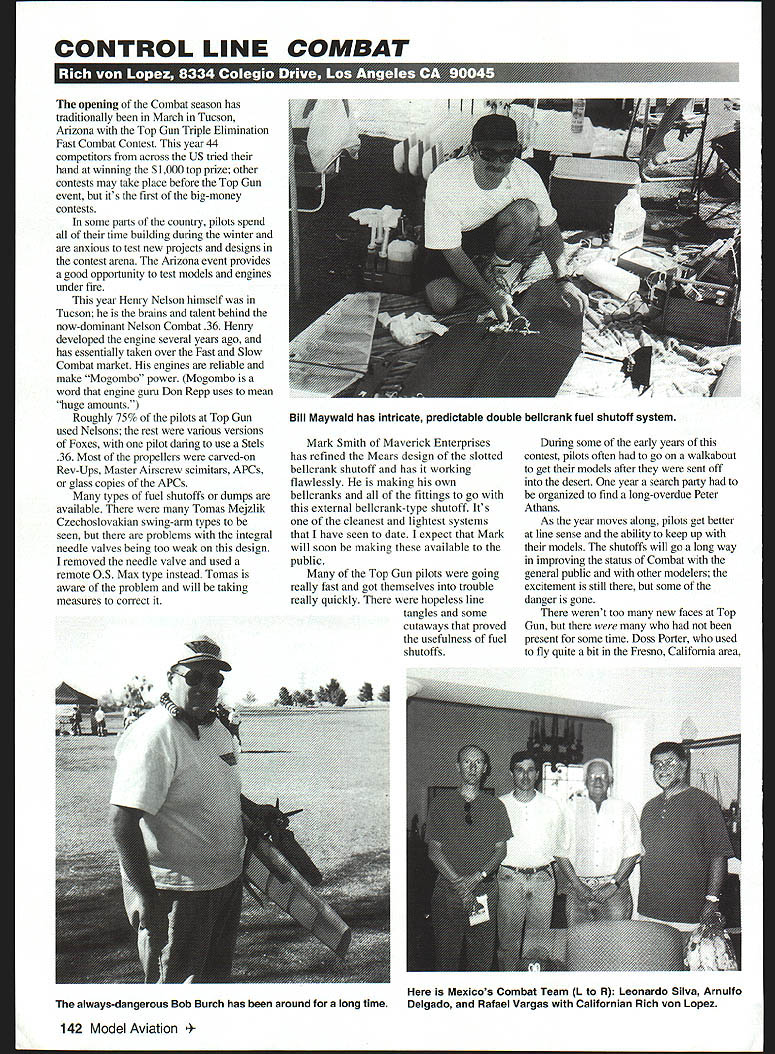
Mark Smith of Maverick Enterprises has refined the Mears design of the slotted bellcrank shutoff and has it working flawlessly. He is making his own bellcranks and all of the fittings to go with this external bellcrank-type shutoff. It's one of the cleanest and lightest systems I have seen to date. I expect Mark will soon be making these available to the public.
Many of the Top Gun pilots were going really fast and got themselves into trouble quickly. There were hopeless line tangles and some cutaways that proved the usefulness of fuel shutoffs. As the year moves along, pilots get better at line sense and the ability to keep up with their models. The shutoffs will go a long way in improving the status of Combat with the general public and with other modelers; the excitement is still there, but some of the danger is gone.
Models and accessories
I did not see anything new in model designs; there were the same foam designs with internal or external controls. There were plenty of short-tail or boom-design Czech models. These ready-to-fly aircraft make it easy for those who have more money than time to be competitive; they cost $45 to $50, depending on shipping.
One new item I saw comes from Henry Nelson's shop — a backplate engine mount for his Combat .36, which was very light and had the exact spacing for a Czech model. The mount is said to be about a half-ounce lighter than a normal metal engine-mount setup. The downside is that it costs $35, but it makes for a clean setup with reduced vibration. Several pilots were using this mounting system for their front-line models. I purchased one and will be testing it in the near future.
Pilots, attendance, and social scene
There weren't too many new faces at Top Gun, but there were many who had not been present for some time. Doss Porter, who used to fly quite a bit in the Fresno, California area, made a comeback. Mitch Williams flew as a youngster in Northern California — a sharp eye could tell you those left-handed moves were not random. Max Boyd moved to the Seattle area, lost weight, and looked to be in fighting trim as he moved deep into the contest.
Regular faces seen at most major competitions included:
- Cleveland, Mears, Hess, Wilcox, Stubblefield, Rudner, Lopez, Capuano, Perkins, Petri, Cranfil, Minor, Cline, Smith, McKinney, Liddle, Le Cour, Skelly, Heppenstall, Cash, Maywald, Athans, Rein, Burdick, Colombo, Henry, Burch, and numerous others.
Several other pilots were present who did not fly:
- James Mears, Riley Wooten, Larry Driskill, Larry Scarnzi, Don Repp, Steve Stewart, Dave Stewart, Gary Cash, and a few more hung around pitting or shooting the breeze. For some, this contest becomes a social event rather than just a model contest. Some tall stories were told under the Texans' canopies about rattlesnakes and other adventures.
Sheikard may have a sore toe and be sneaking up on one of those senior-citizen cards, but his eyesight is sharp, and the kill zone is a quarter-circle long to him.
Contest organization and results
Probably the best thing about the Top Gun contest is that it is run so well; the Arizona guys pride themselves on running a tight and efficient contest. It also helps that it is Fast Combat, the easiest to judge (most of the time) from the point of view that a kill ends the match. Most pilots can tell when they have taken a kill or been killed, so there is little or no arguing.
Competitors were ready at their assigned times, and the contest moved at a quick pace. Even with 44 entries, there was no problem getting through the first four rounds on Saturday; in fact, a couple of fifth-round matches were run before 6:30 p.m.—the equivalent of having 85-plus matches in one day. There were also a couple of relays thrown in to add to the count.
The competition is intense, but friendship often supersedes the need to win. Well-prepared Mark Smith came out on top after some hard-fought matches; Chuck Cline, editor of MACA News (Miniature Aircraft Combat Association), battled his way to second place with what might have been his personal best in major competitions; and the ever-wily and skillful Richard Stubblefield finished third.
Upcoming events
- The 1999 Top Gun will be the 10th annual, and organizers are already working on it. It will be the biggest and best ever, so make your plans to attend.
- The 1998 Bladder Grabber at the end of June will be one of the biggest yet, with Bob Carver putting up $16,000 worth of stereo prizes and other goodies. The contest has a history of being one of the best and offers substantial prizes.
- The Duke Fox Memorial Competition in Chicago, Illinois will return to a Fast Combat format after a one-year experiment in 1997 with 80 mph. There is a need for a major-league contest in the Midwest.
Local field news
I have been out of town for two weeks and have not been at my regular flying field. However, I learned that work has begun on fixing the irrigation system in and around the flying site, which might allow the return of the Money Nats and some new events in the future. The parking situation is the next item to take on. It is amazing how much you can get accomplished if you write a few carefully worded letters in a polite tone.
International contacts
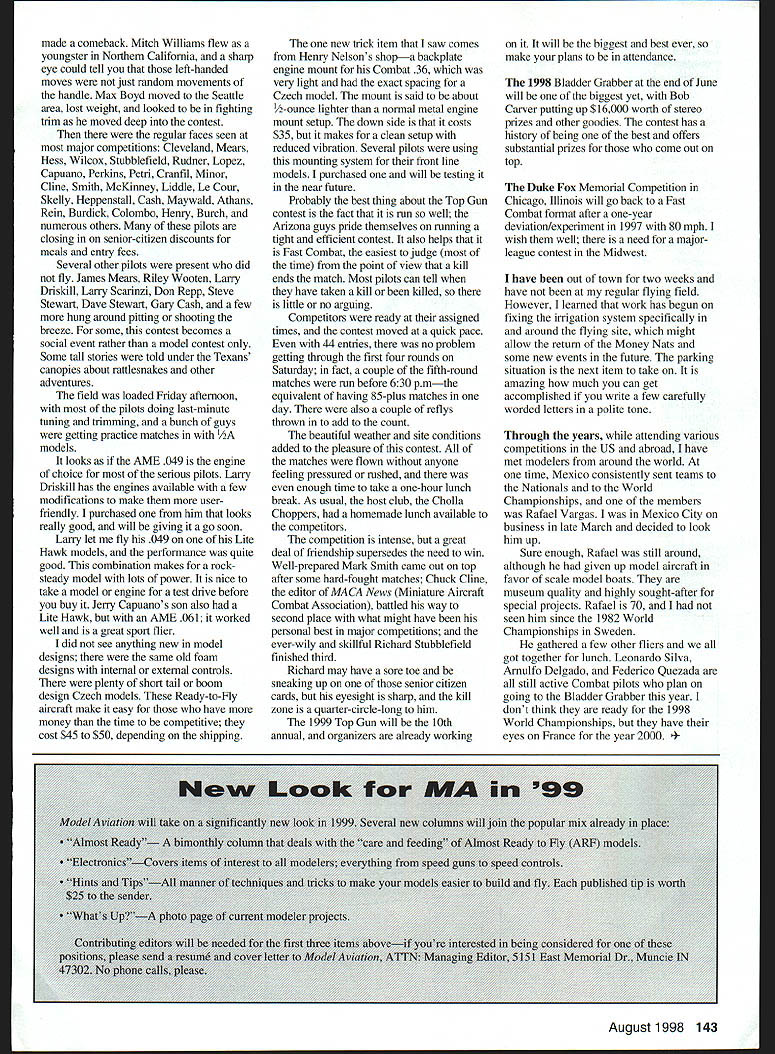
Through the years, while attending various competitions in the U.S. and abroad, I have met modelers from around the world. At one time, Mexico consistently sent teams to the Nationals and to the World Championships, and one of the members was Rafael Vargas. I was in Mexico City on business in late March and decided to look him up.
Rafael was still around, although he had given up modern combat in favor of scale model boats. They are museum-quality and highly sought-after for special projects. Rafael is 70, and I had not seen him since the 1982 World Championships in Sweden.
He gathered a few other fliers and we all got together for lunch. Leonardo Silva, Arnulfo Delgado, and Federico Quezada are all still active Combat pilots who plan on going to the Bladder Grabber this year. I don't think they are ready for the 1998 World Championships, but they have their eyes on France for the year 2000.
Transcribed from original scans by AI. Minor OCR errors may remain.

