
CONTROL LINE COMBAT
By Rich von Lopez
8334 Colegio Drive, Los Angeles, CA 90045
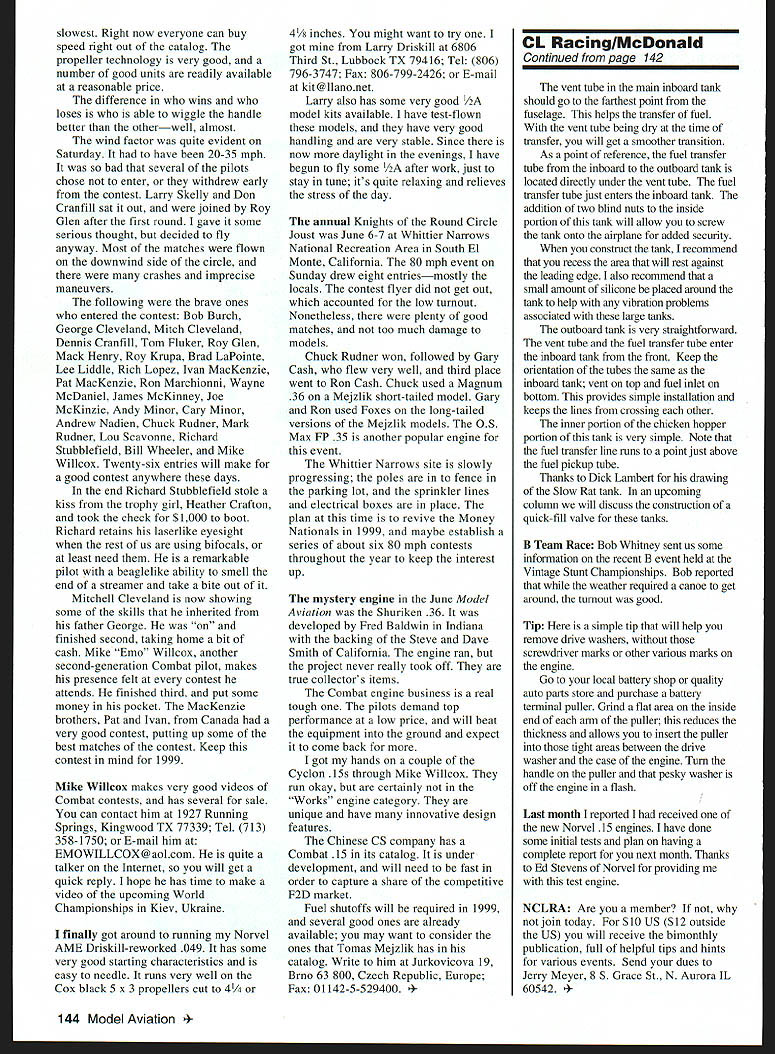
During the latter part of April, Mike Wilcox hosted the United States Open FAI (Federation Aeronautique Internationale) Combat contest in Garland, Texas, near Dallas. It was an attempt to generate some interest in the F2D event in the US, and to give the US team members a chance to fly in a serious contest against some of the more serious competitors.
Most pilots do not get many opportunities to fly in actual Combat conditions during the course of the year; many fly numerous practice matches with short tanks of fuel, in a more relaxed atmosphere. More real contests are needed, in which all of the rules are applied and there is no deviation.
In the past, the only major F2D contest has been the US team trials, which take place every two years; this is certainly not enough to be very competitive with the Europeans, who only fly F2D and are not bogged down with six other forms of Combat. (The Brits may be the exception, what with their 1/2A and Diesel events.) Many Combat pilots are glad to have a major money-type contest in the US; $1,000 contests are abundant around the country for almost all of the Combat events.
Venue and organization
Hobby Park in Garland, TX has plenty of space for Control Line activity; it's convenient to local motels and eateries, and the trek from the Dallas–Fort Worth airport is not too bad. The best part of the contest was the organization, and the fact that all of the officials had considerable Combat experience and were used to looking for cuts, which helps. I do not believe that they missed any of the cuts. The center marshals were fair and applied the rules equally.
The streamers were made of some sort of plastic material that was quite sturdy and did not break or shred because of speed or being hit by a model's wing. The strings, however, were only 2 meters instead of the 2.5 meters called for in the rules, which was just less than 20 inches of cutting distance that was not available to the competitors. It was the same for everyone.
Fuel and pit logistics
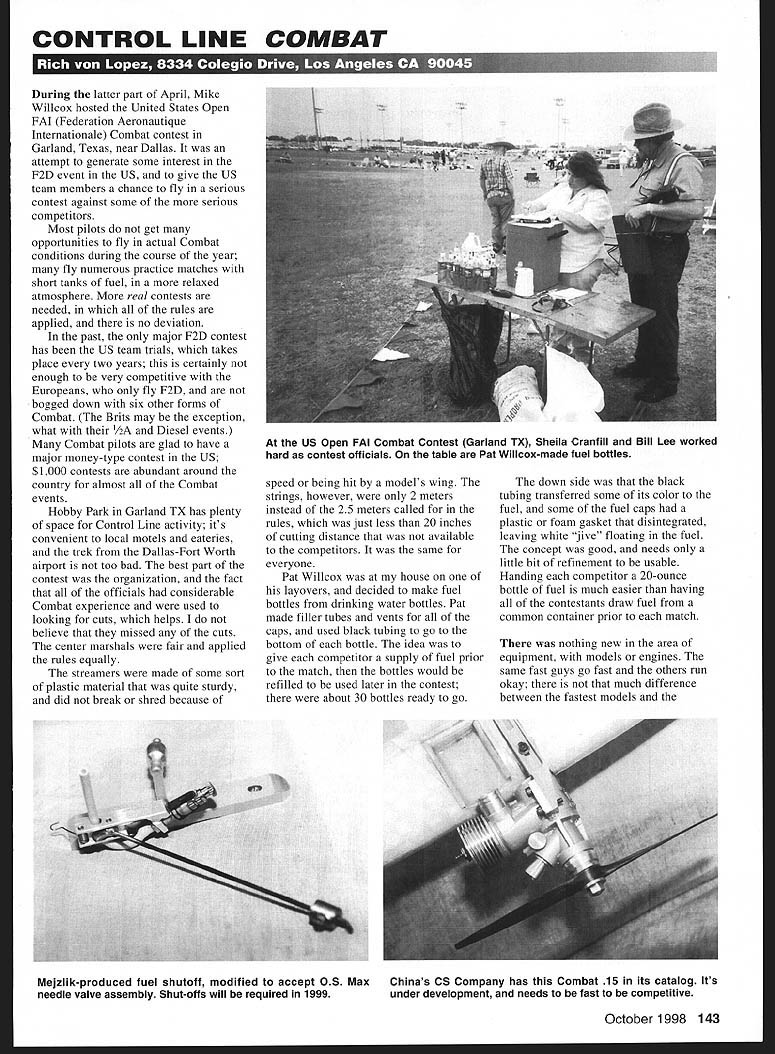
Pat Wilcox was at my house on one of his layovers and decided to make fuel bottles from drinking water bottles. Pat made filler tubes and vents for all of the caps and used black tubing to go to the bottom of each bottle. The idea was to give each competitor a supply of fuel prior to the match; then the bottles would be refilled to be used later in the contest. There were about 30 bottles ready to go.
The downside was that the black tubing transferred some of its color to the fuel, and some of the fuel caps had a plastic or foam gasket that disintegrated, leaving white "gunk" floating in the fuel. The concept was good and needs only a little refinement to be usable. Handing each competitor a 20-ounce bottle of fuel is much easier than having all of the contestants draw fuel from a common container prior to each match.
Equipment and flying
There was nothing new in the area of equipment, models, or engines. The same fast guys go fast and the others run okay; there is not that much difference between the fastest models and the rest.
Most matches were flown downwind; side-circle crashes and imprecise maneuvers followed.
Competitors
The brave ones who entered the contest included:
- Bob Burch
- George Cleveland
- Mitch Cleveland
- Dennis Cranfill
- Tom Fluker
- Roy Glen
- Mack Henry
- Roy Krupa
- Brad LaPointe
- Lee Liddle
- Rich Lopez
- Ivan MacKenzie
- Pat MacKenzie
- Ron Marchionni
- Wayne McDaniel
- James McKinney
- Joe McKinzie
- Andy Minor
- Cary Minor
- Andrew Nadien
- Chuck Rudner
- Mark Rudner
- Lou Scavonne
- Richard Stubblefield
- Bill Wheeler
- Mike Wilcox
Twenty-six entries will make a good contest anywhere. At day's end Richard Stubblefield won the trophy; Heather Crafton took the $1,000 check. Richard retains laser-like eyesight; the rest of us are using bifocals. Mitch Cleveland is now showing some skills inherited from his father George and finished second, taking home a bit of cash. Mike "Emo" Wilcox, another second-generation Combat pilot, made his presence felt at the contest and finished third, putting some money in his pocket. The MacKenzie brothers, Pat and Ivan from Canada, had a very good contest and put up some of the best matches of the event.
Videos and contact
Mike Wilcox makes very good videos of Combat contests and has several for sale. You can contact him at 1927 Running Springs, Kingwood, TX. Tel: (713) 358-1750; E-mail: EMOWILCOX@aol.com. He is quite responsive on the Internet, so you will get a quick reply. I hope he has time to make a video of the upcoming World Championships in Kiev, Ukraine.
Engines, kits and products
I finally got around to running my Norvel AME Driscill-reworked .049. It has some very good starting characteristics and is easy to needle. It runs very well on the Cox black 5 x 3 propellers cut to 4 1/4 inches. You might want to try one. I got mine from Larry Driscill at 6806 Third St., Lubbock, TX 79416; Tel: (806) 796-3747; Fax: (806) 799-2426; E-mail: kit@llano.net.
Larry also has some very good 1/2A model kits available. I have test-flown these models, and they have very good handling and are very stable. Since there is now more daylight in the evenings, I have begun to fly some 1/2A after work, just to stay in tune; it’s quite relaxing and relieves the stress of the day.
The mystery engine in the June Model Aviation was the Shuriken .36. It was developed by Fred Baldwin in Indiana with the backing of Steve and Dave Smith of California. The engine ran, but the project never really took off. They are true collector’s items.
The Combat engine business is a real tough one. The pilots demand top performance at a low price, and will beat the equipment into the ground and expect it to come back for more.
I got my hands on a couple of the Cyclon .15s through Mike Wilcox. They run okay, but are certainly not in the “Works” engine category. They are unique and have many innovative design features.
The Chinese CS company has a Combat .15 in its catalog. It is under development and will need to be fast in order to capture a share of the competitive F2D market.
Fuel shutoffs will be required in 1999, and several good ones are already available; you may want to consider the ones that Tomas Mejzlik has in his catalog. Write to him at Jurkovicova 19, Brno 63 800, Czech Republic; Fax: 01142-5-529400.
Local events — Knights of the Round Circle Joust
The annual Knights of the Round Circle Joust was June 6–7 at Whittier Narrows National Recreation Area in South El Monte, California. The 80 mph event on Sunday drew eight entries—mostly the locals. The contest flyer did not go out, which accounted for the low turnout. Nonetheless, there were plenty of good matches and not too much damage to models.
Chuck Rudner won, followed by Gary Cash, who flew very well, and third place went to Ron Cash. Chuck used a Mejzlik short-tailed model with a Magnum .36. Gary and Ron used Foxes on the long-tailed versions of the Mejzlik models. The O.S. Max FP .35 is another popular engine for this event.
The Whittier Narrows site is slowly progressing; the poles are in to fence in the parking lot, and the sprinkler lines and electrical boxes are in place. The plan at this time is to revive the Money Nationals in 1999 and maybe establish a series of about six 80 mph contests throughout the year to keep the interest up.
Transcribed from original scans by AI. Minor OCR errors may remain.

