
CONTROL LINE COMBAT
Iskandar Taib, 517 Tulip Tree Apartments, Bloomington IN 47408
FOR THOSE WHO DIDN'T make it out to Muncie for the Nats this year, you missed almost perfect Combat flying weather. We had no rain, moderate temperatures toward the end of the week, and just enough wind to keep us cool. There were some surprises, and many spectacular matches.
Unofficial Super Slow (Sunday)
Fox sponsored an unofficial Super Slow event held on the Sunday before the official events began. First prize was a Fox .35 Stunt. With 17 entries, this was the biggest Combat event at the Nats.
Since any airplane was allowed and this was a low-key event, every manner of airplane to which one could attach a .35 Stunt was used—foamies for Fast and Slow, old Flite Streaks, and Czech-built F2D models. Matches were long and there were few midairs. The highest-scoring match was the very first: Joe Kresnak Jr. scored 901 points (four cuts, the 200 bonus "safety" points, 50 points for winning, and 251 seconds of airtime). A couple of fliers did manage to break the speed limit, most notably James Mears and Henry Nelson.
Top final scores:
- Henry Nelson — 2,262 points
- Krystal King — 2,197 points
- Larry Davis — 2,027 points
- Charles Abbot — 1,990 points
Slow Combat (official)
Slow Combat requires airplanes with five-inch nose moments, 24-inch total length, and suction fuel feed. Tanks are often small and tend to leak in crashes, so preparation is demanding. Many fliers now use relatively inexpensive ready-to-fly airplanes from Mejzlik Modellbau (Czech Republic). Joe McKinzie’s Slow Combat design uses the tough paper-covered foam leading edge pioneered by the Russians. Most fliers use Nelson engines; small speed advantages translate into large tactical advantages, so everyone tries to go fast.
Common props used:
- APC 7.9 x 6
- Master Airscrew Scimitar 8 x 6
- Bolly molded 8.5 x 6 (inexpensive and apparently strong enough for high RPM)
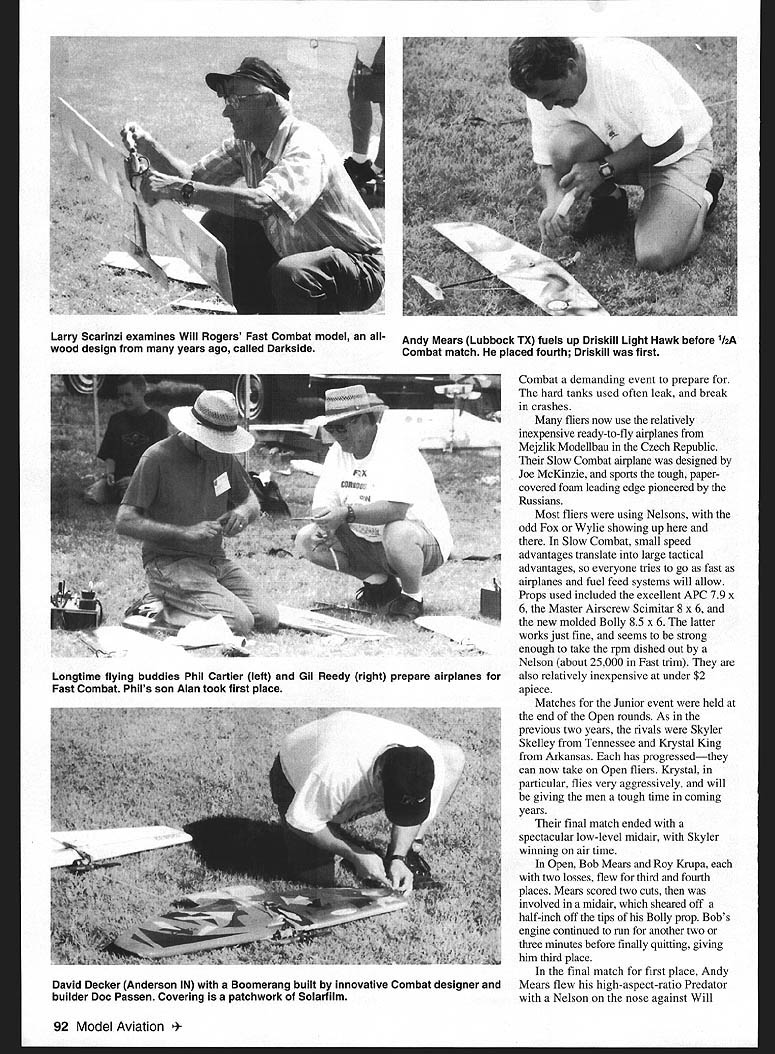
Matches: a Junior event was held, followed by the Open rounds. Rivals Skyler Skelley (Tennessee) and Krystal King (Arkansas) have progressed over the years and can now take on Open fliers. Krystal flies aggressively and will be a strong contender in coming years. The Junior final ended in a spectacular low-level midair, Skyler winning on air time.
Open highlights:
- Bob Mears and Roy Krupa, each with two losses, took third and fourth. Bob scored two cuts and then suffered a midair that sheared off about a half-inch from the tips of his Bolly prop; his engine continued to run for another two or three minutes and he finished third.
- The final for first place featured Andy Mears flying a high-aspect-ratio Predator with a Nelson on the nose against Will Rogers (flying a Flite Streak built from the Sterling kit with a Fox Mark 3). Andy’s Nelson screamed at more than 20,000 rpm compared with the Mark 3’s roughly 16,000 rpm, giving Andy a speed advantage. Andy scored the first cut (taking Will’s entire streamer), then engaged in a breathtaking three-minute close-following duel. Andy’s speed prevented Will from scoring any cuts; Will eventually crashed and Andy took the win.
- Note: in Slow Combat a "kill" is worth 100 points, not an outright win.
1/2A Combat
1/2A Combat began Wednesday morning. Larry Driskill is perhaps the most enthusiastic proponent of 1/2A Combat and brought a dozen or more airplanes, flying them all week and letting others try them. New this year was the VA Mark II engine, imported from Russia by Driskill; it sports a strengthened rod and was sold together with a head that accepted the Nelson plug for about $65. Many fliers used AME .049s and a few Cox Tee Dees as well.
Most competitors flew Driskill’s Lite Hawk design; it builds quickly, is easily repaired, and is sold as a kit. Bob Mears reported building a batch using 3M™77 spray contact cement for major construction and claims he can get a Lite Hawk airborne within four hours of opening the kit. From inside the circle, 1/2A is actually faster than Fast Combat because of the shorter lines. The consensus among competitors was to increase line length to 40 feet (or 42 feet to match Mouse Race). The main weakness of the event is engine starting—1/2A engines are finicky and often don’t start on the first flip. Most matches were decided on air time; few cuts were scored.
Jr./Sr. category:
- Skyler Skelley — 1st
- Krystal King — 2nd
- Gordon Wheeler (Peoria, IL) also competed
Final Open matches among Texans:
- Larry Driskill, Don Cranfill, and Bob Mears all entered the last rounds with one loss each.
- Driskill vs. Mears: simultaneous launches; each scored one cut, then Driskill scored a kill.
- Final match Driskill vs. Cranfill: simultaneous launches; Don scored a cut but Larry came back with a kill via a spectacular midair.
Final standings:
- Larry Driskill — 1st (his second win in three years)
- Don Cranfill — 2nd
- Bob Mears — 3rd
F2D Combat (Thursday)
F2D Combat originated in England and evolved in Europe; the rules differ from American forms. F2D specifies 2.5cc (.15 cu. in.) motors and normally allows two airplanes per pilot per match. At this event, Russian equipment dominated and inexpensive ready-built airplanes from the Czech Republic were used almost exclusively. Before flying began, competitors voted to limit each flier to one airplane per match. F2D rules allow for a one-minute starting period, so many matches began with simultaneous launches.
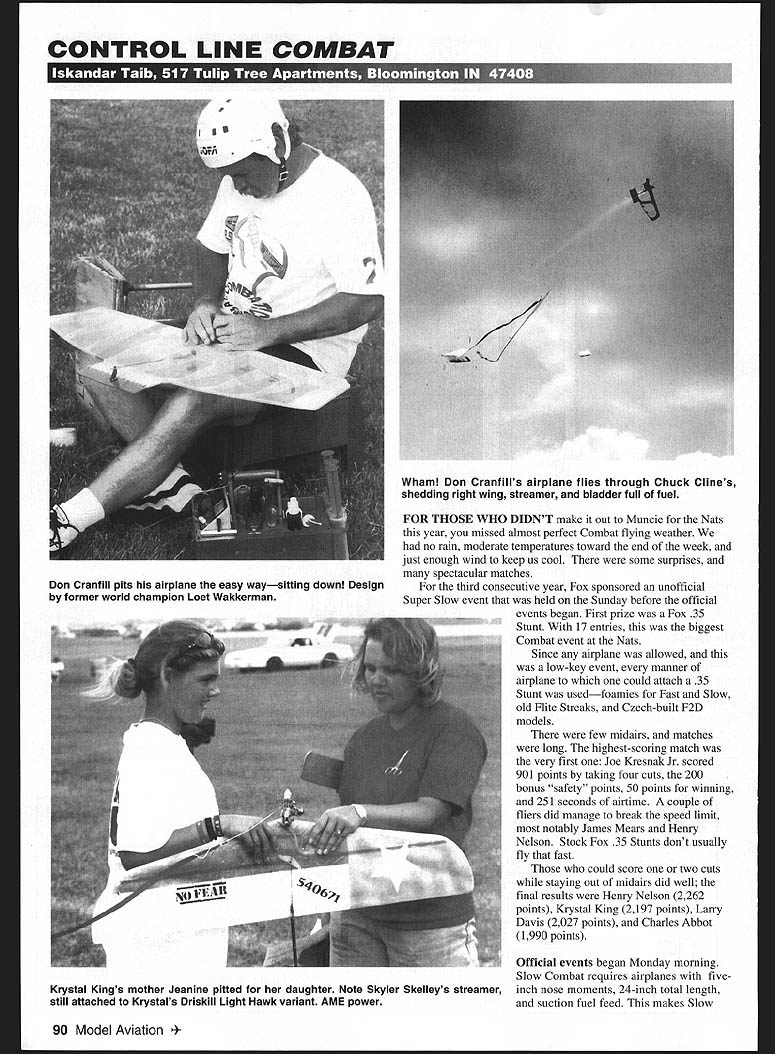
Don Cranfill flew matches without pitmen—he had a helper for launches (he called her "Loulita"), would start the engine during the starting period, walk to the center, don his safety thong, then yank on the lines at the signal to launch.
Notable incidents:
- Skyler Skelley vs. Roy Krupa: a line tangle led to a midair, after which Skyler’s engine stopped but Roy’s kept running. Roy’s airplane pulled Skyler’s around for about 20 seconds, getting lower and lower; Skyler’s airplane hit the ground three times before Roy’s finally pancaked.
- Muncie local Bob Craig built his own copies of Russian designs from dense extruded foam and surprised himself by winning first prize.
Final for first and second:
- Bob Craig — 1st
- Don Cranfill — 2nd
- Larry Skelley — 3rd
(For the final, Craig flooded his engine and couldn’t start; Don called for a refly because he didn’t want an uncontested win. The refly and subsequent flying went in Craig's favor.)
Fast Combat
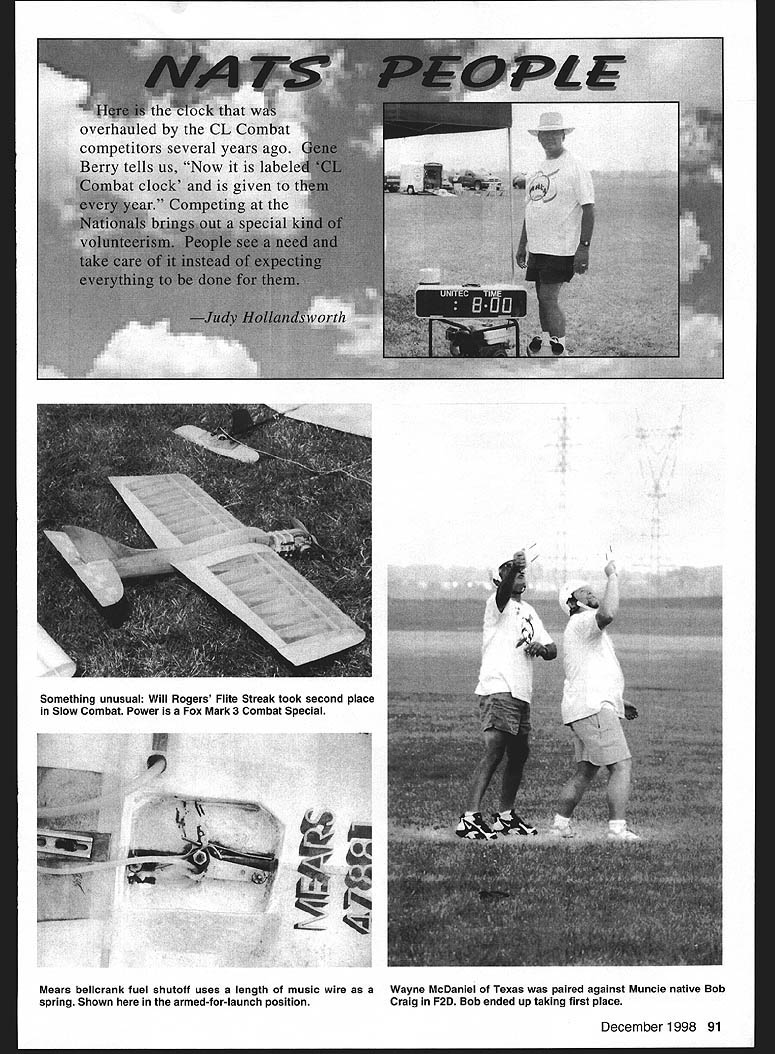
In Fast Combat, a "kill" (cutting the string and taking the entire streamer) is an outright win and matches are usually short. Without fuel-tank restrictions, high-pressure bladder tanks are used, allowing wide-open venturis. The fastest airplanes, equipped with Fox Mark 7s and Nelson .36s, easily hit 125 mph and turn on a dime at the end of 60-foot lines.
Will Rogers brought out some eye-catching airplanes, his take on the old Force design called the Darkside. Seeing them at the Nats with Mark 3s and Y&O propellers was a treat.
This meet was relatively clean—many matches ended quickly with kills rather than long midair-filled contests. Skyler and Krystal again vied for the Junior title; by agreement they flew F2D airplanes on 52-foot lines using Fast scoring. Skyler scored kills in two matches and took first in Juniors.
Top Open rounds:
- Three fliers—Alan Cartier, Larry Driskill, and Wayne McDaniel—reached a 6th round with 5-1 records. McDaniel and Driskill flew first; Driskill scored a 30-second kill. Alan then defeated Driskill (again) with a quick kill.
Final standing:
- Alan Cartier — 1st
- Larry Driskill — 2nd
- Wayne McDaniel — 3rd
Equipment note: the top three fliers used the Fox Mark 7 Combat Special. Fox had recently discontinued them, but John Lowry of Fox indicated that a Mark 8 would be introduced next year.
Transcribed from original scans by AI. Minor OCR errors may remain.

