
Control Line: Combat
Charlie Johnson
WHO'D HAVE thought a few years back that combat guys would fly clear across the country or off to Europe to attend a meet. The racing, speed and stunt fliers have been going to Europe for World Championships for years but that was reserved for the most professional fliers in our sport. Only until a few of us had ventured to the British Nationals and the World Championships in Holland did the idea of attending far-flung contests really catch on.
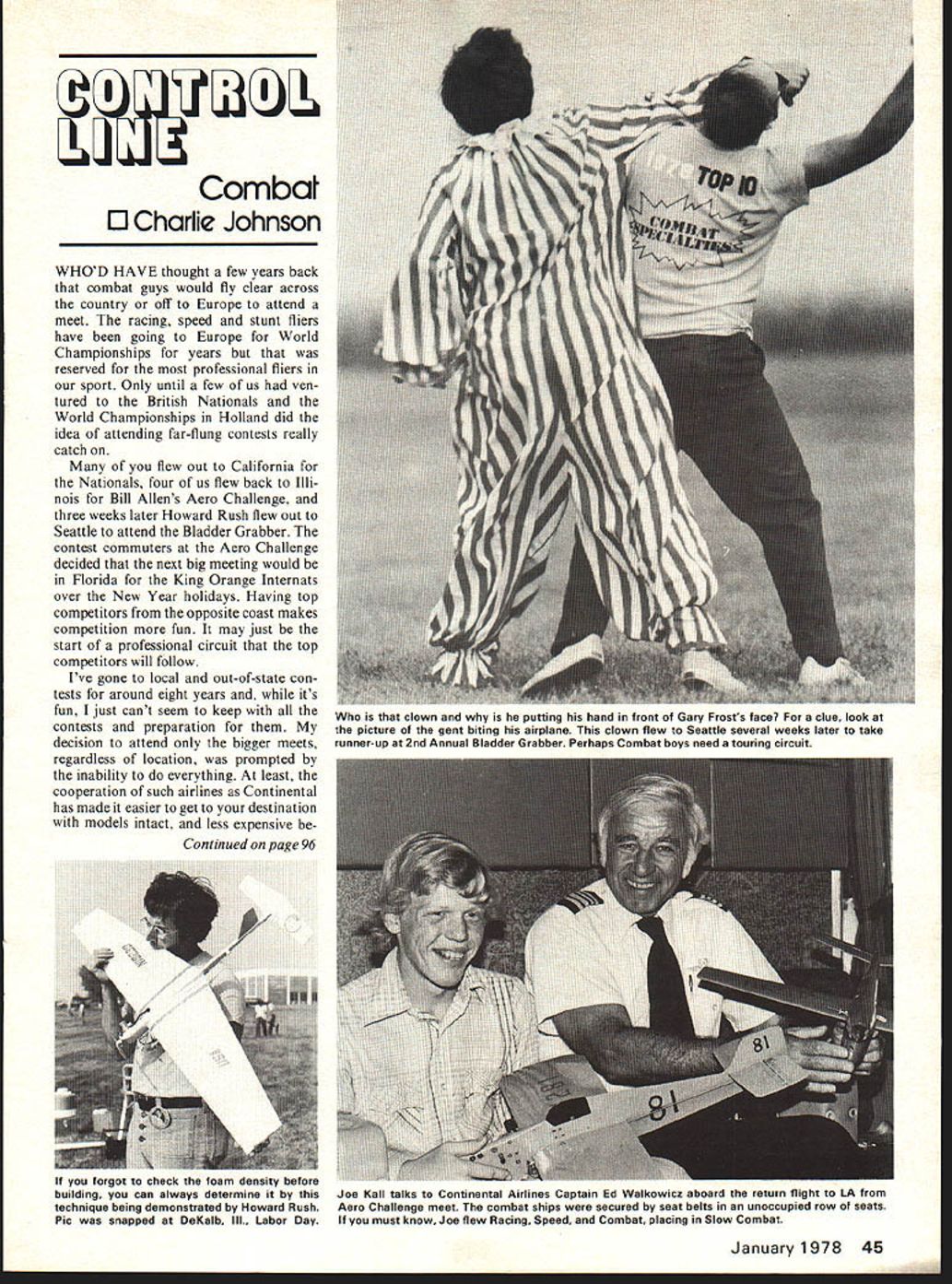
Many of you flew out to California for the Nationals, four of us flew back to Illinois for Bill Allen's Aero Challenge, and three weeks later Howard Rush flew out to Seattle to attend the Bladder Grabber. The contest commuters at the Aero Challenge decided that the next big meeting would be in Florida for the King Orange Internats over the New Year holidays. Having top competitors from the opposite coast makes competition more fun. It may just be the start of a professional circuit that the top competitors will follow.
I've gone to local and out-of-state contests for around eight years and, while it's fun, I just can't seem to keep with all the contests and preparation for them. My decision to attend only the bigger meets, regardless of location, was prompted by the inability to do everything. At least, the cooperation of such airlines as Continental has made it easier to get to your destination with models intact, and less expensive be- certainly alleviate some of the problems of local contests finding judges. There would probably be less cries of, "I got a raw deal at that contest!" if those very same complainers found out what it was to judge a whole day. We have all seen the contests that have to use the judge who sees only patterns once a year, or the contest where the judge is a scale freak and spends all day watching the scale circle during stunt flights. These fellows who are not active fliers and who don't watch patterns all year, have done as much to hurt stunt as those who refuse to help ever for a contest, even when it's in their own city. The writer feels that a total of three days of judging this last summer helped my pattern quite a bit, as the good and bad points of other patterns were seen over and over, and then compared to my flying.
A relatively small problem, in the writer's opinion, with the Categories is the sometime flier who either by choice or pure ignorance signs up for the wrong category. Evidences of this have been brought to the writer's attention since I am generally considered the PAMPA and Stunt News sounding board for gripes. It appears that most instances have been either pure ignorance of what was going on, or a lack of attention by the event director, or a reluctance to advance to the next higher category because of wide variance in recent scores of the competitor in question. The writer feels that there are few cases of "trophy hunters" although there will always be a couple of these fellows around.
Categories in the Nationals:
Yes, both PAMPA president Keith Trostle and the writer have received several letters wanting some form of categories for the Nationals. To legally get categories into the Nationals would be a lengthy and difficult process which probably would require regular legislation on the two-year rules' cycle. And, as of yet, the writer feels that our rather informal "PAMPA Category Rankings" might produce some real squabbles in administration at the Nationals. Let's face it, a 475 average flier in California may be a 520 flier in disguise in Georgia, or a 395 average flier in New Jersey may be a 475 average flier in Texas or Seattle. Counting first places? Yes, we could try that, but we would need about three to five volunteers (which RC usually can get, but controlliners don't seem to step up so readily) to keep track of fliers for about two or three year period. Al Rabe suggested having a "Sportsman" class at the Nationals, but an attempt to clearly define a "Sportsman" fell short of clarity and bordered on hearsay, etc.
We could generalize and state that a Sportsman was someone who has never qualified in the Nationals (in either Junior, Senior, or Open categories). Unfortunately, accurate records for all qualifiers go back to only about 1970, but it's certain that there would be enough old-timers present to question if somebody like Jim Kostecky, Harold Price, Gregory Zajack, or Dick Bishop showed up with a Nobler and a Fox 35.
Bob Reeves, Fruitland, Maryland, recently wrote in suggesting a different cutoff point for the four classes, based on his observation of too many advanced fliers in his area. He suggested the following breakdown: Novice—325 and under; Intermediate—326-445; Advanced—446-500; Expert—500 and over. He states that changing the Intermediate and Advanced points would help the "middle group" of fliers. The writer feels that, regardless of the actual point break, we have accomplished one of our goals with categories by getting more people to stick with the event, knowing that they can compete, generally speaking, with fliers of similar abilities.
All of this talk and words written is valueless without volunteers to pitch in and help with the PAMPA categories. Probably the greatest help would be for stunt fliers in local areas to volunteer to judge and direct the stunt contest, provided it used PAMPA categories. The writer is certain that if Norm Whittle or John Davis in the St. Louis area, or Al Rabe, or Bob Gieseke, in Texas, or Frank McMillan in Omaha, called up the CD and volunteered there would be little hesitation to accept.
cause of the new fares.
Aero Challenge for Muscular Dystrophy:
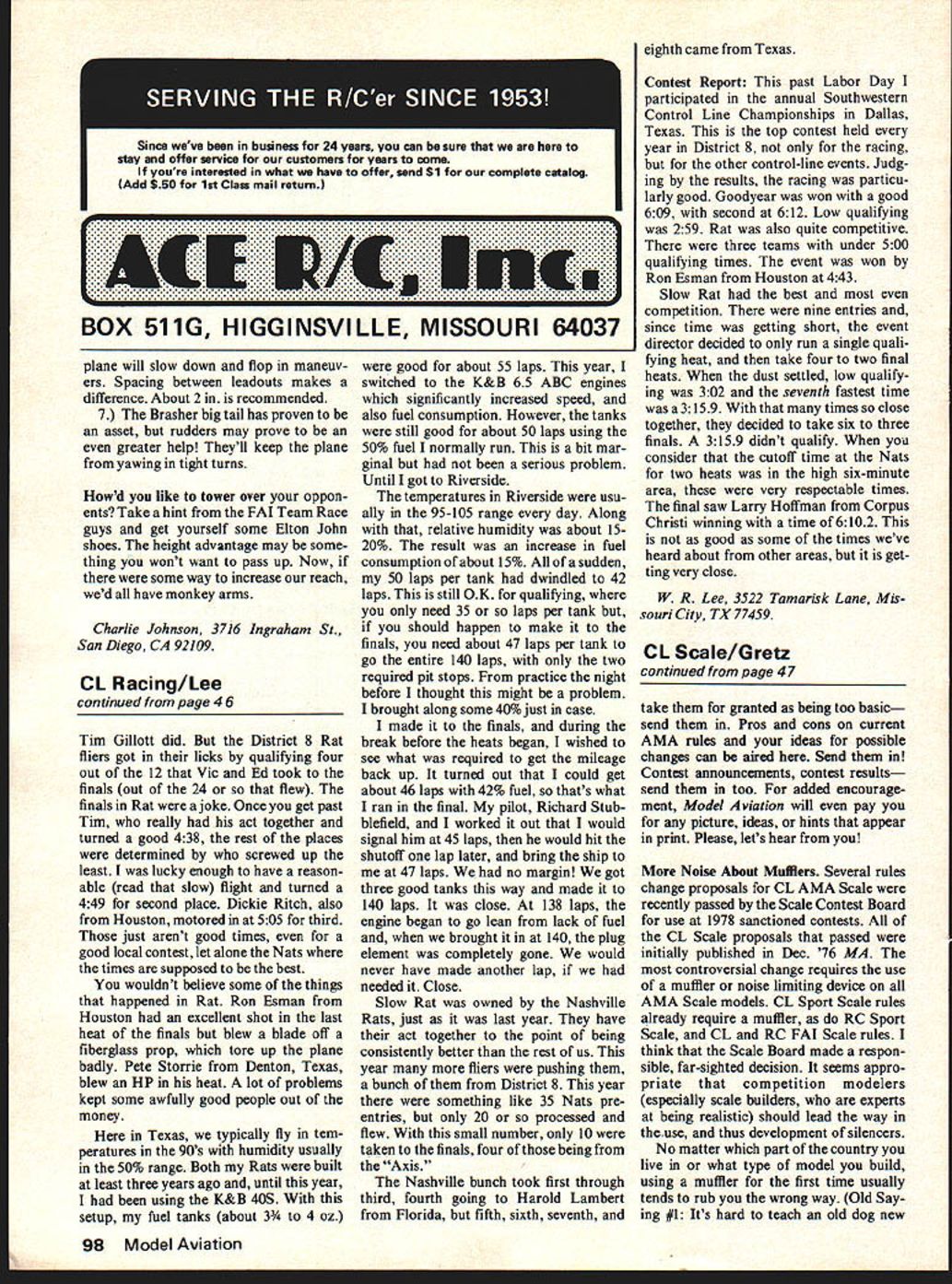
Bill Allen's Labor Day meet at DeKalb, Ill. ranks with the very best in the country. There were 127 contestants with around 88 making it to Bill's home for the dinner the night before. The site was fantastic, as was the competition, the final in Fast Combat being flown after dark due to heavy participation.
AMA Fast Combat was won by Bob Burch, with Paul Hoffman second, and Al Dippirio third. Slow Combat was taken in grand style by Paul Smith with a win over a very impressive Paul Curtis. Dick Imhoff took third. Jr./Sr. Slow was taken by Page Peterson, with Dan Reedy second and Joe Kall (a Californian) third. Fast Jr./Sr. was won by Page Peterson, with Bill Maywald second, followed by John Bryzys. Page also was awarded the Senior High Point Award.
Flying some very good matches, Bob Burch used his Bostas to win first place. Probably his best of the day was against Neal Rose, also flying a Bosta, and doing almost as many fakes and wiggles as Burch. This was the most FAI-appearing match, and a real credit to both pilots for lasting the five minutes without hitting the ground, or each other. Next year, Bill plans to spread out the activity over two days, with FAI and Slow on Saturday, and probably a double elimination Fast meet on Sunday.
Second Annual Bladder Grabber: Three weeks later at Seattle, Wash. found Howard Rush trying for over $2,000 in first prize stereo equipment from Phase Linear. Rich Brasher was having none of it and polished off Rush in the final after a super match. Brasher was on a strong winning streak after losing in the first round at the Nationals. Eight straight wins at the Condor Legion meet, eight more at the Los Angeles Skyburners meet, and finally eight straight in Seattle to relegate Rush to the $500 worth of goodies for second. Ex-Outlaw team member Chuck Thomas nabbed third, using his own design. Brasher used his familiar Rotation Station, and Rush had a long-tailed Nemesis, a leftover from DeKalb.
Duke Fox would like ideas for improving his latest combat engine. In the latest MACA Newsletter Gary Frost suggests that one area for considerable improvement, would be in the design of the metering system, to avoid having to stoke the engine so rich on the ground. Frost believes that a conventional spray bar arrangement with the jet pointing toward the crank, and enough restriction to increase air velocity without hurting power, would help.
It's been my experience with the Rossi that lowering the percentage of oil requires a leaner setting on the ground, just the opposite of what you'd expect. We usually run 16% in the Rossi and 18% in the larger engines, using straight Blendzall, unless the nitro content is over 40%, in which case NPG Synthetic is the choice. Most planes nowadays use a symmetrical fuel tank compartment, that is, it's directly behind the motor and not higher or lower. A definite change in mixture can be had by raising or lowering the compartment. Try strapping an old bladder tube on top of your Ringmaster and note the difference. Maybe asymmetrical fuel pods really are the hot tip.
There was much discussion about Paul Smith's ideas on the team selection program for the 1979 World Championships. Among them, the limiting of entries to 24 which would have been pre-qualified from previous contests, and a triple elimination system. Paul is one of a handful with good ideas on the subject, who has participated in the team selection program and been to a World Champs. Many people like to tell the participants how to do it when, in fact, they've never been anywhere, or know nothing about how other countries' team selection programs work. According to Paul, "They don't get the big picture." I'll have to agree.
Recently received a letter from Gene Pape, who is an Ex-San Diegan transplanted to the Northwest. Here are some of his thoughts on making foam airplanes:
1.) Even if you know how to build wooden planes well, it will take new procedures to make the foam ones go well.
2.) Straight wing airplanes are easier to build, but taper wing planes, like Rotation Station, fly better.
3.) Foam wings need a sheet tip plate, even if you are using conventional wing tips.
4.) The best way to make a bladder tube is to core out the outboard panel, plug the core at the length you want, and then slosh epoxy around inside for fuel-proofing.
5.) The cheapest covering is contact paper found at hardware stores. This plastic material shrinks at a lower temperature than Solar Film. Weight penalty for a 360 sq. in. plane is about 2 ounces.
6.) Wing tip weight is a necessary evil. Only experimenting will get the amount right. It can be bolted onto the tip plate for quick changes. Leadout position also is critical. If too far forward, the plane will be light all the time; if back too far, the
Control Line: Combat
plane will slow down and flop in maneuvers. Spacing between leadouts makes a difference. About 2 in. is recommended.
7.) The Brasher big tail has proven to be an asset, but rudders may prove to be an even greater help! They'll keep the plane from yawing in tight turns.
How'd you like to tower over your opponents? Take a hint from the FAI Team Race guys and get yourself some Elton John shoes. The height advantage may be something you won't want to pass up. Now, if there were some way to increase our reach, we'd all have monkey arms.
Charlie Johnson, 3716 Ingraham St., San Diego, CA 92109.
Transcribed from original scans by AI. Minor OCR errors may remain.

