
CONTROL LINE COMBAT
Rich von Lopez, 8334 Colegio Drive, Los Angeles CA 90045
I am writing this column in early December, and it is a bit cool here in Southern California. The guys have still been going out to the flying field every Sunday. I have missed a few Sundays because of my commitment to the American Youth Soccer Organization (AYSO). I decided to coach for a second year and it has taken quite a bit of time, but I can see the light at the end of the tunnel.
US Team Trials
This is a US team trials year, and the only bids that have been put forth are from Larry Skelley and Chuck Cline. Both bids use the AMA site in Muncie, Indiana; only the dates are different. The first is July 10–11, with the 12th as the rain date—the weekend before the AMA National Aeromodeling Championships (Nats). The second set of dates is August 23–24.
You will need to stay tuned to find out which one is selected; I suspect that the US team trials will be well-attended no matter when they are.
Equipment and Models
Right now there is so much good equipment available that almost anyone can buy a competitive fleet of ready-to-fly models at a very reasonable price. There is also quite a bit of used equipment out there; you just need to ask a few questions and make some deals. The quality of ready-to-fly models is so good that it does not pay to build your own unless you want to be a bit more picky about weights and strength of each model.
Chuck and Mark Rudner have their own fixtures for Russian-style models and are able to produce models that are lighter and stronger than the originals. They are, however, willing to put in the building time.
Top Gun Contest
Most of you will be reading this column early in March; the same time that the Cholla Choppers club in Tucson, Arizona hosts its Top Gun meet.
This contest is usually the first time that some of the nation's best control line combat fliers come out of hibernation, hungry for some fresh kills and in the mood for action. Others have been working diligently on new super-cool model designs, and are ready to test them in battle.
The Top Gun contest has been of top quality and well attended. It's a time to renew old friendships and get acquainted with new pilots from around the country. The dates are March 13–14.
Contact:
- Tom Thompson, 10741 East Avenida Hacienda, Tucson AZ 85748
- Tel: (520) 722-2747
- E-mail: TommyGunAZ@aol.com
This is the 10th annual Top Gun, and it promises to be better than ever. I suggest that you talk to a couple of flying buddies and come out to see the first real action of the year.
Howe Slow Combat Contest
It looks as though the sponsors and workers of the Howe Slow Combat Contest are going to take a well-deserved break in 1999 and not run the contest. It does become a big imposition on those officials, organizers, and their families to give up their Labor Day weekend year after year to officiate a contest.
Richard Howe is to be given a hearty "hip hip hooray" for all of his efforts in sponsoring this contest these past years. Someone else may need to take up the slack and start a contest of their own in order to keep Slow Combat alive and well.
I fly in many combat events, but Slow is one in which I have never taken an interest. 1/2A, FAI (Federation Aeronautique Internationale), Fast, and 80 are about as much as I care to do. Everyone has to make a choice as to what he/she wishes to participate in, and what gives the most satisfaction. The other concern is what is being flown in your area, and how many contests are within driving range.
Slow Combat has never had a strong following in California; therefore, we have never had Slow contests in the state. 80 mph, on the other hand, has one of the highest participation rates.
Rules and Safety
There have been many conversations — in person and via the Internet — about which direction Combat should be going. Do we change rules and reduce the number of events? Do we restrict Fast Combat or change the displacement limit on what can be used in Fast? All sorts of ideas have been put forth, but I believe that Fast Combat must remain untouched — kept in its unlimited state.
However, the safety proposals (fuel shutoffs) recently enacted will help the event rather than hurt it. It is imperative that we keep a clean and safe record in Combat so that flying sites will be made available to us, rather than be taken away. This is more of an urban problem than it is in one where there is a wealth of open land.
Many people have opinions on these matters; if they wish to air them out, a good forum would be the Miniature Aircraft Combat Association (MACA) newsletter: MACA News. The editors are always looking for interesting articles and original thoughts.
If you feel so inclined, write to the editor:
- Chuck Cline, 21445 Ruth, Farmington Hills MI 48336
- Tel: (248) 615-1469
- E-mail: Clinec@aol.com
Winter Maintenance Tips
Here are a few tips that may be useful if you have not flown any of your models during the winter.
- Inspect each model carefully before mounting an engine. Look for cracks in the spars, loose mounts, and tears in the covering.
- Czech models tend to blow the covering off if there is even a slight tear; check thoroughly.
- Replace any bladders from the previous season. They are cheap and should be changed on a regular basis. As an insurance measure, consider using a balloon over the surgical tubing.
- If a bladder breaks in a Czech model while in flight, without a balloon to hold the fuel, chances are good you will permanently damage the aircraft—fuel soaks into wooden ribs and will eat the foam in the leading edge.
- Bladders eventually develop weak or soft spots that cause a lean run in the middle of the flight. If the engine is good at the start, goes lean in the middle, then good again at the end, the bladder is weak.
- On Czech models, inspect the device that connects the pump rod to the control horn. These can break; the brass is thin and will split if overtightened.
- I no longer use the devices that come with the models; I substitute Du-Bro wheel collars with a 1/4-inch 4-40 cap screw.
- For models using threaded rods with a clevis, make sure the small piece of tubing over the clevis has not developed cracks; replace if in doubt.
- If an engine has been in storage during the winter, remove the needle valve and flush out the spray bar before attempting to run it to get rid of coagulated oils.
- If you use fuel filters, clean them before the first flying session of the year.
- Ensure there is oil in the bearings before starting an engine. Pop the dust cover/drive washer off to get at the front bearing and clean it with 3-in-One if it is dry.
- Oil the intake and exhaust and flip the engine over several times to distribute oil. The engine may be tougher to start, but its life will be extended.
- Inspect all syringes; the rubber tip on the end of the plunger is the part that will go bad.
- Go through glow plugs to see which are exhausted and which are strictly for practice. Plugs that have to be "primed" should be placed in the nose of the plug if they will not prime in flight.
- I like plugs with a small hole drilled in the center, as they are easy to prime with a short length of fuel line. My rule is that there will be no used plugs in my field box for contests.
- Check your handles to see if the leadout wires are in good shape. You don't want to crash a model because a frayed wire broke.
- Inspect all lines and discard those with kinks or significant wear.
Engines, Restrictors, and Mounting
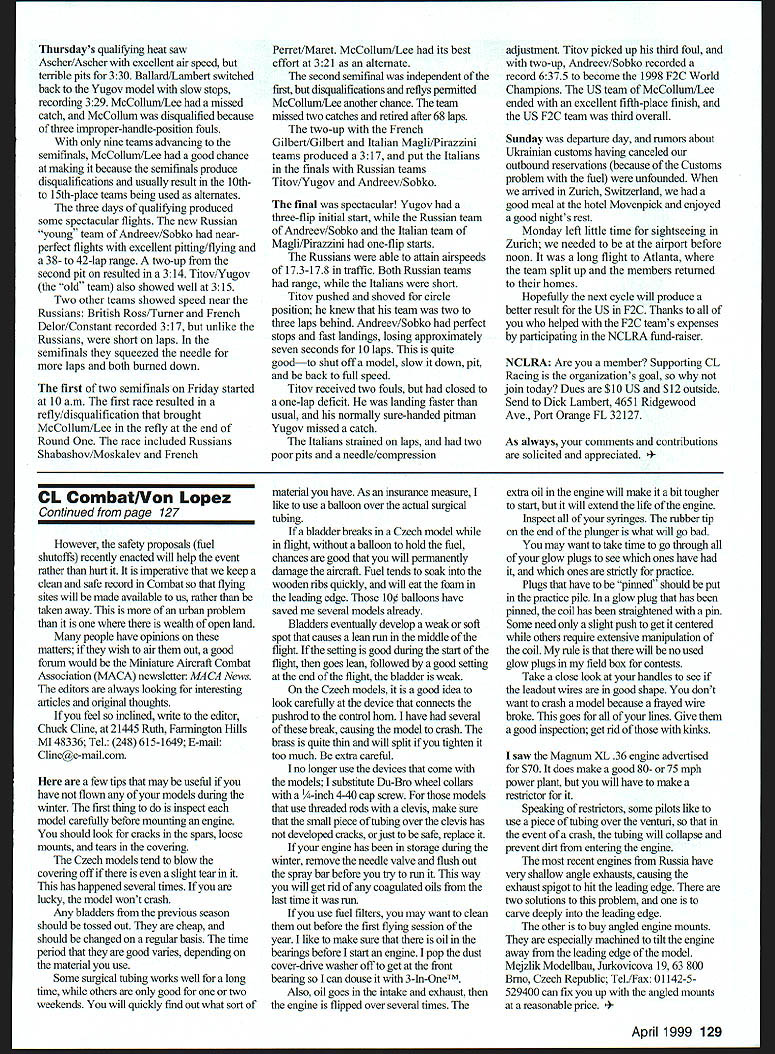
I saw the Magnum XL .36 engine advertised for $70. It does make a good .80- or 75-mph power plant, but you will have to make a restrictor for it.
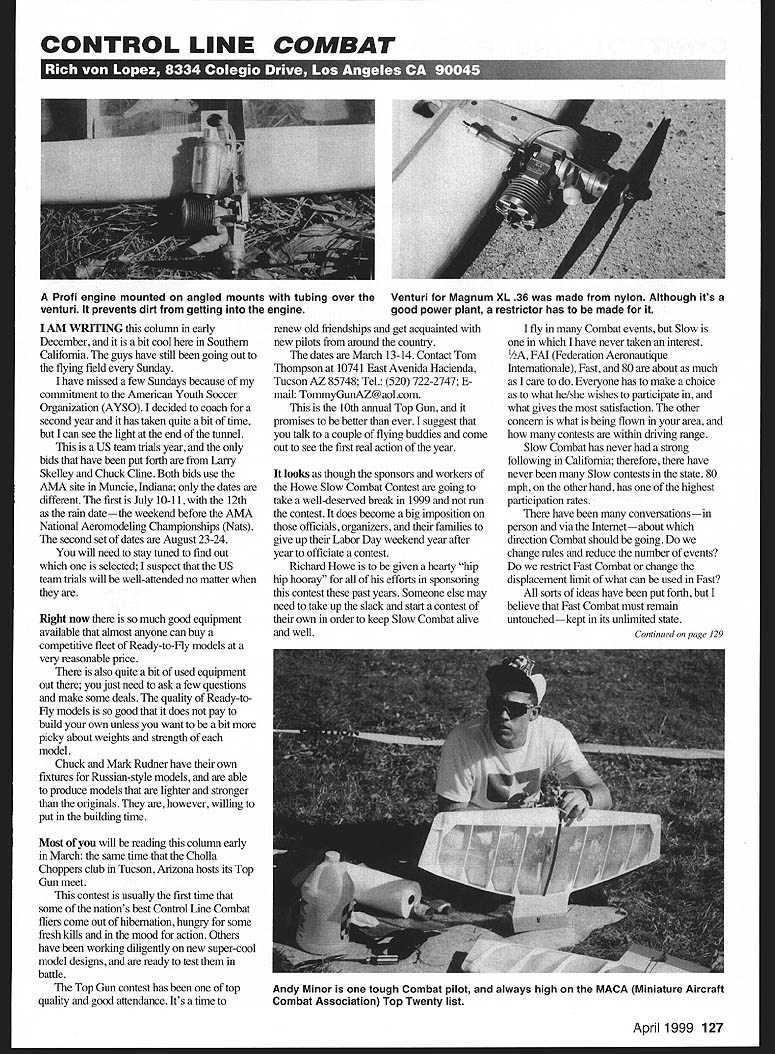
Some pilots like to use a piece of tubing over the venturi so that in the event of a crash the tubing will collapse and prevent dirt from entering the engine.
The most recent engines from Russia have very shallow-angle exhausts, causing the exhaust to spit hot oil into the leading edge. There are two solutions to this problem:
- Carve a deeper lip into the leading edge of the wing.
- Buy angled engine mounts. They are made to tilt the engine away from the leading edge of the wing.
Mephlik Modelbau can supply angled mounts at a reasonable price:
- Mephlik Modelbau, Jurkovicova 19, 63 800 Brno, Czech Republic
- Tel./Fax: 011-42-5-529400
Transcribed from original scans by AI. Minor OCR errors may remain.

