
CONTROL LINE COMBAT
Rich von Lopez, 8334 Colegio Dr., Los Angeles CA 90045
I have been thinking about the number of Control Line (CL) Combat kits that are available at hobby shops, and have come to the conclusion that there are no modern kits to be found.
The only kits that you may see are something like a VooDoo or a Lil' Satan by the Carl Goldberg company. I cannot recall the last time I saw one of these kits in a hobby shop. This becomes a real problem in exposing potential modelers to our hobby. Most hobby shop owners these days know little, if anything, about CL Combat.
It is also rare to find model airplane clubs operating out of the back of a hobby shop whose owner is a modeler; they can still be found, but you really have to look for them. When I started flying in the early 1960s in San Francisco, it was a given that each hobby shop sponsored a club to some extent.
Local hobby shops and clubs (San Francisco, early 1960s)
- Franciscan Hobbies hosted the San Francisco Airplanes and the San Francisco Vultures.
- Zaharis Hobbies hosted the San Francisco Piston Poppers.
- Pat's House of Hobbies was home to the Coastside Gypsy Moths, Komets, and later the Flying Tigers.
- Robbie's Hobbies hosted the San Francisco Flying Tigers.
- Two other shops (names I can no longer remember) hosted the Aero Knights of San Francisco and the San Francisco Ravens.
This trip down memory lane is to illustrate the support network that existed for an interested window-shopper. Models were hung in the windows and from the ceiling of each shop; this gave a prospective modeler, young or old, a point of contact.
Newcomers were welcome at club meetings, and they were offered help with their projects. Pat's House of Hobbies had a full machine shop in the back room, and Pat was quick to offer suggestions on how to make a project better.
When you had an active club, there were modelers hanging around the shop ready to help new customers, because they might have been prospective club members. As Combat enthusiasts, we need to find ways to recruit new modelers and get them the help they need to get started.
This hobby certainly has plenty of how-to books and videos for Radio Control; the books on building techniques help with any project. Learning to do something from a book is usually more difficult than having a person show you how to do it. Learning how to use a computer from a book is quite different from learning how to build a model from a book.
Model building requires a considerable amount of feel; sanding, carving, and shaping require a great deal of practice, and much trial-and-error goes along with working with foam and other materials. This is where an experienced modeler can train the novice and give extra guidance.
I don't have the solution to the diminishing number of clubs and hobby shops where a novice can go for help. However, I can recommend that each of us give the curious spectator a bit of our time to explain what we are doing, and perhaps inquire if they are interested in becoming part of the hobby.
If they answer yes, that is your cue to invite them over for a building session or to the flying field. You never know who will turn out to be a new flying partner or a person quite successful at getting new people started.
Kits and kit makers
Greg Carter at one time produced the Allanplane kit. I did a kit review some time ago and gave some positive comments. Greg has since moved into full-time business in the auto-repair area, but still enjoys flying and does get out to the field like he used to. Greg used some elaborate computerized foam-cutting equipment to produce accurate wing cores. Kits have been available for some time now.
Along came Bill Maywald with the idea that he could take over kit production and distribution. I don't know the exact arrangement Bill made with Greg to acquire foam-cutting equipment, stock parts, and whatever will benefit Combat as a whole. The first batch of 100 kits was boxed January 1999. Bill wants things done right, and the new Allanplane kits are the same high standard as the ones produced by Greg.
For those of you who are unfamiliar with the Allanplane, it is named after its designer (Allan Deveau, a Combat pilot of considerable success). This model is designed for Fast and 80 mph Combat. It features an external bellcrank so that it easily adapts to the Bobby Mears bellcrank shutoff.
The original price of the Greg Carter Allanplane was $30, and the Bill Maywald Allanplane will be $30. Bill also has many metal engine mounts for $15 a set that are specially designed for the models. Call him at (909) 280-9720 to find out where to send your money.
Bill is an excellent machinist, and has displayed his expertise by making unbreakable replacement mounts for the Cyclon PC-2 .15; these sell for $15 a set. I highly recommend that you build one of Bill's models if you want to get started; they almost fall together.
Larry Driskill also makes kits, but his are of the 1/2A variety. He calls them Lite Hawks. I have flown this design, and it is quite stable, yet very responsive. Contact Larry at Kitting It Together, 6806 Third St., Lubbock TX 79416; Tel. (806) 796-3747; E-mail: KIT@LLANO.NET.
Larry also has the new .049 MK 2 engines available. Give him a call and find out what else he can help you out with; you never know what secrets an old U-2 fan has up his sleeve.
Larry is one of the top 1/2A people in the country, and has learned how to make little engines scream for mercy and not blow apart. You may just want to take his advice and save yourself some time on the learning curve.
The easiest option a new flier has is to call on Tomas Mejzlik of Mejzlik Modelbau and order a bunch of Ready-to-Fly models. This option is good if you want to fly, and are not too terribly interested in learning about model building.
I like to build and fly, and the Mejzlik models afford me the opportunity to fly every weekend and free up time in the shop to build some of my favorite designs.
Most of these models, however, are designs taken from world champions, and have the responsiveness to match; they may be a bit much for the new kid on the block.
Tomas is located at Jurkovicova 19, 638 00 Brno, Czech Republic; Tel.: 011-420-5-45-222-768; E-mail: Mejzlik@brno.comp.cz. Call or write to get a catalog so that you can check out all of the other neat stuff he has for sale.
Events and history
As I write this, the Tucson Top Gun contest is weeks away, and many pilots are busy preparing to have a go in this season-opener.
The Cholla Choppers Model Club has consistently put on a well-run competition with competent judges and a friendly atmosphere. Since the 1999 edition of the Top Gun will be the 10th annual, it promises to be the best one yet.
Combat history is something that no one has really taken the time to write about, and as the years pass by, some of the information will get distorted a bit. I am sure that those old models fly much faster now than they really did then.
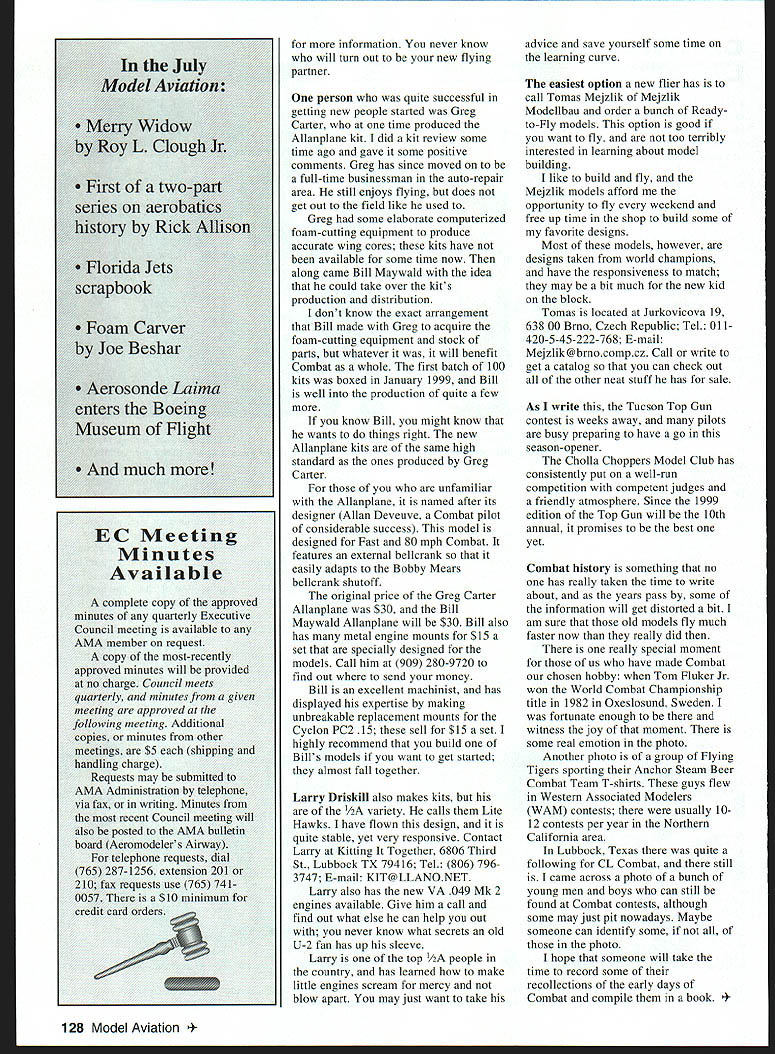
There is one really special moment for those of us who have made Combat our chosen hobby: when Tom Fluker Jr. won the World Combat Championship title in 1982 in Oxelosund, Sweden. I was fortunate enough to be there and witness the joy of that moment. There is some real emotion in the photo.
Another photo is of a group of Flying Tigers sporting their Anchor Steam Beer Combat Team T-shirts. These guys flew in Western Associated Modelers (WAM) contests; there were usually 10–12 contests per year in the Northern California area.
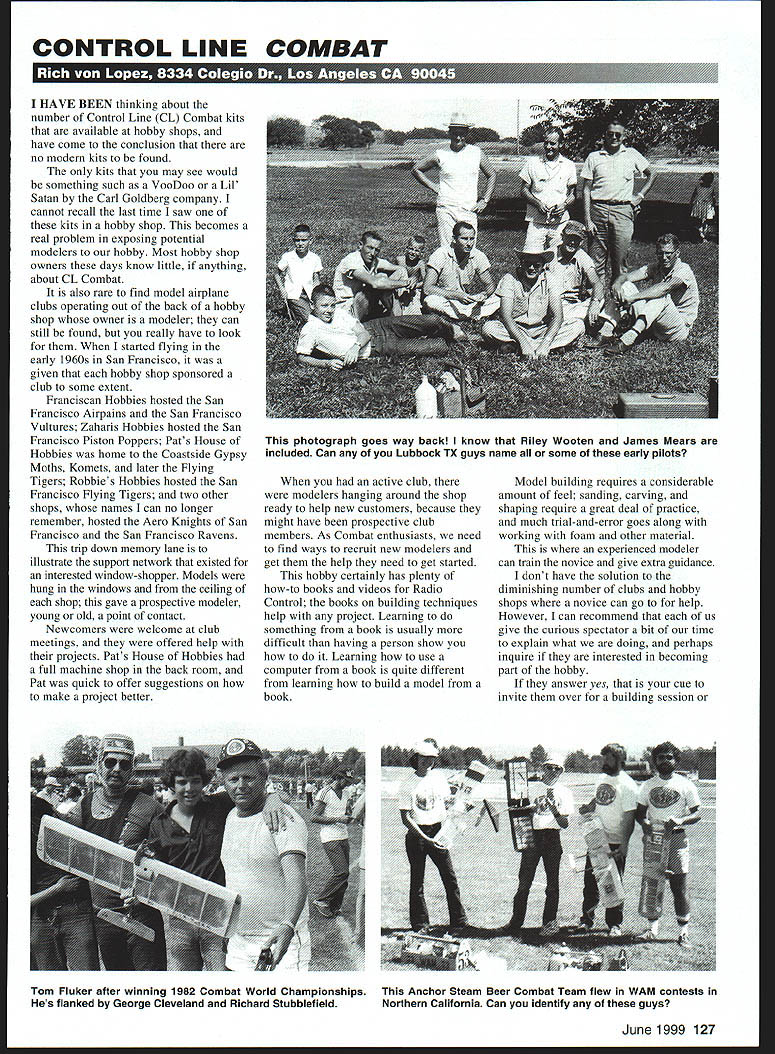
In Lubbock, Texas there was quite a following for CL Combat, and there still is. I came across a picture of a bunch of young men and boys who can still be seen at Combat contests, although some may just be parents now. Maybe someone can identify some, if not all, of those in the photo.
I hope that someone will take the time to record some of their recollections of the early days of Combat and compile them in a book.
Transcribed from original scans by AI. Minor OCR errors may remain.

