
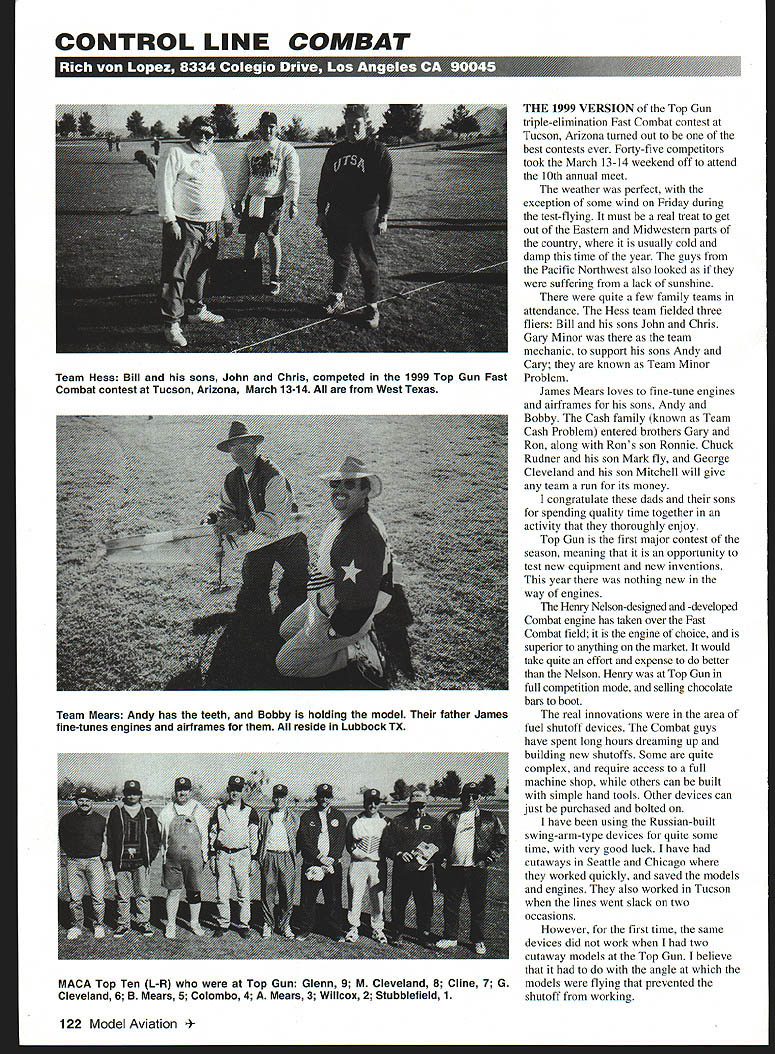
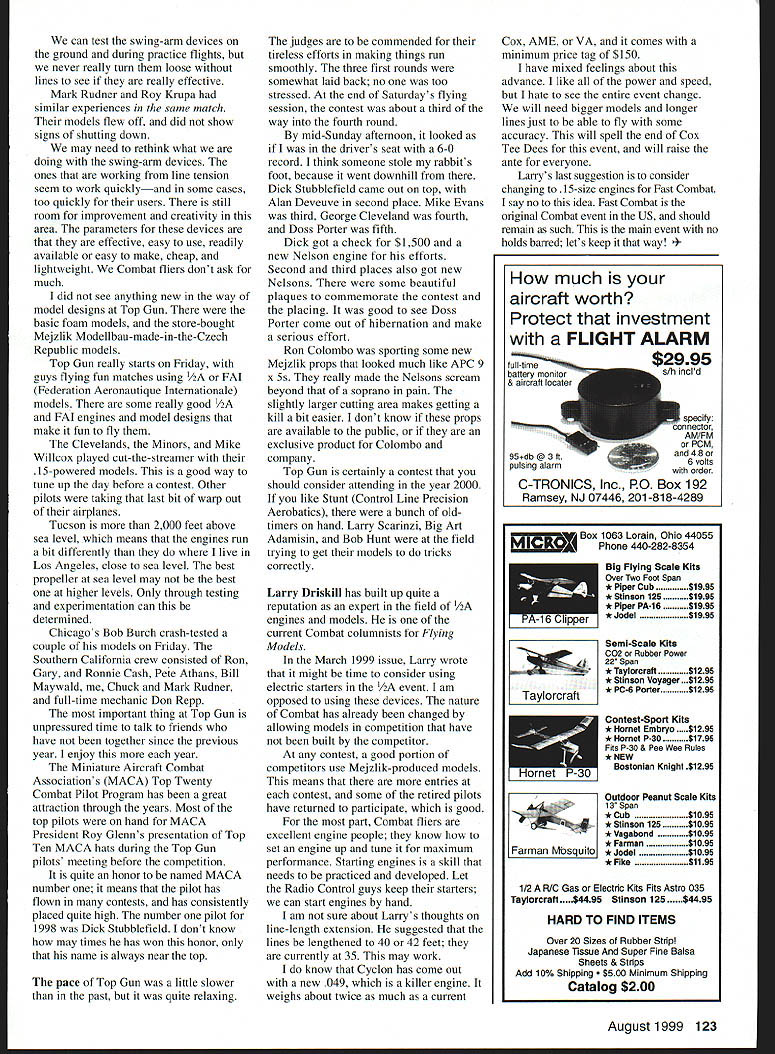
CONTROL LINE COMBAT
Rich von Lopez 8334 Colegio Drive, Los Angeles CA 90045
Event overview
The 1999 version of the Top Gun triple-elimination Fast Combat contest at Tucson, Arizona, turned out to be one of the best contests ever. Forty-five competitors took the March 13–14 weekend off to attend the 10th annual meet. The weather was perfect, with the exception of some wind on Friday during test flying.
Top Gun is the first major contest of the season, an opportunity to test new equipment and inventions. This year there was nothing new in the way of engines, but there were innovations in fuel shutoff devices.
Teams and participants
There were quite a few family teams in attendance, including:
- The Hess team: Bill Hess and his sons John and Chris.
- Team Minor Problem: Gary Minor (mechanic) supporting his sons Andy and Cary.
- James Mears with sons Andy and Bobby.
- Team Cash Problem: brothers Gary and Ron Cash, and Ron's son Ronnie.
- Chuck Rudner and his son Mark Rudner.
- George Cleveland and his son Mitchell Cleveland.
Other attendees included the Southern California crew: Ron, Gary, and Ronnie Cash; Peje Athans; Bill Maywald; Chuck and Mark Rudner; with full-time mechanic Don Repp. Chicago's Bob Burch was also present.
Top Gun also drew a number of retired pilots and old-timers interested in Stunt (Control Line Precision Aerobatics), such as Larry Sarazin, Big Art Adams, and Bob Hunt.
Equipment and innovations
- Engines: The Henry Nelson-designed Combat engine has taken over the Fast Combat field and is the engine of choice. Henry Nelson attended Top Gun in full competition mode (and was selling chocolate bars).
- Fuel shutoff devices: The main innovations this year were in shutoff devices. Combat fliers spent long hours designing and building new devices. Some require a full machine shop, others can be made with simple hand tools, and some can be purchased and bolted on.
I have used Russian-built swing-arm-type shutoffs with good luck in the past; they worked quickly in cutaways in Seattle and Chicago, and also saved models and engines in Tucson when the lines went slack on two occasions. However, for the first time at Top Gun, the same devices failed to work on two cutaway models. I believe the angle at which the models were flying prevented the shutoff from engaging.
Mark Rudner and Roy Krupa had similar experiences in the same match: their models flew off and did not show signs of shutting down. We may need to rethink what we are doing with swing-arm devices.
Parameters for effective shutoff devices:
- Effective and reliable
- Easy to use
- Readily available or easy to make
- Inexpensive
- Lightweight
Swing-arm devices that rely on line tension seem to work quickly—and sometimes too quickly. There is still room for improvement and creativity in this area.
Models and props
I did not see anything new in model designs. The field had basic foam models and store-bought Mejzlik (Modellbau — made in the Czech Republic) models.
Ron Colombo was using new Mejzlik props that looked much like APC 9x5s. They made the Nelsons scream and slightly increased the cutting area, which can make getting a kill easier. I do not know if these props are available to the public or exclusive to Colombo and company.
Practice, altitude, and prop selection
Top Gun activity often starts Friday with fun matches using 1/2A and FAI models. Some highlights:
- The Clevelands, the Minors, and Mike Willcox ran cut-the-streamer with .15-powered models as a tune-up.
- Other pilots spent practice time removing warp and refining their airplanes.
- Chicago's Bob Burch crash-tested a couple of models on Friday.
Tucson is about 2,000 feet above sea level, so engines run differently than at sea level. The best propeller at sea level may not be best at higher elevation; only testing and experimentation will determine the optimum setup.
Contest flow and judging
The pace of Top Gun was a little slower than in past years and quite relaxing. The judges deserve credit for tireless efforts in making things run smoothly. The first three rounds were laid back; by the end of Saturday the contest was about a third of the way into the fourth round.
By mid-Sunday afternoon I was 6–0, but the results shifted. Final top placings were:
- Dick Stubblefield — first place (received $1,500 and a new Nelson engine)
- Alan Deveau — second place (received a Nelson engine)
- Mike Evans — third place (received a Nelson engine)
- George Cleveland — fourth place
- Doss Porter — fifth place
There were also commemorative plaques for placing. It was good to see Doss Porter make a serious effort after a long break.
MACA Top Twenty
The Miniature Aircraft Combat Association's (MACA) Top Twenty Combat Pilot Program continues to attract interest. Most top pilots retain their MACA numbers. MACA President Roy Glenn presented Top Ten MACA hats during the Top Gun pilots' meeting before the competition, an honor recognizing pilots who have flown many contests and consistently placed high. Dick Stubblefield has frequently been near the top.
Opinions and recommendations
- Electric starters: Larry Driskill, a current Combat columnist for Flying Models and an expert on 1/2A engines and models, suggested considering electric starters for the 1/2A event. I oppose this idea. Starting engines by hand is a skill that should be practiced and preserved. Allowing electric starters would further change the nature of Combat, which has already shifted by allowing store-bought models (e.g., many competitors use Mejzlik-produced models).
- Line length: Larry also suggested lengthening lines to 40 or 42 feet from the current 35 feet; this may work, but I am not certain.
- New engines and sizes: Cyclon has introduced a new .049 that is powerful but heavy and expensive (around $150). I have mixed feelings: the power is attractive, but it may force bigger models and longer lines, end the use of Cox Tee Dees for the event, and raise costs for everyone. Larry's suggestion to change Fast Combat to .15-size engines is also opposed; Fast Combat is the original U.S. Combat event and should remain so.
Conclusion
Top Gun is a contest well worth attending. Beyond competition, the most important aspect is the unpressured time to talk with friends and enjoy the camaraderie. Consider attending Top Gun in 2000.
Transcribed from original scans by AI. Minor OCR errors may remain.

