
CONTROL LINE: Combat
Rich von Lopez, 8334 Colegio Drive, Los Angeles CA 90045
A subject of conversation on the Internet revolves around the notion of allowing electric starters in the 1/2A event. Some pilots have spoken of allowing these devices in all of the Combat events. There are many opinions on the subject, ranging from full to limited use, to use at the discretion of the event director.
At the root of this talk is the frustration of trying to get 1/2A engines started during contests, or for that matter, during practice sessions, and the desire of some to have actual flying ability determine the outcome of each match.
When I began model-flying, there was the builder-of-the-model rule: in order to compete, you had to build your own models. Those who drew up the rule no doubt believed that the hobby's goal was the development of all-around modelers, who were creative and innovative. The competitions were mere forums to test one's ideas and inventions.
As a result of the builder-of-the-model rule, I was forced to learn about adhesives, the characteristics of balsa, spruce, bass, pine, plywood, and other woods, and covering techniques with silk, tissue, and later, Mylar films. Builders also needed to know how to use power tools and hand tools to build true lightweight models.
To complement the building aspect, modelers needed to learn about engines and fuels. Engines 35 years ago were not the same quality as today.
Veteran (a mild term for old) Combat pilots will tell you about the good old days of engines such as:
- Fox Rockets
- Johnson Combat Specials
- Veco Combats
- O.S. Max Combats
- SuperTigre G21-35s and Combats
You will hear how well these engines ran, and how many matches were won with them. You will also learn that these engines were sometimes cantankerous and prone to breaking. Some had needle valves that would not hold a setting.
Johnsons were notorious for blowing fabric gaskets out at critical moments. Fox engines tended to be kits that required many aftermarket parts for some consistency of operation. The SuperTigres of the past regularly blew cranks, rear main bearings, and an occasional rod. The Cox .049s and .051s consistently blew ball-and-socket joints, crankshafts, rods, cases, and glow plugs with amazing regularity.
Equipment is considerably better now; the only broken Nelson parts that I have are glow plugs. Russian and Ukrainian FAI (Fédération Aéronautique Internationale) engines are made of outstanding metals, and if treated with some kindness run almost indefinitely.
The current 1/2A engines are more reliable than the Cox Tee Dees, but they can still be difficult.
Back to the subject of allowing electric starters. Today's equipment is much better than in the good old days, and those who have been to a Fast Combat contest can attest to the remarkable starting ability of the Nelson Combat Special. Time after time, you will see one-flip starts. No other form of aircraft modeling can boast this accomplishment.
The FAI engines are almost as good for the most part, but the little muffling canister can hinder starting ability. The 1/2As still require "touch." Some have this touch, and others never will; most of us are somewhere in between.
I like the fact that a pilot needs to know how to start an engine and needs to spend time developing a technique. One reward of developing a technique is an occasional air-time win. If you have moderate ability in starting an engine, you will get up in the air, and still have the opportunity to wiggle the handle at the correct instant to get the ever-elusive kill.
What has to be considered here is whether or not to take away the engine-handling aspect of the hobby. The model-building aspect has been eliminated, which has allowed more people to participate in this dying segment of the hobby. I like to see many people at contests, and I don't mind that some of the models are store-bought. I don't like the fact that a youngster may never learn all the subtleties of building models and the proper use of tools.
We can probably live without electric starters.
Many people are still trying to figure out what to do about 75 or 80 mph Combat.
I have grown to love the 80 mph event; it is simple, and it gives participants the freedom to select from a variety of equipment—none of which needs to be expensive.
There was an 80 mph contest at Whittier Narrows June 5–6, in which there were 11 entries. It was a laid-back contest with good flying. This is what was intended when the idea of Slow Combat came about.
Fuel shutoffs were required for this contest, but we did not see how effective they were since there were no flyaways.
Results:
- Gary Cash — first place
- Pete Athans — second place
- Rich von Lopez — third place
Repaired Fast Combat models work very well for 80 mph, but might not be trusted for Fast. The key to the 80 mph event is finding the right size venturi opening and the correct propellers. Once you find what works, it is just a matter of flying.
If you are starting from square one, begin with a very small venturi opening and some sort of 9x4 prop. Check the speed; if it is too slow, drill out the venturi a little at a time. If you have a full spray bar running through the venturi, you can file metal off both sides to let more air in the venturi.
That is what I did with my old K&B ringed .35s. The engines ran very well, but they were heavy, and did not want to start when they were hot, or on hot days. I resorted to putting ice on them between runs, or dousing them with water if they had to be restarted during a match.
Many of the contestants like to use O.S. Max FF .35s because they are cheap and light. Several pilots at Whittier Narrows used old Fox diesel engines, and others used Magnum XL .35s with good results.
Doss Porter came down from the flatlands of Fresno CA and wore himself out trying to start a SuperTigre G21 with loose head bolts. Doss works as a refrigeration engineer, and he claims that cooling units work best if their head bolts are loose; he figured that model engines worked on the same principle.
There were old foam models and some store-bought Czech models in the competition. Bill Maywald was present with Allplane kits for sale. He informed me that he is now the editor of the Miniature Aircraft Combat Association (MACA) newsletter. Bill will do an excellent job, and with the help of the Combat fraternity writing an occasional article, will put out a quality product that will be informative and creative.
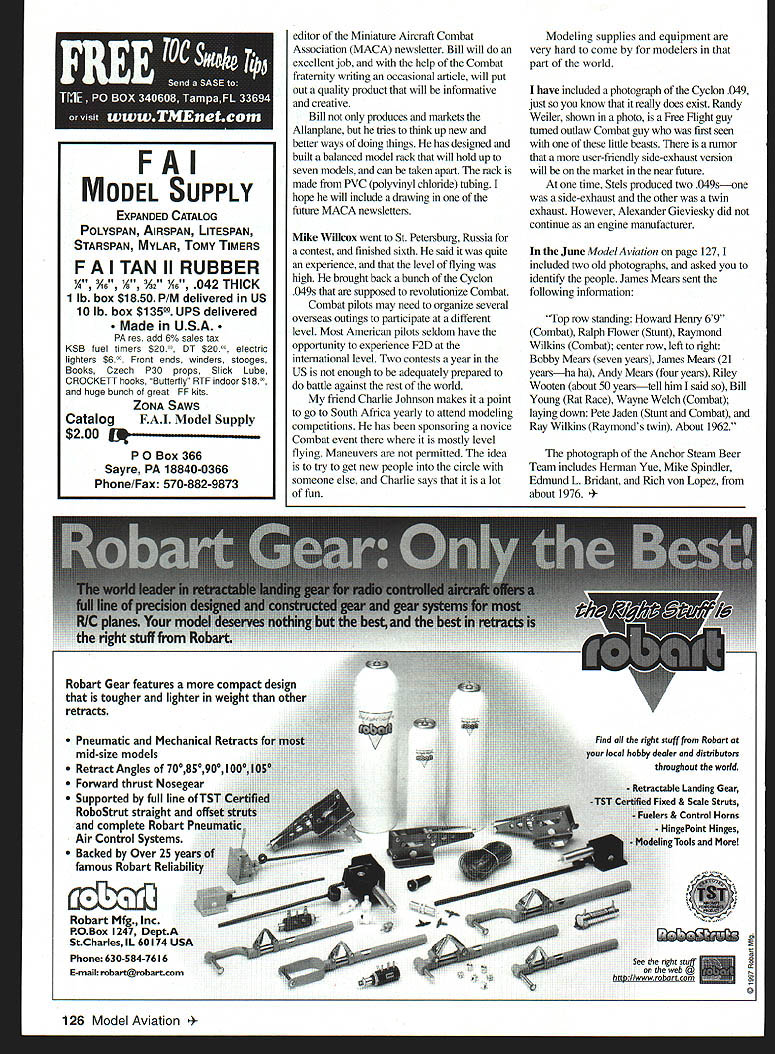
Bill not only produces and markets the Allplane, but he tries to think up new and better ways of doing things. He has designed and built a balanced model rack that will hold up to seven models and can be taken apart. The rack is made from PVC (polyvinyl chloride) tubing. I hope he will include a drawing in one of the future MACA newsletters.
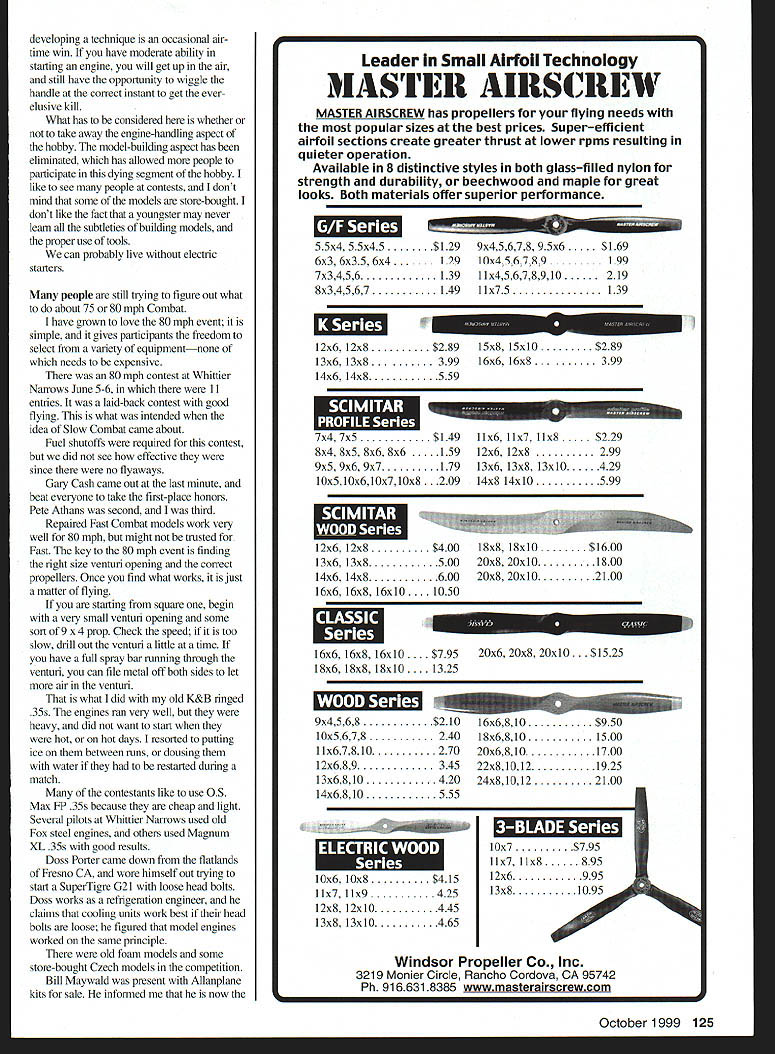
Mike Willcox went to St. Petersburg, Russia for a contest and finished sixth. He said it was quite an experience and that the level of flying was high. He brought back a bunch of the Cyclon .049s that are supposed to revolutionize Combat.
Combat pilots may need to organize several overseas outings to participate at a different level. Most American pilots seldom have the opportunity to experience F2D at the international level. Two contests a year in the US are not enough to be adequately prepared to go head-to-head against the rest of the world.
My friend Charlie Johnson makes it a point to go to South Africa yearly to attend modeling competitions. He has been sponsoring a novice Combat event there where it is mostly level flying. Maneuvers are not permitted. The idea is to try to get new people into the circle with someone else, and Charlie says that it is a lot of fun.
Modeling supplies and equipment are very hard to come by for modelers in that part of the world.
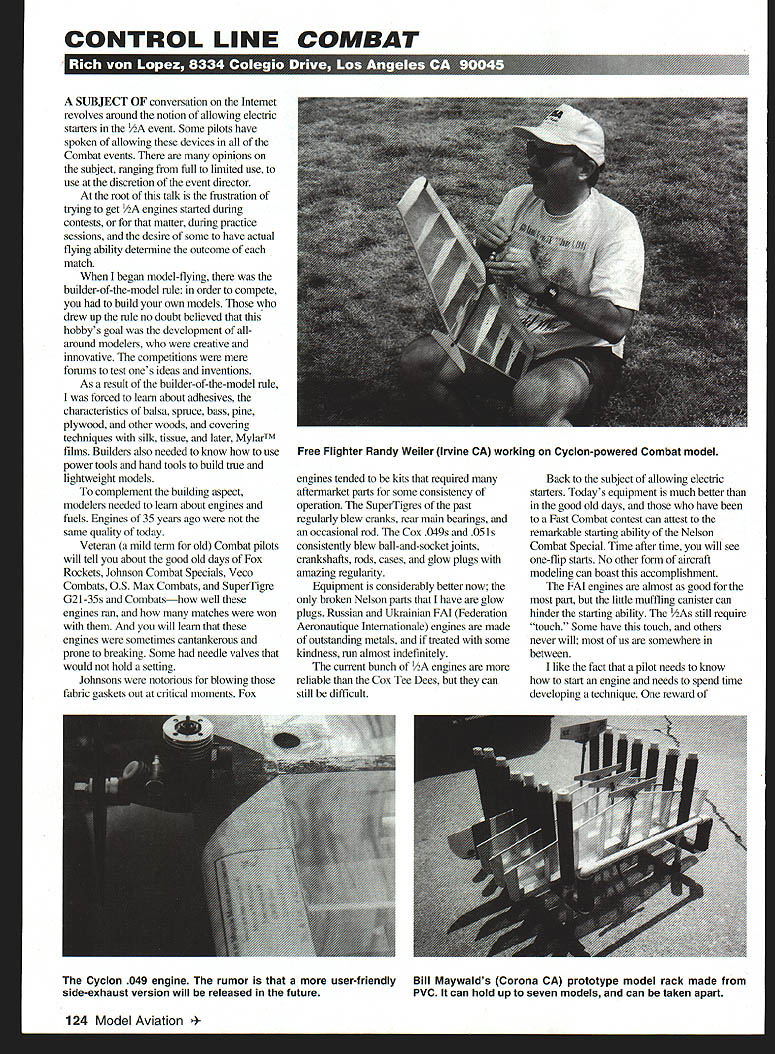
I have included a photograph of the Cyclon .049, just so you know that it really does exist. Randy Weller, shown in a photo, is a Free Flight guy turned outlaw Combat guy who was first seen with one of these little beasts. There is a rumor that a more user-friendly side-exhaust version will be on the market in the near future.
At one time, Stels produced two .049s—one was a side-exhaust and the other was a twin exhaust. However, Alexander Gieviesky did not continue as an engine manufacturer.
In the June Model Aviation on page 127, I included two old photographs and asked you to identify the people. James Mears sent the following information:
- Top row, standing: Howard Henry ('69) (Combat), Raymond Wilkins (Combat)
- Center row, left to right: Bobby Mears (seven years), James Mears (21 years — ha ha), Andy Mears (four years), Riley Wooten (about 50 years — tell him I said so), Bill Young (Rat Race), Wayne Welch (Combat)
- Bottom row: Pete Lande (Stunt and Combat), Ray Wilkins (Raymond's twin)
- Approximate year: 1962
The photograph of the Anchor Steam Beer team includes:
- Herman Yue
- Mike Spindler
- Edmund L. Bridant
- Rich von Lopez
- Approximate year: 1976
Transcribed from original scans by AI. Minor OCR errors may remain.

