
CONTROL LINE COMBAT
Iskandar Taib, 517 Tulip Tree Apts., Bloomington IN 47408
The Nationals (Nats) Control Line (CL) Combat events enjoyed good weather—moderate wind and 70–80°F temperatures—sandwiched between weeks of 95°+ heat and high humidity. Event Director Larry Skelley raised $4,000 in prize money for Combat ($1,000 per event), attracting fliers from across the U.S. and producing the largest Combat Nats since Lubbock, TX, in 1995. The recent trend of declining attendance was, at least temporarily, reversed.
F2D (Team Trials)
F2D was flown Saturday and Sunday as a U.S. team trials rather than an official Nats event. The top three finishers and the highest-scoring junior would represent the U.S. at the 2000 World Championships in France, so stakes were high and crews well prepared.
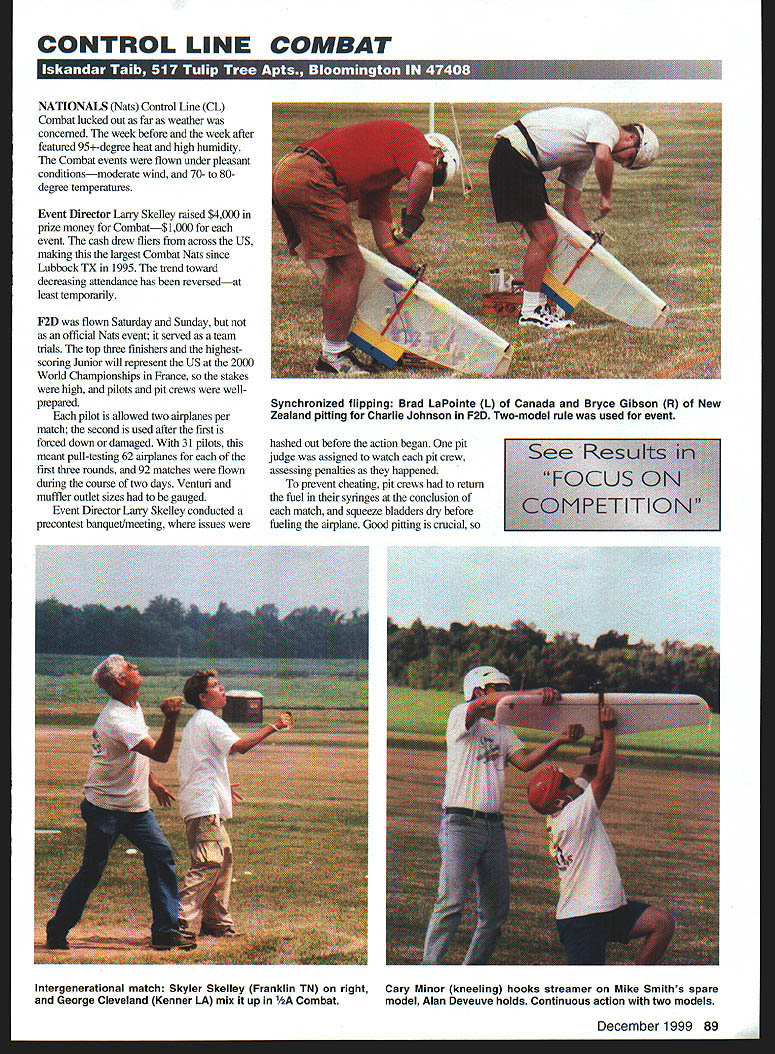
- Each pilot was allowed two airplanes per match (the second used after the first was forced down or damaged). With 31 pilots this meant pull-testing 62 airplanes for each of the first three rounds; 92 matches were flown over two days.
- Precontest banquet/meeting addressed rule issues. One pit judge watched each pit crew and assessed penalties as they occurred.
- To prevent cheating, pit crews had to return fuel in syringes after each match and squeeze bladders dry before fueling the airplane.
- To save equipment, no flyoff was held for the top three spots; prize money helped cover team expenses.
Team-trials qualifiers to the 2000 World Championships:
- Mike Wilcox
- George Cleveland
- Tom Fluker (former world champion)
Junior team spot:
- Skyler Skelley won the junior flyoff over Krystal King. Krystal had a strong match against Jeff Rein (scoring at least four cuts) and then tied Skyler after three rounds before the flyoff.
Equipment notes for F2D:
- Buy-and-fly equipment primarily came from the Czech Republic, Ukraine, and Russia.
- Streamers and heavy crepe-like Mejzlik/Modellbau paper were among the best seen.
- Profi was the common engine; Redko’s Zorro was the fastest. A small number of Cyclon engines were used.
- High RPMs sometimes required thin-bladed glass propellers.
Fast Combat (Open)
Fast Combat ("Combat") produced high-adrenaline flying with ~120-mph airplanes, .36 engines and bladder tanks.
- With 31 entries, contestants were drafted to judge matches, making early rounds hectic. Matches were scheduled roughly every 6–8 minutes and were often decided in seconds when a streamer was taken.
- Shutoff devices were mandated for Fast Combat; while there were some problems, they were fewer than in Slow Combat.
- The Nelson .36 was the most common engine; occasional use of a Fox Mark VII and the .36 Wylie was noted.
Notable matches and results:
- Early standout match: Mark Rudner vs. Howard Rush — Howard scored two cuts and the kill in 30 seconds.
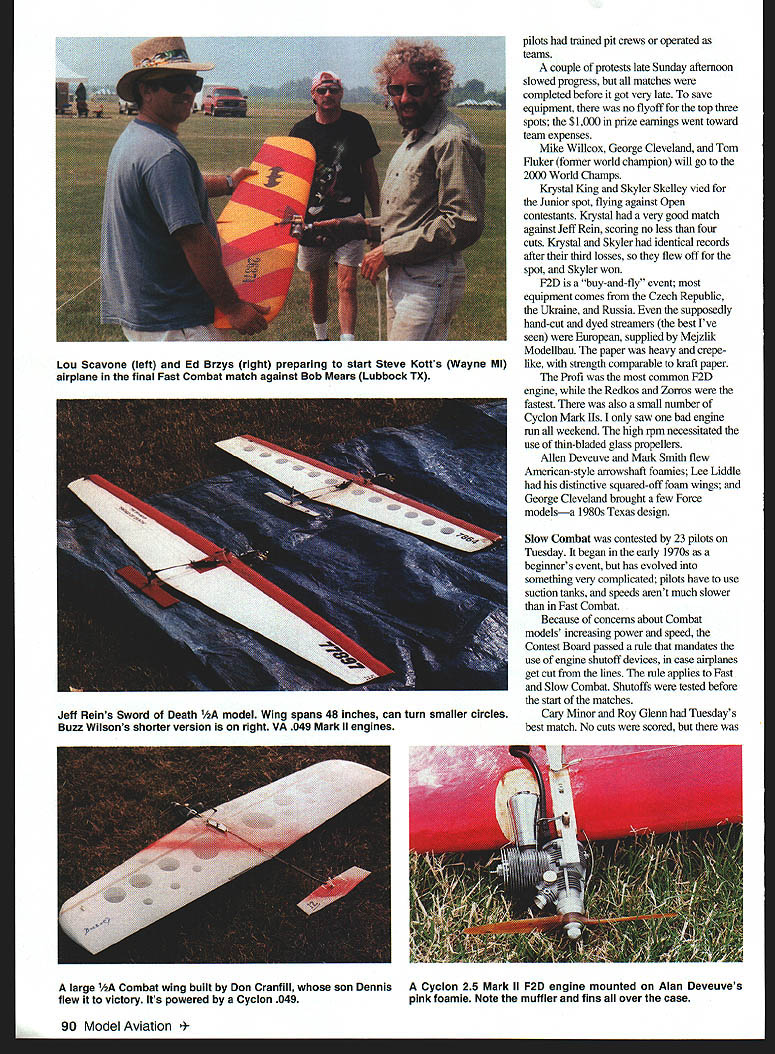
- Final (1999 National Combat champion): Steve Kott (Michigan) defeated Bob Mears (Texas). Steve flew a Steve Hills Arrowplane; Bob flew a pastel green Predator foamie. Steve scored the final kill after about a minute of flying.
Top Fast Combat placements:
- Steve Kott
- Bob Mears
- Howard Rush
- Larry Driskill
- Don Cranfill
- Phil Cartier
- Andy Mears
- Henry Nelson
Slow Combat
Slow Combat drew 23 pilots. What began as a beginner event in the early 1970s has evolved into a complex contest—pilots now use suction tanks and speeds approach those of Fast Combat.
- Because of concerns about increasing power and speed, the Contest Board mandated engine shutoff devices for both Fast and Slow Combat. Shutoffs were tested before matches.
- Shutoff unfamiliarity caused more trouble in Slow Combat, mainly because the extra plumbing length needed to route fuel past the shutoff made fueling more difficult; many airplanes launched then went lean during maneuvering.
Notable Slow Combat items:
- Cary Minor and Roy Glenn had Tuesday’s best match—no cuts were scored.
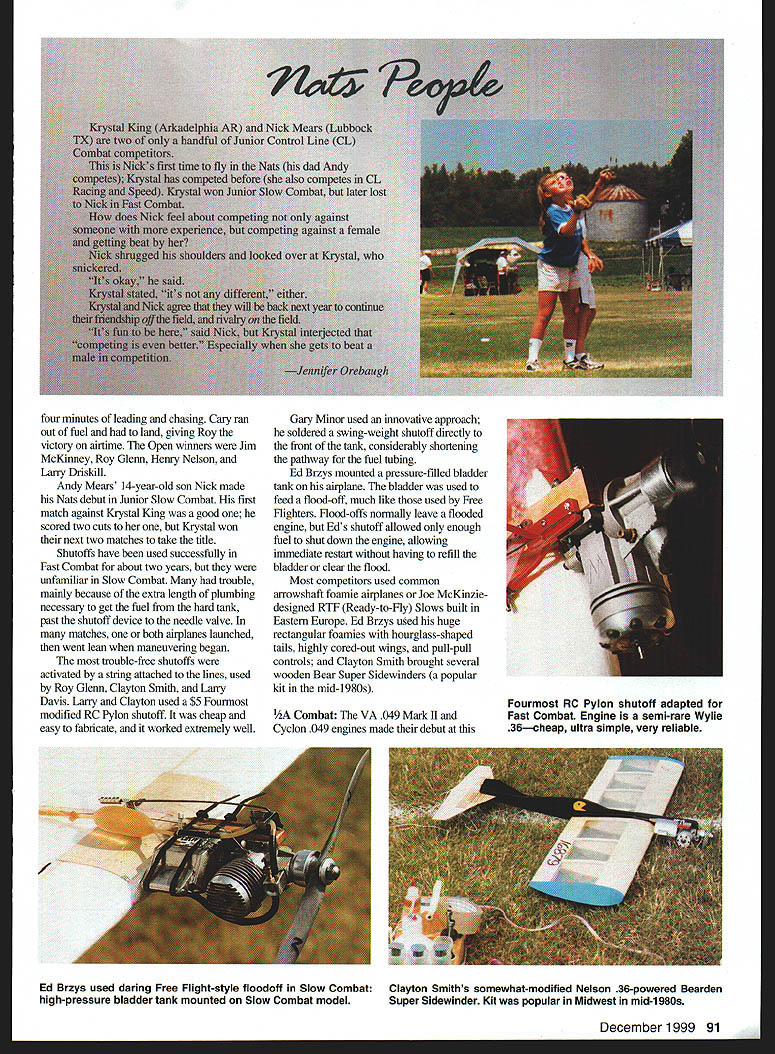
- Junior Slow Combat: Krystal King won the junior title. She lost her first match (scoring two cuts in that bout), then won her next two matches to take the title.
- Andy Mears’ 14-year-old son Nick made his Nats debut in Junior Slow Combat; Krystal beat Nick twice en route to the title.
Common Slow Combat airplanes included arrowshaft foamies and Joe McKinzie–designed RTF Slows built in Eastern Europe. Ed Brzys used large rectangular foamies with hourglass tails, and Clayton Smith brought wooden Bear Super Sidewinders.
1/2A and 1/4A Combat
1/2A Combat:
- Starting problems were scarce as fliers have learned to start and run the small Russian engines; most matches were decided in the air rather than by frantic flipping.
- 1/2A was dominated by Texans. By round four, five of the 20 pilots left in Open were Texans (James McKinney of Louisiana being the primary non-Texan).
Notable 1/2A match:
- Dennis Cranfill vs. Don Cranfill: a long match between father and son ended with Dennis scoring a cut and then a kill; for fun they continued flying after the kill.
1/2A top placements:
- Dennis Cranfill (8–1 after beating James McKinney twice in the final)
- James McKinney
- Andy Mears
- Don Cranfill
- Cary Minor (fourth/fifth resolved by coin flip)
1/4A Combat:
- The VA .049 Mark II and Cyclon .049 engines (both from Russia) made appearances. Larry Driskill imports the VA .049.
- AME engines were rare in 1/2A; Ed Brzys used the only Cox Tee Dee on an ultralight airplane without too much disadvantage.
Notable 1/2A designs:
- Larry Driskill's Lighthawk was the most common 1/2A model and influenced many designs.
- Jeff Rein’s "Sword of Death" stood out: a foam wing with a 48-inch span, large root chord and powered by a .049, it performed aggressively and turned tight loops.
Shutoff Devices and Innovations
Shutoffs have been used successfully in Fast Combat for about two years, but adapting them to Slow Combat produced challenges and several clever solutions:
- String-activated shutoffs: A string attached to the lines pulls an arm that allows normal fuel flow; when lines are cut the arm springs back and shuts off the fuel. Used effectively by Roy Glenn, Clayton Smith, and Larry Davis. Larry and Clayton used a $5 Fourmost-modified RC Pylon shutoff—cheap, easy to fabricate, and very effective.
- Swing-weight shutoff: Gary Minor soldered a swing-weight shutoff directly to the front of the tank, shortening the tubing pathway and easing fueling.
- Pressure-filled bladder with controlled flood-off: Ed Brzys mounted a pressure-filled bladder feeding a flood-off type shutoff. His version allowed only enough fuel to shut down the engine, permitting immediate restart without refilling or clearing a flood.
- Simple piano-wire shutoff: Phil Cartier built one from bent piano wire and springs; the arm is pulled toward the pilot while lines are attached and springs return it to cut the fuel if the lines are severed.
Equipment, Engines and Airframe Notes
- F2D equipment sources: Czech Republic, Ukraine, Russia. Mejzlik/Modellbau supplied strong crepe-like paper and well-made streamers.
- Common engines: Profi (F2D), Redko/Zorro (fastest), Cyclon (some use). High rpm runs sometimes necessitated thin-bladed glass props.
- Foamies and homebuilt models:
- Allen Deveuve and Mark Smith flew American-style arrowshaft foamies.
- Lee Liddle’s distinctive squared-off foam wings attracted attention.
- George Cleveland brought several Force models (1980s Texas design).
- Ed Brzys and Clayton Smith flew distinctive large or wooden designs (rectangular foamies and Bear Super Sidewinders respectively).
Notable Pilots and Matches (highlights)
- Don Cranfill demonstrated excellent use of the entire circle; in one match he evaded low and attacked to rip most of an opponent’s streamer and later took the string along with a stabilizer.
- Long family match: Dennis vs. Don Cranfill—lengthy, familiar match before Dennis scored the decisive cut and kill.
- Cary Minor vs. Roy Glenn (Slow Combat): a well-flown, defensive bout with no cuts recorded.
- Mark Rudner vs. Howard Rush (Fast Combat): Howard scored two cuts and the kill in 30 seconds.
Sponsors and Thanks
Thanks to the many who helped and sponsored the Combat events:
- Sandy Frank (AMA District VIII VP)
- James Mears Mazda and Volvo
- Larry Driskill — "Kitting It Together"
- Mejzlik Modellbau
- Nelson Engines
- Ritch's Brew Fuels
- Lone Star (Riley Wooten)
- Phil Cartier
- George Cleveland
- Mack Henry
- R.W. Howe
- Louis Lopez
- Richard Stubblefield
- The East Coast Modellers
Larry Skelley did a superb job as Combat event director, supported by many volunteers who judged and helped run the contest.
Transcribed from original scans by AI. Minor OCR errors may remain.

