

Control Line: Combat
Charlie Johnson
The Control Line and Scale World Championships will be held August 4 through 10 at RAF Woodvale which is about 10 miles north of Liverpool, England. First, a bit about what will be going on, and then some thoughts on how to get there with a minimum of hassle and expense.
Along with Combat there will be Speed, Aerobatics, Team Race and CL and RC Scale. In contrast to the Utrecht site, where there were practice circles, the Woodvale airfield offers ten practice circles for Combat, and at least eight for Speed and Racing. Both the Team Race and Speed circles will have special nylon nets. The nylon fishing net was able to catch a 60-powered speed ship that was let go at 160 mph for the test (little damage to the model!).
The British are sympathetic when it comes to entry and supporter fees, something like $3.00 entry when I entered the British Nationals. Very nice dorms will be available, plus on-site camping. It should be possible to get by for as little as $45, if you opt for the camping, or in the neighborhood of $135, if staying in the dorms at Liverpool University. I would suggest the dorms because the competitors will be staying in one dorm block this year. It will be a perfect opportunity to meet the big names. We may have a bit of rain during the competition, but there should be very little wind due to the 500 yards of sand dunes and pine trees between the airfield and the ocean.
"Supporters" (those who go to world championships to root for and assist the team) likely will have to sign up through AMA, so if you are interested be sure to write AMA early to get on a list to receive particulars. Air carriers fly directly into Manchester from various cities in the states, with connecting flights from London at no charge, if the airline of your choice doesn't fly directly to Manchester. Generally, the cost of a charter from the West Coast is about $450 and $300 from the East. It all depends on the time of year, point of departure, and whether the plane is 80% or 100% full. For those who like to wait until the last minute, you can always stand in line for one of the Laker Skytrains from New York. One last detail, passports are required, and you should allow several weeks for processing.
FAI Combat is undergoing many changes now, and probably a lot more during and after the WC. The British are sticking to slightly lower but more precise turning models; the G-20 still rules. The Russians have developed a motor equal to the Rossi. 15 (for combat purposes anyway) and have been making progress despite setbacks, thanks to the British giving them "the latest in designs." The British lads were rolling on the floor with laughter when the Russians fell for one particular design that they'd given up on, but stopped laughing when, at the European Championships, they discovered that the Russians had sorted out the bugs, and it wasn't a bad performer. Maybe, the Americans should ship over a couple cases of the infamous Big Otto design.
The Americans are the least experienced in world class flying, although certainly not lacking in AMA type, since the team consists of the very best in the country, Gary Frost/Chuck Rudner/George Cleveland. If any of you really would like to help our team, you might bring along some models, a few for yourself, and a few to lend to the team members for practice. There will be lots of time before, and during, the contest to get in plenty of practice. This is the "sparring partner" idea; there is opportunity to fly against some top-notch competitors, and the team members get some valuable experience against a wide variety of opponents. This is something we should be doing right now in the USA. It's up to you locals to help get Frost, Rudner and Cleveland in shape for the big one.
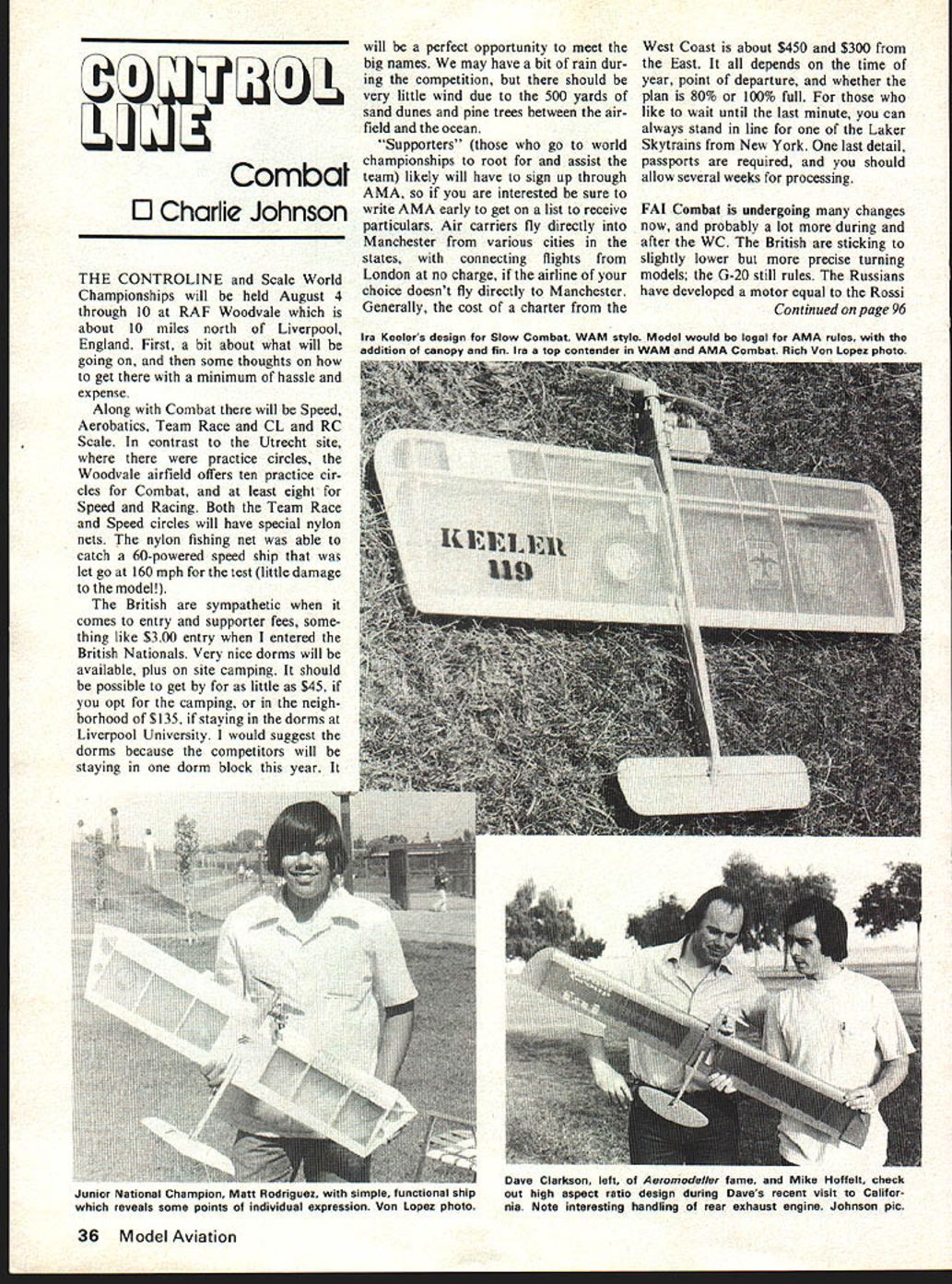
I had a picture of the engine area of Mike Hoffelt's FAI design in the Nats article, and many of you wanted a better view. I've included a shot of Dave Clarkson (Aeromodeller fame), and Mike during Dave's recent visit. Some of the trick items include a cable pushrod, single leadout guide, exhaust exit through wing (fiberglass molding), inboard fuel compartment with pressure regulations capabilities. The Rossi 15 makes lots of power on 40% nitro and 15% Blendzall fuel, turns a much modified Zinger 7.5 about 24,000 rpm. The prop is reworked to put most of the pitch at the hub. Sure, it has its disadvantages, like a fairly small fuel capacity, sensitivity to even a small warp, and being fragile. A 12-ounce plane can stand up to flying stresses, but not ground impact. As Richard Wilkens would say, "If you build it light, you may not hit the ground." Those of you who saw the planes in action at the Nats, will probably agree that they're real mind-blowers compared to any current FAI design.
Has anyone noticed that we have quite a few changes in our Combat rules? None of them will have that big of an impact; no gear in Slow, and the engine is farther forward. The line entanglement rule has been deleted, which means that, if you're ahead, you'll have to bellcrank the guy, rather than fly a loop around his lines and punch in. As was pointed out in the MACA N/L, the no kill rule in Slow Combat will mean about the same thing. If you take the whole streamer right off, the safest thing to do in terms of winning the match would be to center punch the guy. When I voted to do away with the kill (as a member of CAC) I thought it would make for more interesting matches, but then again, I thought we were flying for fun.
I do have a couple suggestions. Since our combat simulates real combat, it is obvious that a mid-air kills both pilots. We could then move these people that would have been pushin' up the daisies into a special bracket for people that can't win without hitting a plane. A second way might be to allow a certain number of rounds rather than a pyramid affair, your total cuts and air points for three or four rounds determining the winner. Even if you took the lot right off, you could still get air points, and staying in the air would be to your advantage.
How about a streamer making machine? Current practice in rainy weather is to run 3/4-in. masking tape down the length of the streamer, not too hard a job although rolling it up again sure is. The tape keeps the streamer from shredding in wet weather and allows the prop to cut off one piece without pulling the entire streamer with it. Another idea to make the planes more flyable was to increase line length to 60 ft. for the FAI's, and 70 ft. for AMA planes. Those extra few feet add a tremendous amount of extra space to fly in. The longer lines cost a bit more and, of course, require more room, but that isn't generally a problem with grass flying sites. More line rake may be needed too. The idea of FAI type fuel (lubricant and alcohol) has been tried, too. It's OK for the club meet where one source of fuel is used, but impossible to police on a larger scale. A Fox or Tigre set up to run on FAI fuel is still very fast and, with the high compression needed to extract maximum horsepower, it is hard to tune and pops plugs at least as often as nitro fuel. The big advantage is in the cost of fuel. A gallon of no nitro fuel may be mixed for as little as $3.00, compared to $10 for high nitro brews.
Our ultimate in "nasty medicine" reported in last month's column (60% nitro, 20% propylene oxide, and 20% NPG oil) has another side effect besides making excess horsepower. It burned a hole through the piston and caved in the dome. A lot of you probably have done the same thing on much lower percentages of nitro.
George Mattei has had a series of very informative articles in the MACA Newsletter concerning engine set-up and fuels, well worth the $6 it costs to join MACA. For MACA membership send $6 to Patty Sansett, Treasurer, 1443 McKinley, Escondido, CA 92025.
Charlie Johnson, 3716 Ingraham St., San Diego, CA 92109.
Transcribed from original scans by AI. Minor OCR errors may remain.

