
Control Line: Combat
Charlie Johnson
ONE PROBLEM that competition and sport fliers have in common is water contamination of their fuel. If you leave your gallon can open for any length of time, you'll notice the telltale signs of contamination indicated by a milky appearance. Low power, higher than normal operating temperatures, and poor needle settings are some of the results.
I stumbled across a product used to keep photo finishing chemicals free from contamination. It's called XDL and is made by Bessler in convenient spray cans. It is an inert, heavier-than-air gas that will settle on top of the fuel, thus displacing moisture-laden air. Storage life of partially filled photo chemical bottles will be increased to that of completely full bottles. Our model fuel doesn't generally deteriorate with age, as does the photo stuff, so it might be possible to exclude air for however long it takes you to burn up a gallon of fuel. To use the spray, all you do is shoot a few seconds' worth inside the container. It should never get out, if you have vent and fill tubes soldered into the cap (always use a filter on the fill line).
More Power a Blessing? World Engines recently released the MK-2 Supertigre that will compete with Fox and K&B in the super-potent .35 class. The new engine features a much more rugged case (heavier too), Perry ports, new crank and rear bearing setup. The biggest complaint about Tigres has been their appetite for crankshafts. Hopefully, the problem will have been solved with the new 15mm OD shaft and larger 9-ball rear bearing.
The intake port on the crank is gigantic, something like 15mm by 11mm, although the gas passage through the crank is a mere 10mm! The area of the intake port is about double that of the passage through the crank. No doubt, the engine will make a lot more power than previous models and, with the beefier bottom end, it will probably live a lot longer too.
At a recent contest, I spent a great deal of time keeping track of how much time was spent in actual combat. We all know that the match goes for five minutes, but I wanted to know how much time was spent with both planes in the air engaged in combat. What I found out may be no surprise to some of you competition fliers; 30% of the matches lasted less than 10 seconds, 50% lasted less than 30 seconds, 90% never made it to one minute.
I was generous in awarding these times. I started the watch when the second plane launched, and stopped it when a kill was made, or one or both planes hit the ground. I've had a lot of non-flying friends tell me how they like to watch combat, but remarked that it took so long to get a match ready only to have it end so quickly. I wonder how they'd like to have spent six hours building the plane that was destroyed or badly damaged in 35% of the matches.
Mick Tiernan had an excellent article in the January 1978 issue of AeroModeller commenting on the sad state of combat in Europe. If you're wondering who Mick Tiernan is, let me say that he's won the British Nationals, and is probably one of the four or five best FAI pilots in the world. Mick admits to being from the "old school" of combat, where planes went slower and lasted a long time, as did the matches. There's been a slow escalation here in the USA, but in Europe there was a radical change two years ago from 70-mph diesels to 90-100-mph glows. The current breed of horsepower motors has enabled even the rankest beginner to acquire the means for a 120-mph model held under control by his 60-mph skill and reflexes.
What to do for an easy to build Slow Combat ship? If you like to scratch-build a ship, I'd suggest a Cheater Slow by Dan Rutherford (May 1977, MA) or maybe the Slow form of Rich Brasher's Rotation Station. For a kit-type plane you might start with a Nemesis or Voodoo, and add longer motor mounts to make the 5-in. minimum from leading edge to thrust washer (remember no prop extensions or extra thick thrust washers allowed). A boom-type body can be made out of 3/8" balsa capped with 3/16" spruce or bass, top and bottom.
To get the plane to balance properly you might make an extra long body (on your first attempt), and cut it to length once the proper balance is achieved. Not many guys have used flaps, but it is worth a try, especially if you use mylar hinges (since you could add or subtract flaps with ease). Probably 30° flap movement is enough, coupled with only 15° elevator. If your plane doesn't turn tightly enough with 15° elevator, it is too nose-heavy, or the wing loading is too high.
If you're not in the mood for building original Fast Combat designs, you might modify a Nemesis or Voodoo. Add a 7-in. monoboom with 3 by 12" stabilator and recess the engine as far as possible. You probably can get away with 1/2 in. on the Voodoo, since a bladder tube will reinforce the leading edge, but it's hard to get the engine very far back in a plane with Nemesis construction. Voodoo kits come with very heavy leading edges so, for a performance boost, you might replace them with a commercial variety selected for lightness. Make some giant wing tips out of 4-in. wide wood, and be sure not to read any articles on airfoils because they will only confuse you.
Combat sport fliers have a common water contamination problem. If you leave a gallon can open for any length of time you'll notice the telltale signs of contamination, indicated by a milky appearance, low power, higher than normal operating temperatures, and poor needle settings. Some results stumbled across a product used to keep photo finishing chemicals free of contamination. It's called XDL, made by Bessler, in convenient spray cans. An inert, heavier-than-air gas will settle on top of the fuel, thus displacing moisture-laden air. Storage life of partially filled photo-chemical bottles will be increased if completely full bottles are used. Model fuel doesn't generally deteriorate with age; do the photo stuff might possibly exclude air ever. Long takes burn up a gallon of fuel; use spray—shoot a few seconds worth inside container. It should never get out; have vent fill tubes soldered to the cap and always use a filter fill line.
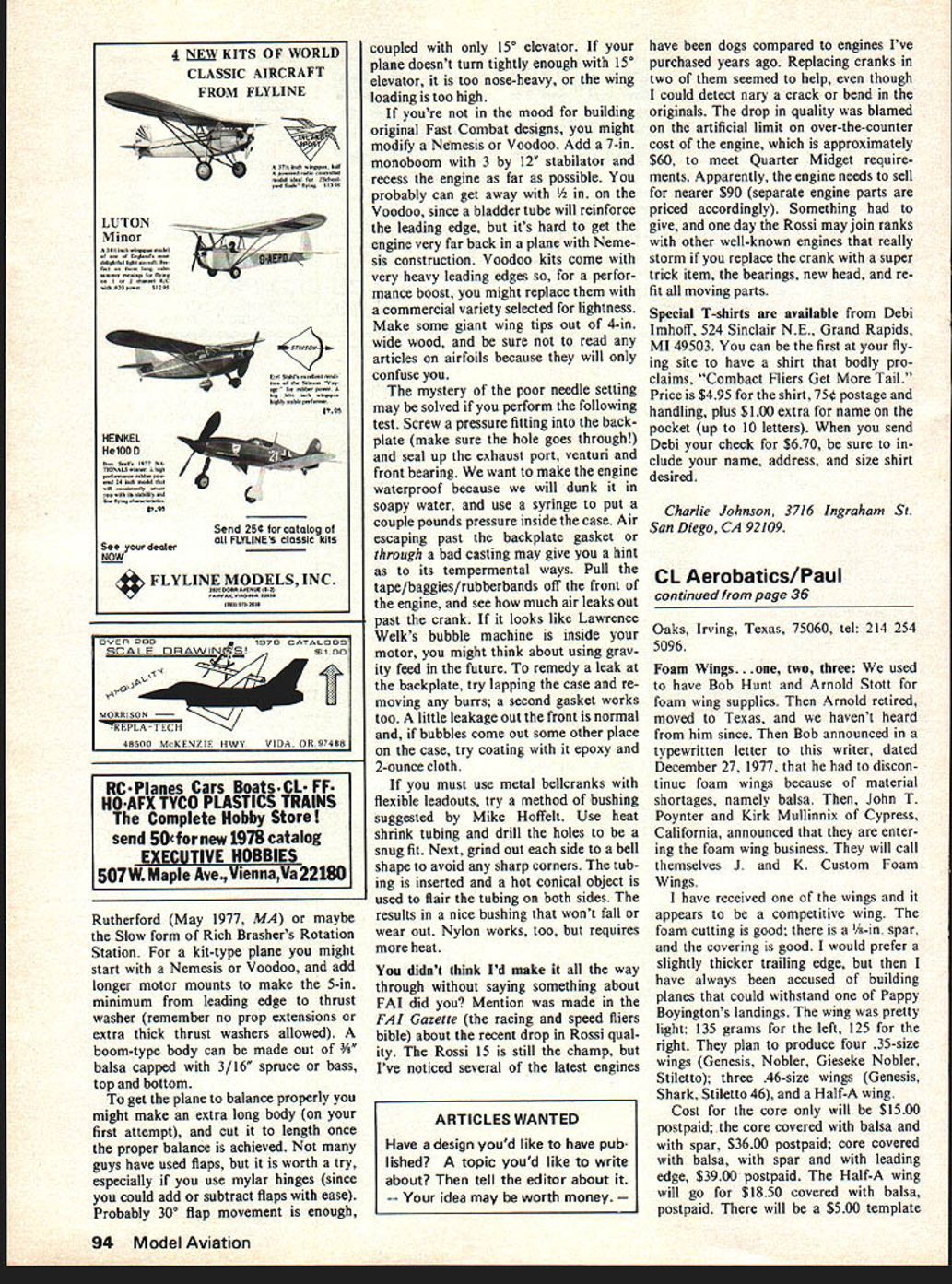
The mystery of the poor needle setting may be solved if you perform the following test. Screw a pressure fitting into the backplate (make sure the hole goes through!) and seal for up the exhaust port, venturi and front bearing. We want to make the engine waterproof because we will dunk it in soapy water, and use a syringe to put a couple pounds pressure inside the case. Air escaping past the backplate gasket or through a bad casting may give you a hint as to its temperamental ways. Pull the tape/baggies/rubberbands off the front of the engine, and see how much air leaks out past the crank. If it looks like Lawrence Welk's bubble machine is inside your motor, you might think about using gravity feed in the future. To remedy a leak at the backplate, try lapping the case and removing any burrs; a second gasket works too. A little leakage out the front is normal and, if bubbles come out some other place on the case, try coating with kit epoxy and 2-ounce cloth.
If you must use metal bellcranks with flexible leadouts, try a method of bushing suggested by Mike Hoffelt. Use heat shrink tubing and drill the holes to be a snug fit. Next, grind out each side to a bell shape to avoid any sharp corners. The tubing is inserted and a hot conical object is used to flair the tubing on both sides. The results is a nice bushing that won't fall or wear out. Nylon works, too, but requires more heat.
You didn't think I'd make it all the way through without saying something about FAI did you? Mention was made in the FAI Gazette (the racing and speed fliers bible) about the recent drop in Rossi quality. The Rossi 15 is still the champ, but I've noticed several of the latest engines have been dogs compared to engines I've purchased years ago. Replacing cranks in two of them seemed to help, even though I could detect nearly a crack or bend in the originals. The drop in quality was blamed on the artificial limit on over-the-counter cost of the engine, which is at approximately $60, to meet Quarter Midget requirements. Apparently, the engine needs to sell for nearer $90 (separate engine parts are priced accordingly). Something had to give, and one day the Rossi may join ranks with other well-known engines that really storm if you replace the crank with a super trick item, the bearings, new head, and refit all moving parts.
Special T-shirts are available from Debi Imhoff, 524 Sinclair N.E., Grand Rapids, MI 49503. You can be the first at your flying site to have a shirt that boldly proclaims, "Combat Fliers Get More Tail." Price is $4.95 for the shirt, 75¢ postage and handling, plus $1.00 extra for name on the pocket (up to 10 letters). When you send Debi your check for $6.70, be sure to include your name, address, and size shirt desired.
Charlie Johnson, 3716 Ingraham St., San Diego, CA 92109.
Transcribed from original scans by AI. Minor OCR errors may remain.

