
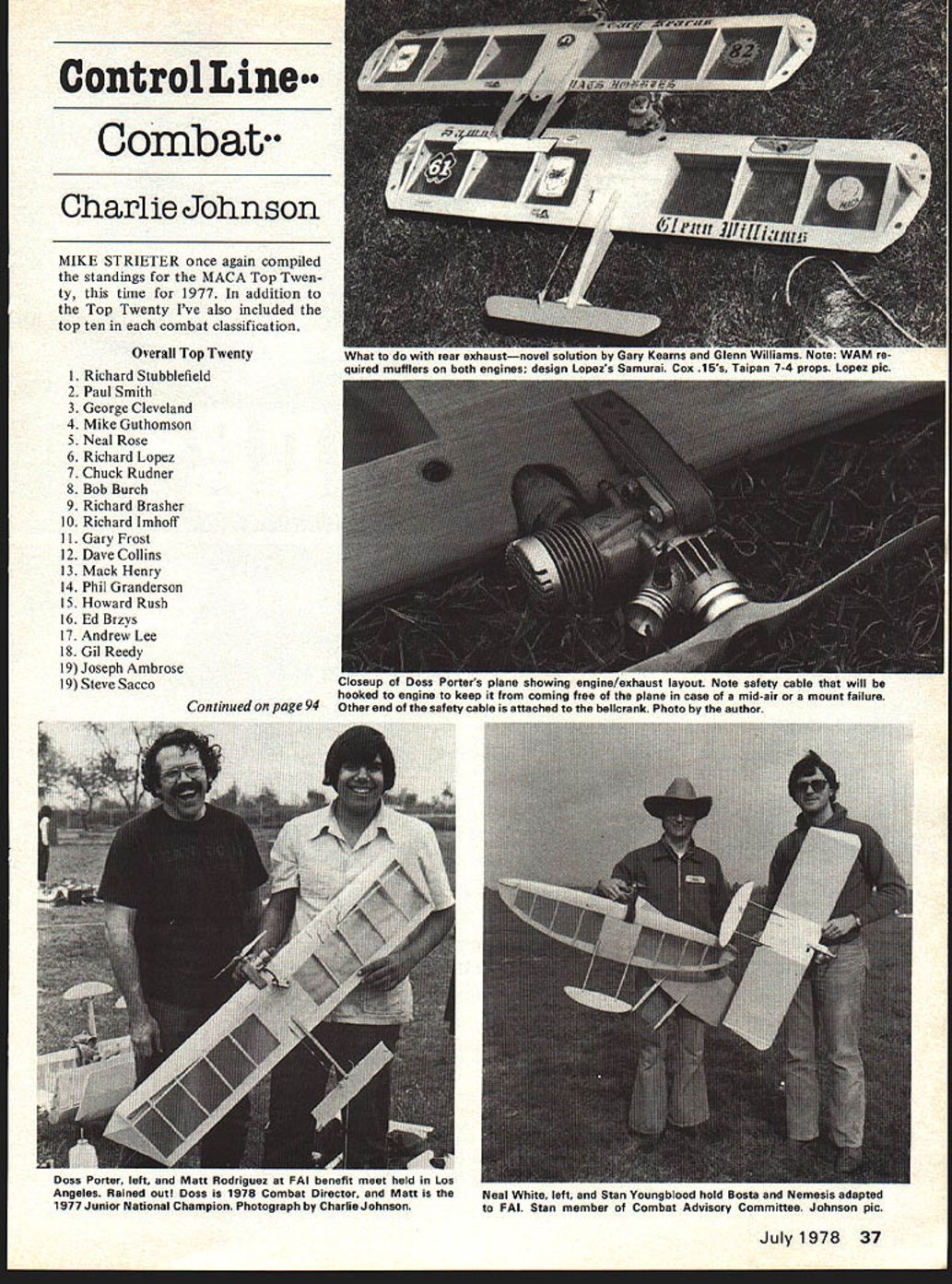
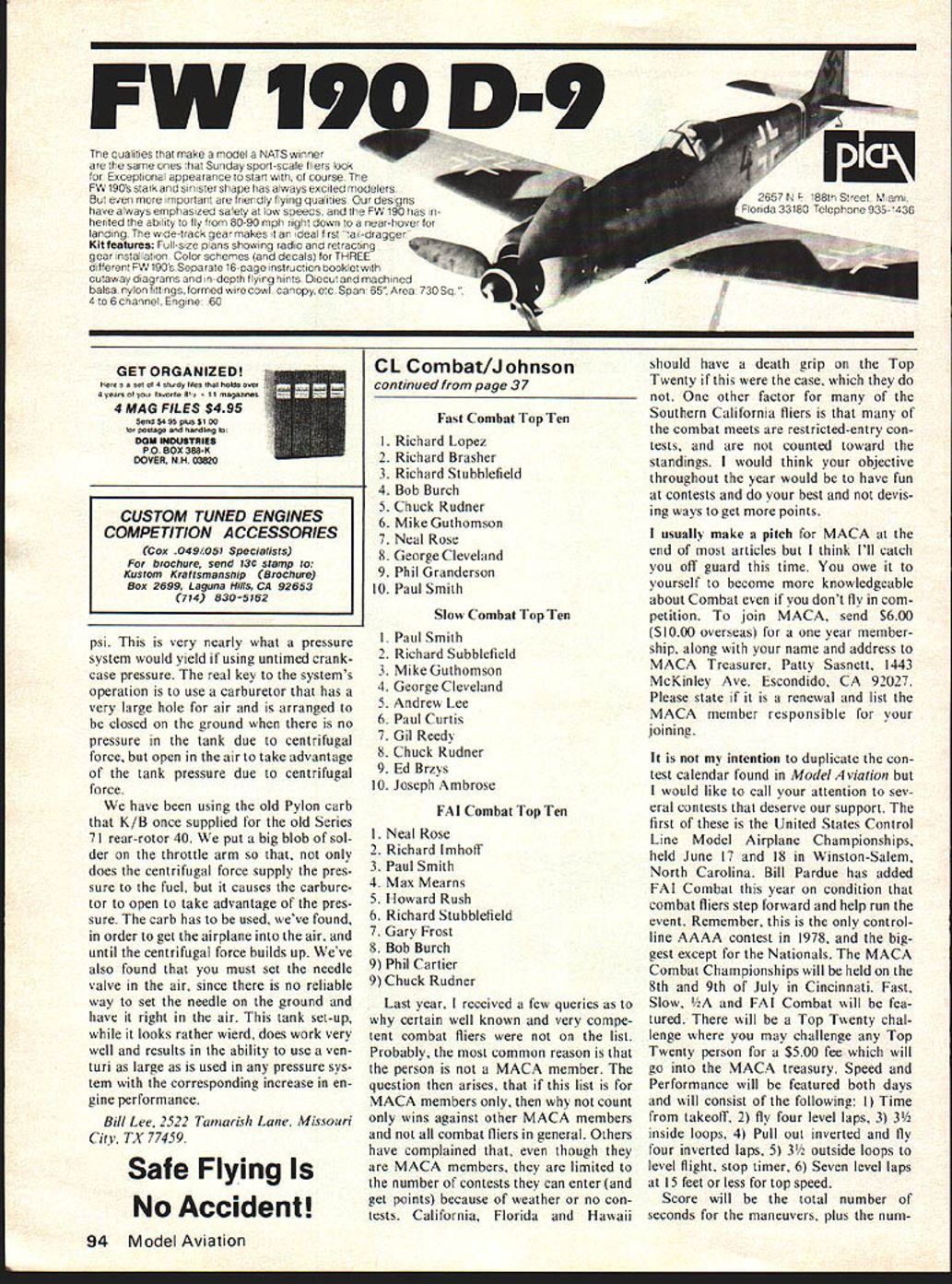
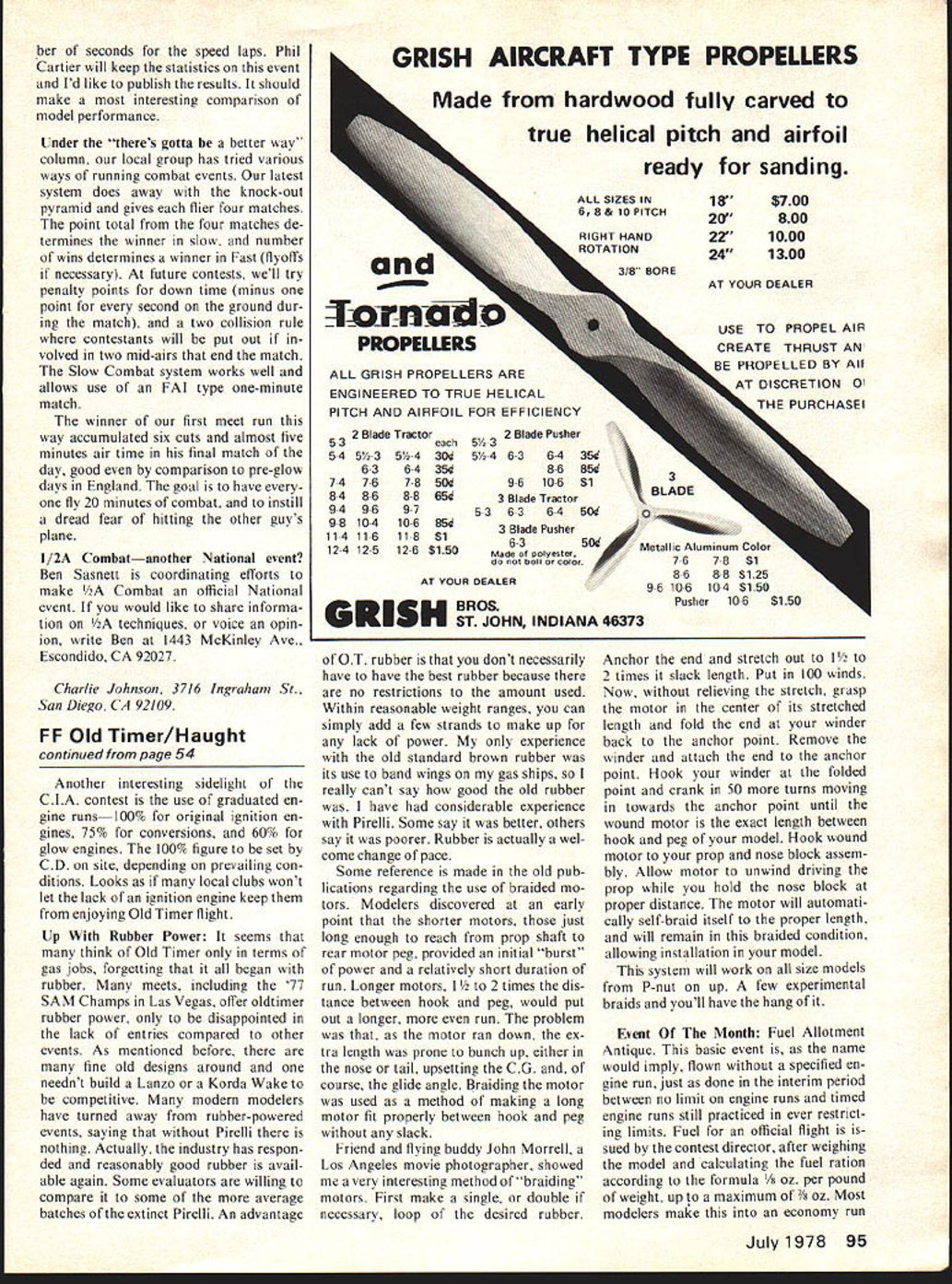
Control Line: Combat
Charlie Johnson
MIKE STRIETER once again compiled the standings for the MACA Top Twenty, this time for 1977. In addition to the Top Twenty I've also included the top ten in each combat classification.
Overall Top Twenty
- Richard Stubblefield
- Paul Smith
- George Cleveland
- Mike Guthomson
- Neal Rose
- Richard Lopez
- Chuck Rudner
- Bob Burch
- Richard Brasher
- Richard Imhoff
- Gary Frost
- Dave Collins
- Mack Henry
- Phil Granderson
- Howard Rush
- Ed Brzys
- Andrew Lee
- Gil Reedy
- Joseph Ambrose
- Steve Sacco
- Richard Lopez
- Richard Brasher
- Richard Stubblefield
- Bob Burch
- Chuck Rudner
- Mike Guthomson
- Neal Rose
- George Cleveland
- Phil Granderson
- Paul Smith
Fast Combat Top Ten
Slow Combat Top Ten
- Paul Smith
- Richard Stubblefield
- Mike Guthomson
- George Cleveland
- Andrew Lee
- Paul Curtis
- Gil Reedy
- Chuck Rudner
- Ed Brzys
- Joseph Ambrose
FAI Combat Top Ten
- Neal Rose
- Richard Imhoff
- Paul Smith
- Max Mearns
- Howard Rush
- Richard Stubblefield
- Gary Frost
- Bob Burch
- Phil Cartier
- Chuck Rudner
Last year, I received a few queries as to why certain well known and very competent combat fliers were not on the list. Probably, the most common reason is that the person is not a MACA member. The question then arises that if this list is for MACA members only, then why not count only wins against other MACA members and not all combat fliers in general. Others have complained that, even though they are MACA members, they are limited to the number of contests they can enter (and get points) because of weather or no contests. California, Florida and Hawaii should have a death grip on the Top Twenty if this were the case, which they do not. One other factor for many of the Southern California fliers is that many of the combat meets are restricted-entry contests, and are not counted toward the standings. I would think your objective throughout the year would be to have fun at contests and do your best and not devising ways to get more points.
I usually make a pitch for MACA at the end of most articles but I think I'll catch you off guard this time. You owe it to yourself to become more knowledgeable about Combat even if you don't fly in competition. To join MACA, send $6.00 ($10.00 overseas) for a one year membership, along with your name and address to MACA Treasurer, Patty Sasnett, 1443 McKinley Ave., Escondido, CA 92027. Please state if it is a renewal and list the MACA member responsible for your joining.
It is not my intention to duplicate the contest calendar found in Model Aviation but I would like to call your attention to several contests that deserve our support. The first of these is the United States Control Line Model Airplane Championships, held June 17 and 18 in Winston-Salem, North Carolina. Bill Pardue has added FAI Combat this year on condition that combat fliers step forward and help run the event. Remember, this is the only control-line AAAA contest in 1978, and the biggest except for the Nationals. The MACA Combat Championships will be held on the 8th and 9th of July in Cincinnati. Fast, Slow, and FAI Combat will be featured. There will be a Top Twenty challenge where you may challenge any Top Twenty person for a $5.00 fee which will go into the MACA treasury. Speed and Performance will be featured both days and will consist of the following: 1) Time from takeoff, 2) fly four level laps, 3) 3½ inside loops, 4) Pull out inverted and fly four inverted laps, 5) 3½ outside loops to level flight, stop timer, 6) Seven level laps at 15 feet or less for top speed.
Score will be the total number of seconds for the maneuvers, plus the num- ber of seconds for the speed laps. Phil Cartier will keep the statistics on this event and I'd like to publish the results. It should make a most interesting comparison of model performance.
Under the "there's gotta be a better way" column, our local group has tried various ways of running combat events. Our latest system does away with the knock-out pyramid and gives each flier four matches. The point total from the four matches determines the winner in slow, and number of wins determines a winner in Fast (flyoffs if necessary). At future contests, we'll try penalty points for down time (minus one point for every second on the ground during the match), and a two collision rule where contestants will be put out if involved in two mid-airs that end the match. The Slow Combat system works well and allows use of an FAI type one-minute match.
The winner of our first meet run this way accumulated six cuts and almost five minutes air time in his final match of the day, good even by comparison to pre-glow days in England. The goal is to have everyone fly 20 minutes of combat, and to instill a dread fear of hitting the other guy's plane.
1/2A Combat—another National event? Ben Sasnett is coordinating efforts to make 1/2A Combat an official National event. If you would like to share information on 1/2A techniques, or voice an opinion, write Ben at 1443 McKinley Ave., Escondido, CA 92027.
Charlie Johnson, 3716 Ingraham St., San Diego, CA 92109.
Transcribed from original scans by AI. Minor OCR errors may remain.

