
Control Line: Combat
Charlie Johnson
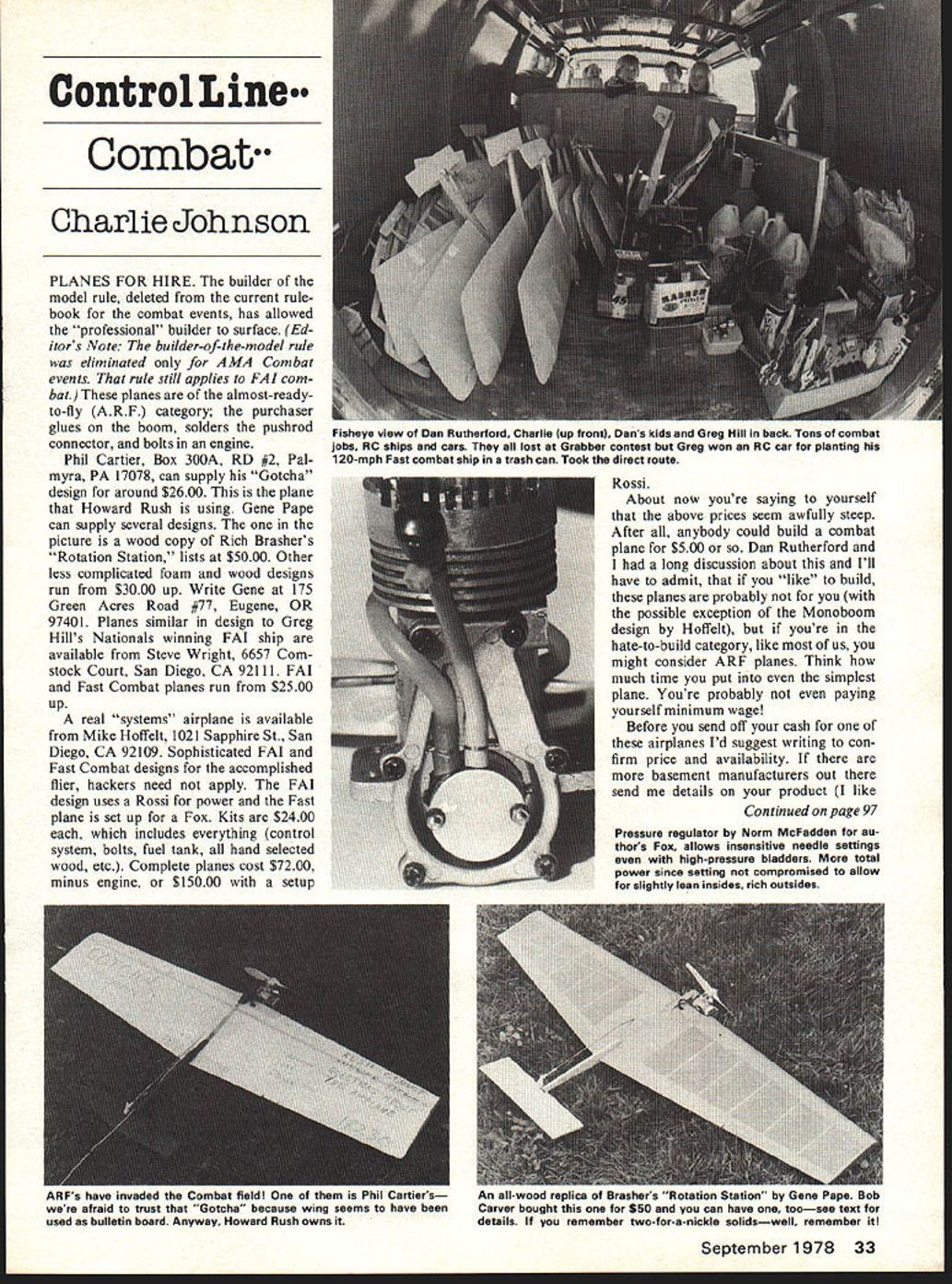
PLANES FOR HIRE. The builder-of-the-model rule, deleted from the current rulebook for the combat events, has allowed the "professional" builder to surface. (Editor's Note: The builder-of-the-model rule was eliminated only for AMA Combat events. That rule still applies to FAI combat.) These planes are of the almost-ready-to-fly (A.R.F.) category; the purchaser glues on the boom, solders the pushrod connector, and bolts in an engine.
Phil Cartier, Box 300A, RD #2, Palmyra, PA 17078, can supply his "Gotcha" design for around $26.00. This is the plane that Howard Rush is using. Gene Pape can supply several designs. The one in the picture is a wood copy of Rich Brasher's "Rotation Station," lists at $50.00. Other less complicated foam and wood designs run from $30.00 up. Write Gene at 175 Green Acres Road #77, Eugene, OR 97401. Planes similar in design to Greg Hill's Nationals winning FAI ship are available from Steve Wright, 6657 Comstock Court, San Diego, CA 92111. FAI and Fast Combat planes run from $25.00 up.
A real "systems" airplane is available from Mike Hoffelt, 1021 Sapphire St., San Diego, CA 92109. Sophisticated FAI and Fast Combat designs for the accomplished flier, hackers need not apply. The FAI design uses a Rossi for power and the Fast plane is set up for a Fox. Kits are $24.00 each, which includes everything (control system, bolts, fuel tank, all hand selected wood, etc.). Complete planes cost $72.00, minus engine, or $150.00 with a setup Rossi.
About now you're saying to yourself that the above prices seem awfully steep. After all, anybody could build a combat plane for $5.00 or so. Dan Rutherford and I had a long discussion about this and I'll have to admit, that if you "like" to build, these planes are probably not for you (with the possible exception of the Monoboom design by Hoffelt), but if you're in the hate-to-build category, like most of us, you might consider ARF planes. Think how much time you put into even the simplest plane. You're probably not even paying yourself minimum wage!
Before you send off your cash for one of these airplanes I'd suggest writing to confirm price and availability. If there are more basement manufacturers out there send me details on your product (I like test samples too) and I'll publish in the next article.
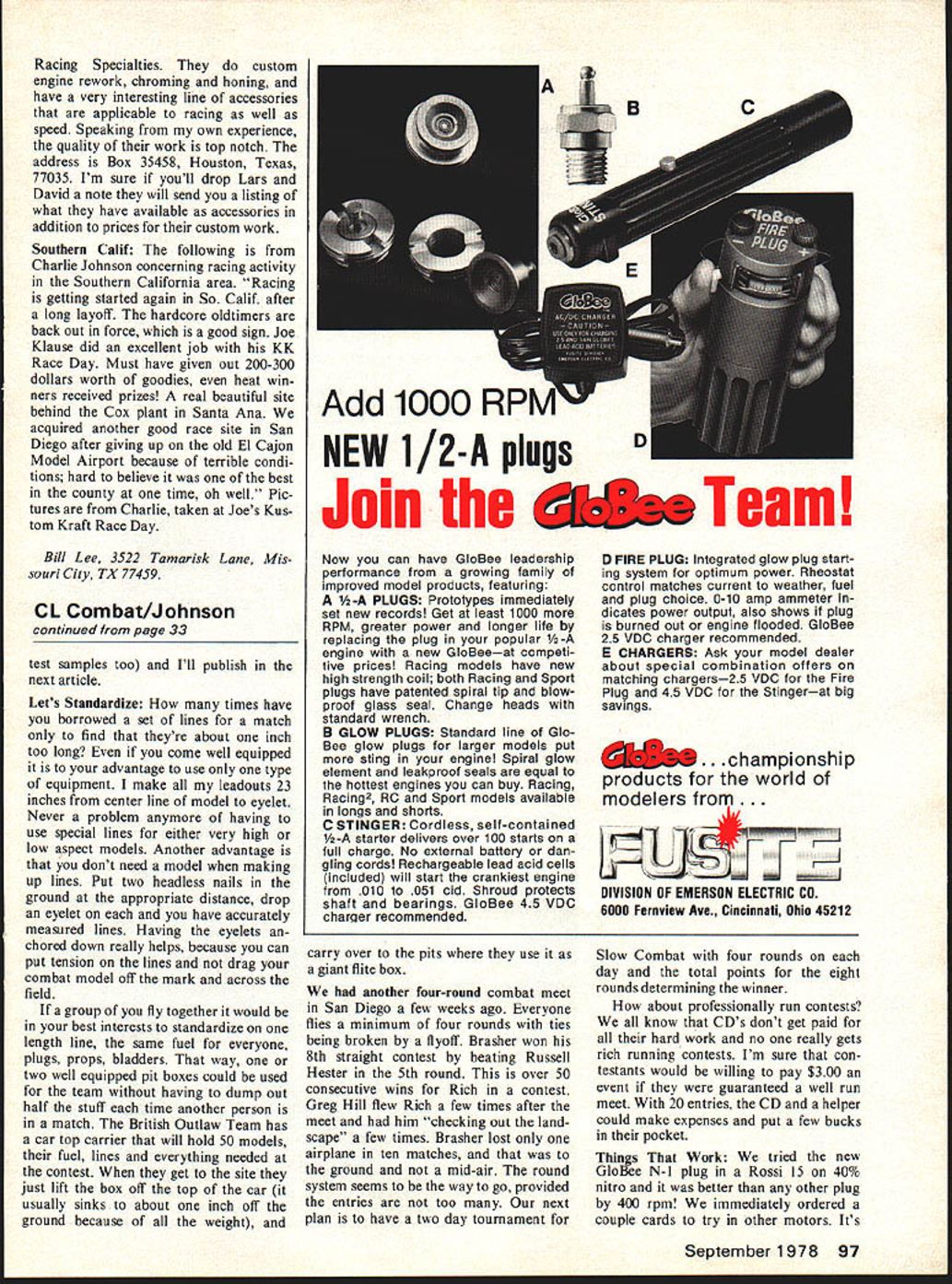
Let's Standardize: How many times have you borrowed a set of lines for a match only to find that they're about one inch too long? Even if you come well equipped it is to your advantage to use only one type of equipment. I make all my leadouts 23 inches from center line of model to eyelet. Never a problem anymore of having to use special lines for either very high or low aspect models. Another advantage is that you don't need a model when making up lines. Put two headless nails in the ground at the appropriate distance, drop an eyelet on each and you have accurately measured lines. Having the eyelets anchored down really helps, because you can put tension on the lines and not drag your combat model off the mark and across the field.
If a group of you fly together it would be in your best interests to standardize on one length line, the same fuel for everyone, plugs, props, bladders. That way, one or two well equipped pit boxes could be used for the team without having to dump out half the stuff each time another person is in a match. The British Outlaw Team has a car top carrier that will hold 50 models, their fuel, lines and everything needed at the contest. When they get to the site they just lift the box off the top of the car (it usually sinks to about one inch off the ground because of all the weight), and carry over to the pits where they use it as a giant flite box.
We had another four-round combat meet in San Diego a few weeks ago. Everyone flies a minimum of four rounds with ties being broken by a flyoff. Brasher won his 5th straight contest by beating Russell Hester in the flyoff. This is over 50 consecutive wins for Rich in a contest. Greg Hill flew Rich a few times after the contest and had him "checking out the landscape" a few times. Brasher lost only one airplane in the matches, and that was to the ground and not a mid-air. The round system seems to be the way to go, provided the entries are not too many. Our next plan is to have a two day tournament for Slow Combat with four rounds on each day and the total points for the eight rounds determining the winner.
How about professionally run contests? We all know that CD's don't get paid for all their hard work and no one really gets rich running contests. I'm sure that contestants would be willing to pay $3.00 an event if they were guaranteed a well run meet. With 20 entries, the CD and a helper could make expenses and put a few bucks in their pocket.
Things That Work: We tried the new GloBee N-1 plug in a Rossi .15 on 40% nitro and it was better than any other plug by 400 rpm. We immediately ordered a couple cards to try in other motors. It's nice to have a plug that is fast and lasts but the icing on the cake was the fact that the engine would run very rich without dying. I've been so discouraged with some brands of plugs that I'd considered going to diesels, well, maybe just ignition engines.
Something else that really works is the Brasher/McFadden fuel regulator. These babies are hard to come by. Norm fixed one of my motors and installed one at the same time. Rather than a half turn adjustment on the needle you have about five turns! The plane holds its speed through turns much better because the engine isn't dropping off lean on the insides and slightly rich on the outsides. The regulator is "sometimes" available from Norm. Duke Fox has experimented with them but it may not be possible to make them available commercially.
Charlie Johnson, 3716 Ingraham St. San Diego, CA 92109.
Transcribed from original scans by AI. Minor OCR errors may remain.

