
Control Line: Combat
Charlie Johnson
World Championships
You'll be able to read elsewhere in this issue about the World Championships, but I'll throw in a few of my own comments. The British made a one-two finish in the Championships, which is a minor miracle considering Vernon Hunt's loss in the losers' round and not exactly inspiring performances by Mick Tiernan and Dave Wood in earlier rounds. Besides the three Americans there were other very capable pilots in contention, including Fraisse from France and Dutchman Fred Meyer. The Europeans are not better pilots, nor do they have better equipment. It was a matter of putting it all together on a particular day, plus a little luck at the right time.
The new FAI Combat is the same as our Fast, except it is for cuts and you can use two planes. Big foam planes with lots of horsepower is the way to go.
The Aero Challenge
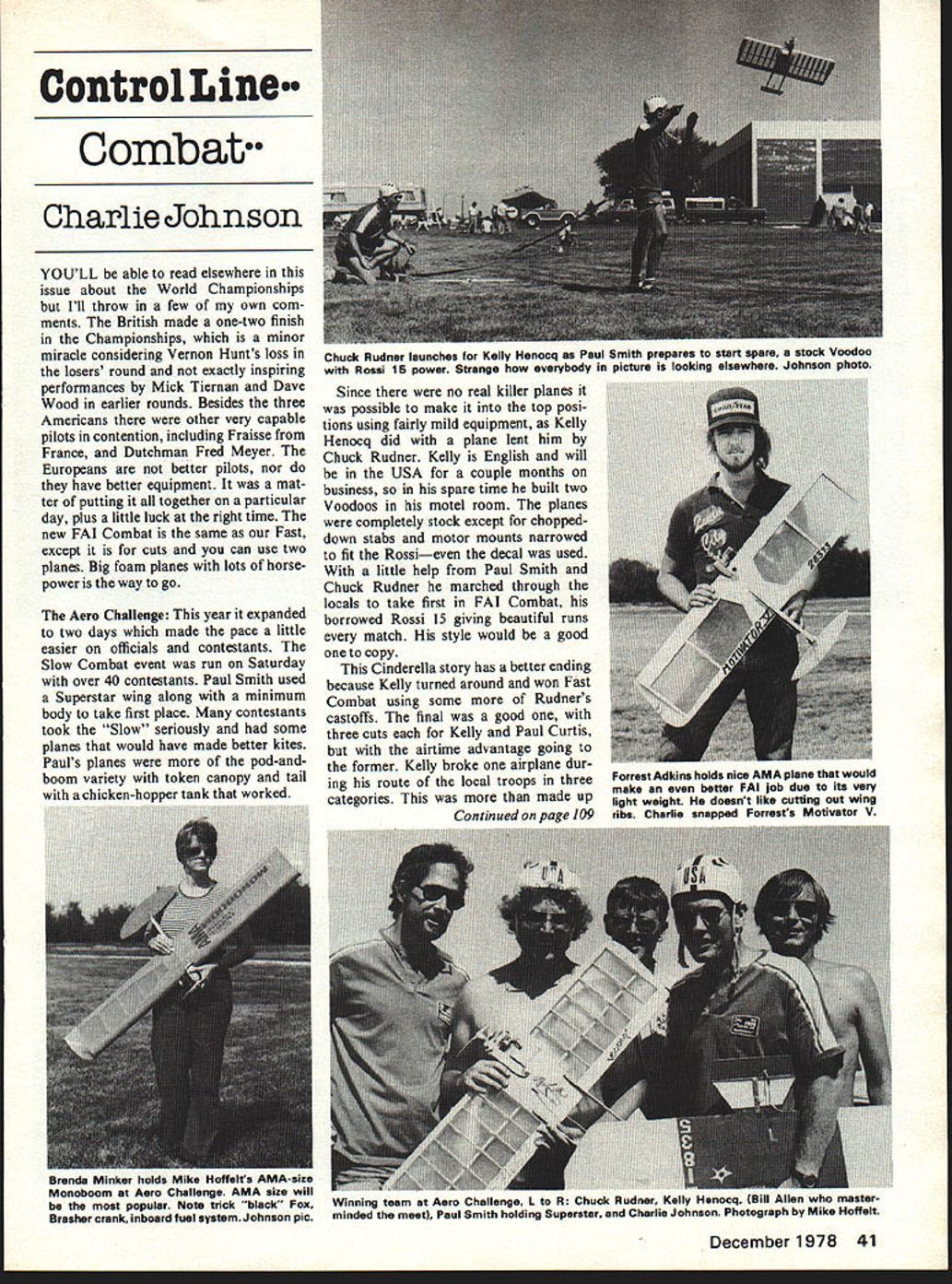
This year it expanded to two days, which made the pace a little easier on officials and contestants. The Slow Combat event was run on Saturday with over 40 contestants. Paul Smith used a Superstar wing along with a minimum body to take first place. Many contestants took the "Slow" seriously and had some planes that would have made better kites. Paul's planes were more of the pod-and-boom variety with a token canopy and tail and a chicken-hopper tank that worked.
Since there were no real killer planes it was possible to make it into the top positions using fairly mild equipment, as Kelly Henocq did with a plane lent him by Chuck Rudner. Kelly is English and will be in the USA for a couple of months on business, so in his spare time he built two Voodoos in his motel room. The planes were completely stock except for chopped-down stabs and motor mounts narrowed to fit the Rossi—even the decal was used. With a little help from Paul Smith and Chuck Rudner he marched through the locals to take first in FAI Combat, his borrowed Rossi 15 giving beautiful runs every match. His style would be a good one to copy.
Kelly turned around and won Fast Combat using more of Rudner's castoffs. The final was a good one, with three cuts each for Kelly and Paul Curtis, but with the airtime advantage going to Kelly. He did break one airplane during his route of the local troops in three categories, but that was more than made up for with the prizes. He was rewarded with:
- a Rossi for his FAI win
- a TWA 36 for Fast
- a complete Carter Bumblebee kit for third in Slow Combat
- other assorted goodies
Open contestants and racing events
Open contestants were concerned. In fact, TR was better attended at W‑S due to the World Champs conflict for the Nats. I competed at W‑S but was working as CL category director at the Nats and could only stand and watch. The one item that really stands out after these contests is the overall performance level of the contestants in Goodyear.
This is the first year where the use of any tuned pipe, other than a mini-pipe, was not allowed in the racing events. This affected Goodyear more than any other event since the megaphone was the apparent "hot" setup. Some of us never thought that the pipe was worth the effort. It seems this contention was proved since the Goodyears are running faster this year than ever. All of a sudden, all the performance that had been hiding inside the inconsistency of the pipe just burst onto the scene! A year ago, a Goodyear running in the 15's was a very good airplane. This year, there are at least a couple that are dipping into the 14's. The ten finalists at the Nats qualified with times under 3:00! Last year, if memory serves, there were only two times under 3:00.
Rat at both contests was still at the same performance plateau that it has been at for several years. Both contests were won by the Lamberts, Dick and his father Harold, with times in the low 4:50's. This corresponds to last year's two-pit time of about 4:40, a level that has been the norm for four or five years. Rat isn't getting faster, although I feel that the potential is there if someone can really put it all together. I have witnessed a 4:36 three-stop time this year here in Houston, turned by Dick Ritch, and Tim Gillott turned a 4:39 in Eugene, Oregon this summer. These races were no flukes, but the bugs keep jumping up to keep the times from being consistently better.
The Nashville Rats still reign as the Kings of Slow Rat, winning handily at both the W‑S and Lake Charles contests. Times this year at the Nats were quite a bit better than last, even with the burden of an additional pit stop in the finals. The big question left unanswered in this event is the inadequately defined infamous "production" engine rule that leaves Contest/Event Directors in a quandary. The AMA's Control Line Contest Board is going to have to supply some answers on this one!
A Tale of Woe
Mike Hoffelt wanted me to fly some of his Monoboom designs at the World Championships for demonstration purposes. Since I was leaving three weeks ahead of time and landing in Casablanca, we decided to ship the models to Manchester. Mike did everything right. He built a strong box to ship them and sent them air freight in plenty of time to arrive before the contest. Apparently, $150 freight charges don't guarantee anything because the models took nine days to get to Manchester rather than the two the company had promised, and then they sat in British Customs and we weren't notified.
I came home the day after the Championships not knowing that the models had arrived in England. Thus, we had to have them shipped back to the USA for another ridiculous amount. We learned our lesson the hard way with the models, and also with several cases of fuel that were shipped over. You can trust the freight companies to do the wrong thing. If I can't carry it on the plane with me I'm going to make sure it gets in the cargo compartment of the plane I'm flying in. The very worst time for losing your baggage is when making connections between different flights; you may make it but your baggage won't.
Engines and equipment
There hasn't been too much happening in engines since the latest Fox hit the market. The Brasher cranks and a little rework have made them potent and reliable. The Perry‑port Supertigre hasn't done much except weigh more than previous models. The hop‑up artists haven't been able to pull much power out, and the engine design seems to have topped out horsepower‑wise. A new Schnuerle is their only hope of catching Fox.
The K&B 5.8 is a real killer but its weight is against it. At the DeKalb meet I saw some of the latest TWA combat engines produced by Glen Dye. I think the engine has more potential than anything else on the market. It's a rear‑exhaust Schnuerle using an early model K&B‑type front end, backplate, and rod. The liner is brass and the piston aluminum; they say it is almost impossible to destroy with a bad run. The rear exhaust gives the most even run through the turns. If you don't like the exhaust blasting your wing, you can turn it around and have a front exhaust—which would cool better anyway. A little elbow on the exhaust stack would deflect the exhaust away from the intake.
If you're interested in this highly refined engine write to Performance Model Parts, Inc., 1015 South 6th St., Minneapolis, MN 55415. List price on the combat model is $75.00, which you might think is rather high for an engine that will get buried, burned down and generally mistreated. Out of the box the engine is ready to go, no need to purchase special bearings or a replacement rod and crank. We don't need more horsepower in the AMA events, but more dependability, which this engine should offer—at a price.
FAI Combat preferences
Something less expensive than a Rossi for FAI Combat? You bet. The USA team started off practice at the World Championships using Rossi 15's and ended up with Fox 15's. The Fox made almost the same power as the Rossi when tuned for combat, had about double the fuel mileage, insensitive needle settings, started easily and could use almost any prop without complaining. I'll save a Rossi for an all‑out exhibition plane, but it's gonna be Fox for me in FAI from now on. Chuck Rudner took a chance on one of his motors, not replacing the Fox glow plug with a screw‑in type, but no problem—even on the 50% nitro these engines love to run on.
Charlie Johnson 3716 Ingraham St. San Diego, CA 92109
Transcribed from original scans by AI. Minor OCR errors may remain.

