
Control Line: Combat
Charlie Johnson
Phil Cartier FAI combat model — overview
Upon my return from the World Championships I received a pleasant surprise from Phil Cartier: an almost-ready-to-fly FAI combat model. These planes are shipped in heavy cardboard boxes with plywood reinforcement on the sides to avoid a crushed critter. Mine arrived in perfect condition.
The wing is already covered, controls installed, and the motor mount, monoboom and tail are painted and ready to epoxy in place. Even the dowel for the motor mount and pushrod, the horn, and an adjustable link are furnished. Assembly takes about half an hour, but it would be a good idea to use slow-dry epoxy for maximum strength; in that case the model should cure overnight. Assembly could be done at the flying field if you have access to a soldering gun and power supply.
The completed plane weighed 15¼ ounces with a Fox 15, Tornado 7-4 white prop, bladder but no fuel. No trimming was necessary except to add a couple turns of down in the control linkage. No warps — it flies right off the board (or out of the box). The Fox runs best with about 50% nitro; a little more power makes for a better flight. Handling is predictable and the plane's tight turning radius helps get you out of trouble when you get over your head.
Consecutive loops, U-turns, wiggles, and top speed (100+ mph) are more than acceptable. What the plane doesn't do is last for a season of sport flying. This is a competition airplane and it will last through enough matches to get your money's worth, but fatigue does set in after several dozen flights, especially if you break a bladder as I did. My sample did not have a bladder tube and I think it would be a good idea to install one. Phil may put them in the new planes after our experience with Frost's plane at the World Championship, which broke two bladders in one match.
Fuel systems and pit recommendations
The Fox is insensitive to needle settings, but a Rossi may give trouble with a high-pressure bladder. An alternative I'd suggest is to use a pacifier. I was tempted to install a pod on my test plane but left it stock. Heavy-handed pitmen should steer clear of this model too; the trailing edge is not reinforced and can be damaged if held against a body. The balsa tip ribs are handy for hanging additional weight if you need it for windy weather or more pull.
You'll notice the difference in handling between the beginning of the flight with a full load of fuel and the end where the plane hinges less in hard turns. The pacifier pod would minimize that difference. Check the MACA Newsletter for the latest information on the price and availability of the model.
Goodyears (W. R. Lee)
W. R. Lee 3522 Tamarisk Lane, Missouri City, TX 77459
The first weekend in October I was back at Ft. Worth and turned a 5:32. This is not a "pat myself on the back" scene, but a lead-in to a few words on fast Goodyears. Right now there are some really good-running planes in the country, several consistently in the low 15s and a couple in the 14s! I'm fortunate to have one that is regularly running 14.5 to 14.8 seconds for 1/2 mile. Why does it go so cotton-pickin' fast? To tell the truth, I don't know! I have some ideas that I'll pass along.
You might look at the pictures that accompany this column.
Engine
I run an old, small-crank Rossi that was originally set up by George Aldrich. I switched to an ABC piston/liner two years ago and feel that this is the best set-up. The liner/piston is completely stock — one of two I got last winter from Bud Harris. I also feel that the small-crank Rossi is superior to the later large-crank versions if you can keep it together. So far (knock on wood) I have not yet blown up any of my engines.
Propeller
I have been using Kelly fiberglass props for several years. Initially I used the Tornado nylon 7-6 cut to about 6-3/4". This was quite competitive five years ago. One of the first 7-6 props Kelly produced was the fiberglass copy of the Tornado nylon, and I found that merely switching from nylon to glass was worth about 0.5 second. Then one day in a race I nicked a prop on a pit and found about another 0.5 second; later measurement showed the diameter down to about 6-1/2". That was the size I used in Riverside in '77, placing fifth.
This year I built a new plane and went out early in May to test it. With last year's prop it was going about 15.3. I had a couple of Kelly's new props, the Willoughby 6-3/4-5/4, which is actually about 6-1/2 to 6 when measured. This prop is what Stew Willoughby used in Riverside and is basically a thinned-blade version of the Kelly Tornado equivalent. I switched to this prop (stock) on the new plane and immediately went to 14.8! Props are where it's at.
Airframe
My Goodyears have been somewhat unique over the years in that I have built, in the last six years, with totally internal controls: pushrod, control horn, everything. I have consistently striven to make the airplane as slippery as possible, even building the landing gear into the fuselage so that it is out of the air. I believe the new plane is the best so far in that, except for the quick-fill tube, everything that could cause serious drag is hidden behind the engine or built inside the profile fuselage.
I don't know if any of these items are terribly important individually, but the total combination works, as the plane's performance will attest.
CL Combat — Johnson (continued)
Line lengths and fly-aways
In the AMA Combat events we have a plus-or-minus line length that could add up to one foot differences between opposing models. Even with this much leeway you'll find many contestants using improper line lengths. Over the years I've found that contestants will use whatever they have, even if it means being at a disadvantage with short lines. Lax checking at meets (and at the Nats) means more fly-aways because of greater differences in line length.
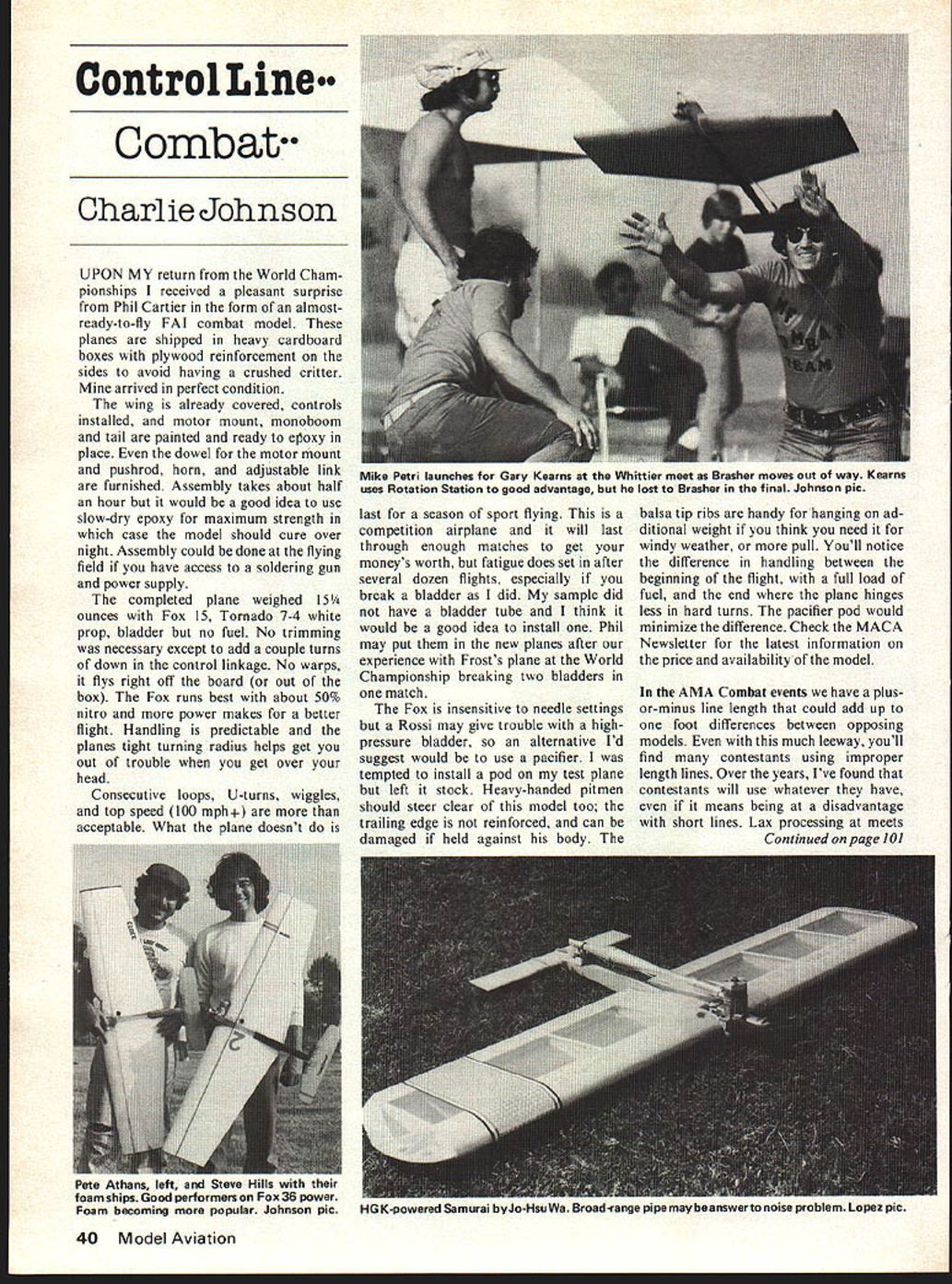
I'd noticed that certain fliers were always involved in fly-aways and, upon close inspection, found that they invariably stood several feet behind the other person and zeroed in on the lines. Some pilots use their outboard wing on a foam model to snag the string — it cuts through the foam and locks in to assure a kill. One of the pictures shows a good example of this.
Streamers
Streamers are also a big problem at contests. Light crepe doesn't cause damage to models, or wrap up engines, but it has other drawbacks. The shock of hitting the crepe paper often broke the string, and it sometimes broke just from the stress of 100-mph speeds (140-mph for you Texans). Heavy string and 1/4" tape down the center of the streamer is the way to go, but rolling up the streamers was always a hassle.
Bill Allen uses a clothes-pin arrangement in a low-speed drill: just insert the end of the streamer and apply power; with very little effort you have a nicely rolled streamer. Taped streamers stand up in rainy weather and usually require a prop to cut them. Note that the new crepe paper is 8½ feet, so don't mix it up with the old 10-foot variety. Also be sure to leave enough string ahead of the mark to tie securely on the plane.
Differential props — fact or fiction?
I first heard about differential-pitch props in the MACA Newsletter a few months back and thought someone was pulling my leg. At the Aero Challenge I cornered Bob Burch and found out the straight scoop. It seems the prop-making machine was producing props with 1/4" more pitch in one blade than the other. The pylon racers true up the hub anyway, so they could have cared less. The combat lads found the prop worked better for them if left with this differential pitch: top-end speed is supposed to be enhanced by the higher-pitch blade, and turns are better because of the lower-pitch blade. Props do funny things in the air, so any argument or theory is as good as anyone else's.
My theory on "theories" has always been to do as little as possible scientifically, or you'll get hung up on experiments and forget why you're doing it — flying combat. A bash-'em-crash-'em event like ours lends itself more to seat-of-the-pants research than to anything very scientific. A "scientific" approach to piloting skills would be of greater value than differential-pitch props. But the quest for the free horsepower is still there, and since it's easier to use the prop "as is" than to true up the blades, I hope there is something to be gained, or at least not lost. Three props, courtesy of Bob Burch, may help me make up my mind. Write quickly if you have any test results so I can publish them next issue.
Tuned pipes
Check out the picture of the tuned pipe on the FAI combat model. It may be the way to go if noise presents more of a problem in the future. Pipes can be designed to work over a very broad range. A great boost in performance is not really needed — just less noise and more dependability.
Charlie Johnson 3716 Ingraham St., San Diego, CA 92109
Transcribed from original scans by AI. Minor OCR errors may remain.

