
Combat
Tom Southern
FROM ENGLAND to Mexico City, combat fliers came to Lake Charles, La. to compete in the U.S. National Championships. Few other contests in our country can compare to the Nationals for combat competition, and the best from everywhere showed up at Lake Charles to pit their skills and their planes against one another.
Combat has always ranked among the top spectator drawing events at the Nationals. This year the spectator got to see the best Combat that the Nationals has ever produced. For instance, FAI Combat this year came into its own, highlighted by a match between Bob Burch of Cicero, Ill., and Richard Wilkins from England. This match was by far the "Best Match" of the entire week, possibly the best I have ever seen anywhere. Both fliers were given a standing ovation by the spectators and competitors alike when they finished the match. A fine show of flying ability and super moves left Bob Burch the winner of the match. Richard Wilkins, by virtue of the FAI rule which flies the losers of the first round off to get back into the winners bracket, went on to win 5th place in the FAI event.
Richard Stubblefield of Houston, Tex., and winner of Open Combat last year, was back to defend his title this year. Richard must have come to fly Combat this year because no less than twice did I see him tell his pit crew to put him back up when his airplane was in the pit and he had the match won even if he stayed down. If we had a sportsmanship award in Combat, Richard Stubblefield would get my vote. Richard finally finished 3rd in Open Combat and 1st in Open Slow Combat.
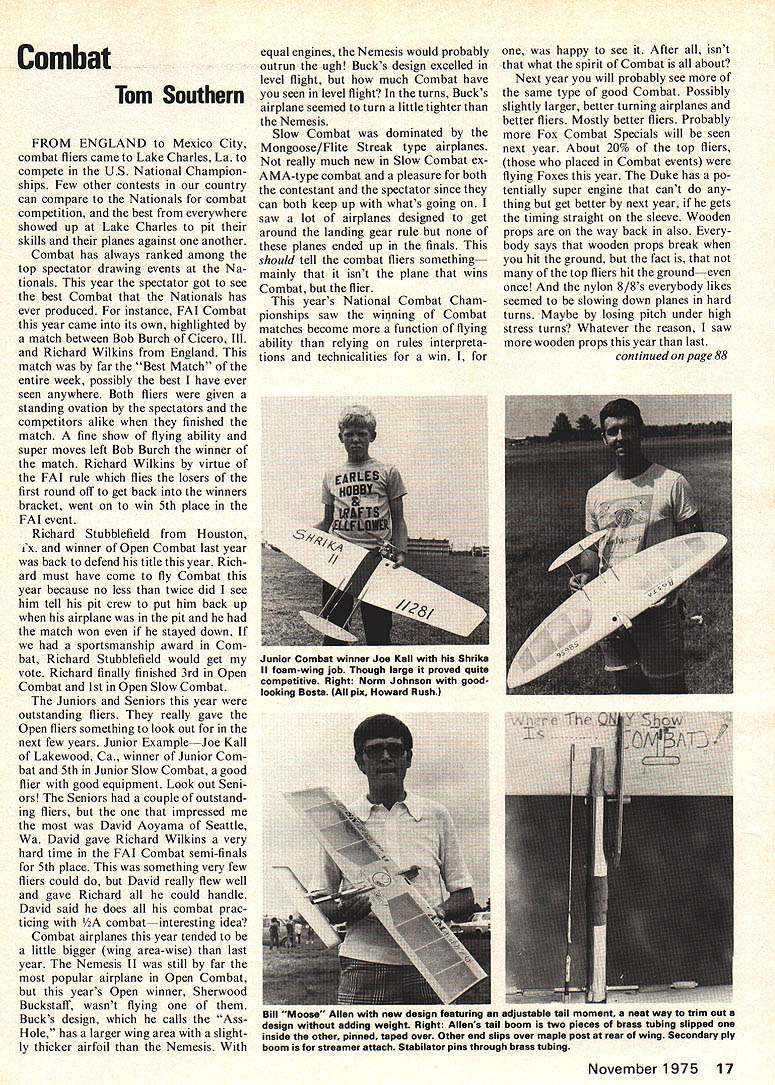
The Juniors and Seniors this year were outstanding fliers. They really gave the Open fliers something to look out for in the next few years. Junior example — Joe Kall of Lakewood, Ca., winner of Junior Combat and 5th in Junior Slow Combat, a good flier with good equipment. Look out Seniors! The Seniors had a couple of outstanding fliers, but the one that impressed me the most was David Aoyama of Seattle, Wa. David gave Richard Wilkins a very hard time in the FAI Combat semi-finals for 5th place. This was something very few fliers could do, but David really flew well and gave Richard all he could handle. David said he does all his combat practicing with 1/2A combat — interesting idea?
Combat airplanes this year tended to be a little bigger (wing area-wise) than last year. The Nemesis II was still by far the most popular airplane in Open Combat, but this year's Open winner, Sherwood Buckstaff, wasn't flying one of them. Buck's design, which he calls the "Ass-Hole," has a larger wing area with a slightly thicker airfoil than the Nemesis. With equal engines, the Nemesis would probably outrun the 'Ass-Hole.' Buck's design excelled in level flight, but how much Combat have you seen in level flight? In the turns, Buck's airplane seemed to turn a little tighter than the Nemesis.
Slow Combat was dominated by the Mongoose/Flite Streak type airplanes. Not really much new in Slow Combat — ex-MA-type combat and a pleasure for both the contestant and the spectator since they can both keep up with what's going on. I saw a lot of airplanes designed to get around the landing gear rule but none of these planes ended up in the finals. This should tell the combat fliers something — mainly that it isn't the plane that wins Combat, but the flier.
This year's National Combat Championships saw the winning of Combat matches become more a function of flying ability than relying on rules interpretations and technicalities for a win. I, for one, was happy to see it. After all, isn't that what the spirit of Combat is all about? Next year you will probably see more of the same type of good Combat. Possibly slightly larger, better turning airplanes and better fliers. Mostly better fliers. Probably more Fox Combat Specials will be seen next year. About 20% of the top fliers (those who placed in Combat events) were flying Foxes this year. The Duke has a potentially super engine; he can't do anything but get better by next year, if he gets the timing straight on the sleeve. Wooden props are on the way back in also. Everybody says wooden props break when you hit the ground, but the fact is, that not many of the top fliers hit the ground — even once! And the nylon 8/8's everybody likes seemed to be slowing down planes in hard turns. Maybe losing pitch under high stress turns. Whatever the reason, I saw more wooden props this year than last. Well, so much for the fliers. There was a group of Combat fliers at the Nats this year that did not get to fly Combat! What, say? Did those sorry people running Combat not let them fly? No, as a matter of fact, those guys didn't fly because they ran the event this year, and did a super job, too. I was listed as Co-director of Combat but I didn't do that much, so I can talk about it. Gary James, Kan.; Greg Turpin, Ca.; Ron McNally, Va.; and Pat Wilcox, N.J., really did a fantastic job of running the event. Everything was run on scheduled times and the schedule was realistic and adhered to. This resulted in an event that ran continuously and smoothly through the whole week. Four independent judges were used on each match—two on each plane. Not very much was missed and only two protests were filed the whole week — a new record for Combat at the Nats. There was a rumor around the hangar that Pat Wilcox and Ron McNally may run Combat at the Nationals next year. If that is true, it will be even better than this year because these guys really know what they are doing.
Another thing that all these people have in common is the fact that they are all MACA (Miniature Aircraft Combat Assoc.) members. In fact, over half of the top 35 Combat fliers from this year's Nats are MACA members! So, if you have read this article this far, you are bound to be a Combat flier and you need to be a part of MACA. Send $5.00 to Tom Southern, 2207 Paul, Longview, Tex. 75601 for a year's subscription to the MACA Newsletter. But I digress.
Combat is finally getting down to flying ability. Joe Kall, Ca.; Tim Blake, Tx.; and Sherwood Buckstaff, Tx., this year proved to all of us who were there that they weren't pansies, and if anyone wants to beat them next year, they better be ready to out-fly them and not stop to quarrel about the rules. I feel sure they will all be back next year to give all you Combat fliers a chance at them.
Transcribed from original scans by AI. Minor OCR errors may remain.

