
Control Line: Combat
By Charlie Johnson
NASA and Honda factory teams sweep Nationals! Well, not really, but if the trend toward more professional competition continues and there is an escalation in the number and amount of cash prizes, we may see some real "factory teams." As it stands, many manufacturers sponsor a good number of competition fliers, but generally they had the name before the sponsorship. What if a big company like Honda decided there was enough prestige in winning various model airplane events to invest time and capital in developing a winning team?
Most of us aren't really good enough to compete against full-on teams. If Honda and NASA teamed up they'd make some killer speed models, free flights, or whatever.
Factory teams and combat
Suppose combat were the chosen target. The first day unlimited technology would produce a power package that made more power than a Rossi or Fox, weighed less because of superior alloys, and used a fuel system that worked flawlessly every time. In the .35-size class they could even design an engine that didn't break cranks.
Back at training camp the team would be practicing with an unlimited number of first-line models. Team members would be selected not only for flying skills (which can be learned) but for reflexes, coordination, and aggressiveness. The same guy could go out and learn to run 200-mph laps at Indy. With no compromise in equipment (what's a couple thousand carbon-fiber props to a big corporation?) and the best talent in pilots and coaching, there's no doubt what would happen—look at any professional sport.
When's the last time you drove in the Monaco Grand Prix?
World Championship and team trials
You do have a chance to represent your country in the next World Championship if you start preparing now. The team trials are proposed for September, so enter, build lots of planes, practice, and you'll get a team spot—provided you beat all the other guys. The next World Champs will be in Poland, which may make travel arrangements a little more difficult for those not on the team. Judging by the number of combat observers from the U.S.A. at the British World Champs, two of you might be better off renting a car in Germany and driving.
Manufacturers and contacts
People do move, so addresses change. When writing anyone for information, include a stamped, self-addressed envelope.
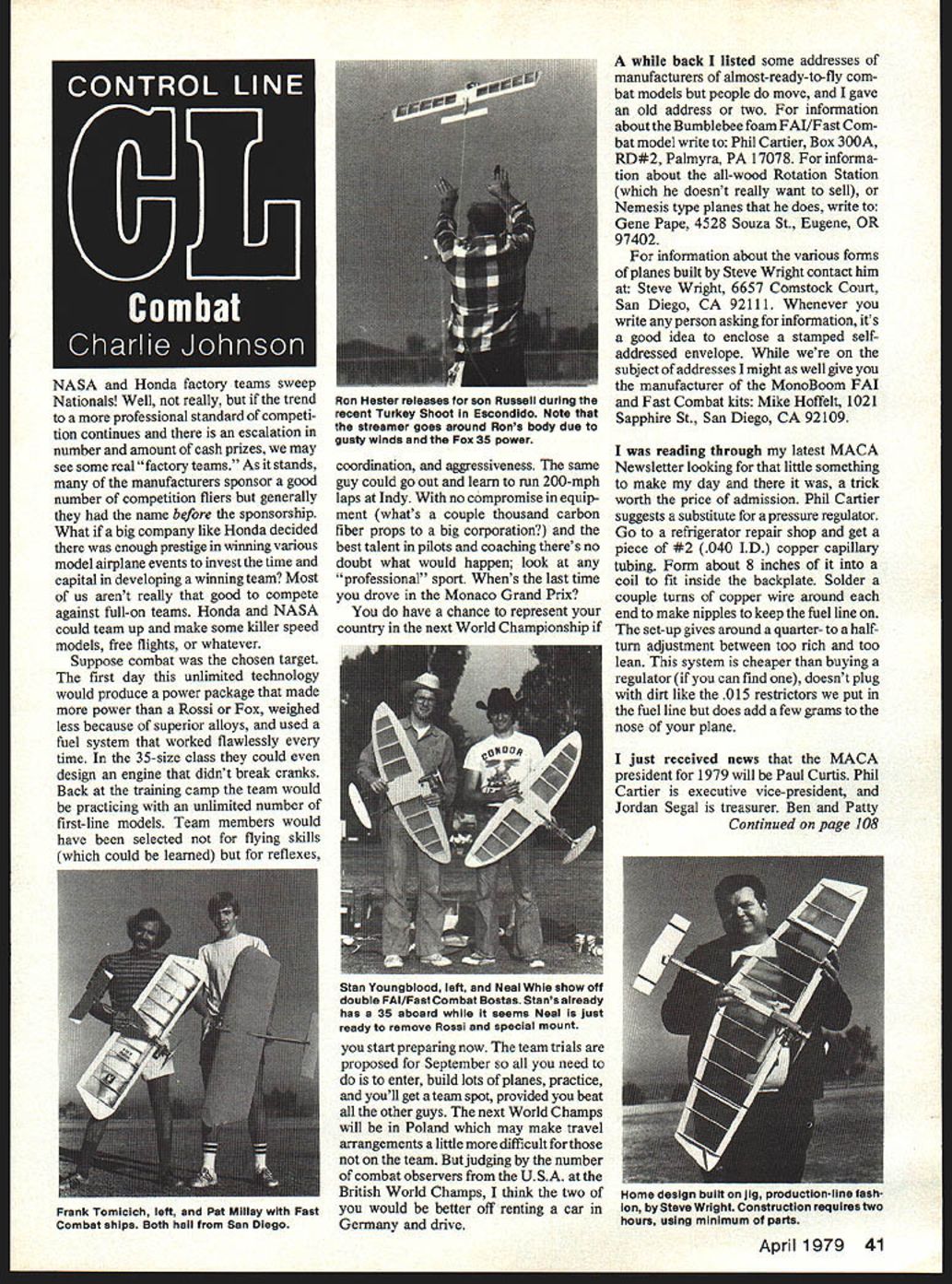
- Phil Cartier — Bumblebee foam FAI/Fast Combat model
Box 300A, RD #2, Palmyra, PA 17078
- Gene Pape — Rotation Station (all-wood) and Nemesis-type planes
4528 Souza St., Eugene, OR 97402
- Steve Wright — Various plane designs
6657 Comstock Court, San Diego, CA 92111
- Mike Hoffelt — MonoBoom FAI and Fast Combat kits
1021 Sapphire St., San Diego, CA 92109
Fuel-regulator substitute (Phil Cartier tip)
Phil Cartier suggests a cheap substitute for a pressure regulator: get a piece of #2 (.040 I.D.) copper capillary tubing from a refrigerator repair shop. Form about 8 inches into a coil to fit inside the backplate. Solder a couple turns of copper wire around each end to make nipples to keep the fuel line on. The setup gives around a quarter- to a half-turn adjustment between too rich and too lean. It's cheaper than buying a regulator (if you can find one), doesn't plug with dirt like the .015 restrictors we put in the fuel line, but it does add a few grams to the nose of your plane.
MACA news and membership
- I just received news that the MACA president for 1979 will be Paul Curtis. Phil Cartier is executive vice-president, and Jordan Segal is treasurer.
- Ben and Patty Sasnett will continue as newsletter editor(s).
- MACA membership: send $6.00 to MACA N/L Editors, 1443 McKinley Ave., Escondido, CA 92027, or Jordan Segal at 8314 W. Oak Ave., Chicago, IL 60648.
- The site of the MACA Nationals will be either Chicago or Nashville, depending on a possible runoff between top finishers in the recent poll.
Prop construction, fibers, and molding
Fibers and materials
The fiber you use in the prop gives it much of its final characteristics. Fiberglass fibers are commonly used and can be obtained by cutting and stripping a piece of extra heavy glass cloth. Another commonly used, but harder to obtain, fiber is carbon (graphite) fiber. Union Carbide's Thornel carbon fiber is available in small quantities; the WYP-15 grade of yarn is recommended for prop making. Thornel is priced around $32–35 per pound; you will use only about 1/4 ounce of the fiber in a typical 8" prop.
When working with resins and fibers, wash your hands and avoid breathing the vapors as much as possible.
Saturating the fibers and laying in the mold
When you get ready to start loading the fibers into the mold, it's important to get them thoroughly saturated with resin. If you attempt to do this in the mold itself you'll likely damage the PVA release coating and may destroy the mold after the prop has cured.
- Use a large sheet of aluminum or other non-porous material.
- Arrange the fibers on the sheet in the order you intend to lay them in the mold.
- Pour some mixed resin over the fibers and use an epoxy brush to work the resin into them.
- Once saturated, pick the fibers up with the point of a knife and your fingers and lay them gently in the mold, positioning them where you want them to lie. A little liquid resin in the mold will help placement.
- Get a lot of fibers into the hub—no voids in this critical area.
- Pour the remainder of the resin into the mold.
- Place a small piece of light fiberglass cloth in the center of each tip of the prop as you lay in the fibers; this increases resistance to splitting at the tips.
When you place the mold together you should get a fair amount of resin oozing out—keep everything covered with wax paper so spilled resin will be easy to dispose of when hardened.
Curing and demolding
Once the resin has set up so it is no longer runny, cure the prop to ultimate strength by applying heat: place the mold and prop in an oven set at about 150–200°F for a couple of hours. While this might not be the optimal cure schedule for every resin, most epoxies benefit from elevated-temperature cure.
When removing the mold/prop assembly, be careful—the mold is hot and can burn you, and it will break easily when hot. If the PVA release agent was properly applied, the mold will almost pop apart while hot.
FAI contest notes, rules, and flying
Some innovations in FAI were tried during the December FAI contest in San Diego. Paul Smith used the ladder elimination system as proposed for the team trials. An itemized tally of each contestant's score was available, listing air time, cuts, points lost for various infractions, and position on the ladder.
- Best offensive flying at the meet was done by Greg Hill, using a Hoffelt Monoboom primary plane and his own-design backup; final score was around 784 points. The fully taped streamers let you get small cuts rather than tearing the whole streamer off.
- Best defensive flying was done by Paul Smith, using a Cartier FAI Bumblebee while trying to avoid letting Greg Hill get a cut. The Cartier design is excellent for low-level maneuvers; Paul jockeyed inches off the ground to keep the ground out of his plane between Greg and the streamer. Greg avoided hitting the ground for about three minutes and finally got a cut on Paul when he came up for air.
With the new minus-points rule in FAI, defensive abilities will be tested since you can no longer rely on building air-time margin by taking a few quick cuts; you can end up with minus scores over 200 points.
Rule discussions and suggestions
- Fast and Slow Combat rules are being revised again this cycle—this tends to happen every two years.
- A common suggestion is to increase line length to 60 feet (or 70 feet in Fast and Slow) to slow things down.
- The use of alkyl oil fuel may be worth considering because of increasing cost and unavailability of some fuels in Europe.
- There is recurring debate about minimum model weights, maximum number of models per contest, and allowing only one model per match. Most people favor the one-model-per-match rule because it reduces emphasis on super pit crews and is closer to traditional competition.
Props and experiments
You may have heard about differential-pitch props being better than equal-pitch props. My tests aren't scientific enough to detect subtle differences—top speed, elapsed time through a speed pattern, and the Johnson Shakeometer test couldn't find enough difference between supplied props. That lets me keep using an 8½–6½ prop without truing the hub.
I'm going to try a single-blade prop like those used on FAI speed planes. The idea came from a Newton FAI speed kit: they take a Zinger or Rev-Up, chop off one blade, then add pieces of .015 brass shim on each side of the hub, extended out far enough to fill with solder for counterweight. All this fits inside the spinner so you only have one hole where the prop exits. Static balance can be done with a normal Prather-type balancer; dynamic balance is another story. Maybe I'll try it on someone else's motor first.
If any combat types are interested in a two-line speed model that goes and looks like the "big boys," with a real magnesium pan and metal wing, write to:
- John Newton — 2154 Los Padres Drive, Rowland Heights, CA 91748. Price: around $104 for a semi-finished kit.
Sources
- Puffer Supply Co., 112 Meyerland Plaza, Suite 25, Houston, TX 77096; phone (713) 668-9457. Distributor in Houston for Hy-sol brand epoxies. My source for epoxy resins for molds and props.
- Union Carbide Corp., Carbon Products Div., c/o David G. Lowery, 120 S. Riverside Plaza, Chicago, IL. Source for Thornel carbon fiber.
- Bill Lee, 3522 Tamarisk Lane, Missouri City, TX 77459.
- John Newton, 2154 Los Padres Drive, Rowland Heights, CA 91748.
- MACA N/L Editors, 1443 McKinley Ave., Escondido, CA 92027.
- Jordan Segal, 8314 W. Oak Ave., Chicago, IL 60648.
Charlie Johnson 3716 Ingraham St., San Diego, CA 92109
Transcribed from original scans by AI. Minor OCR errors may remain.

