
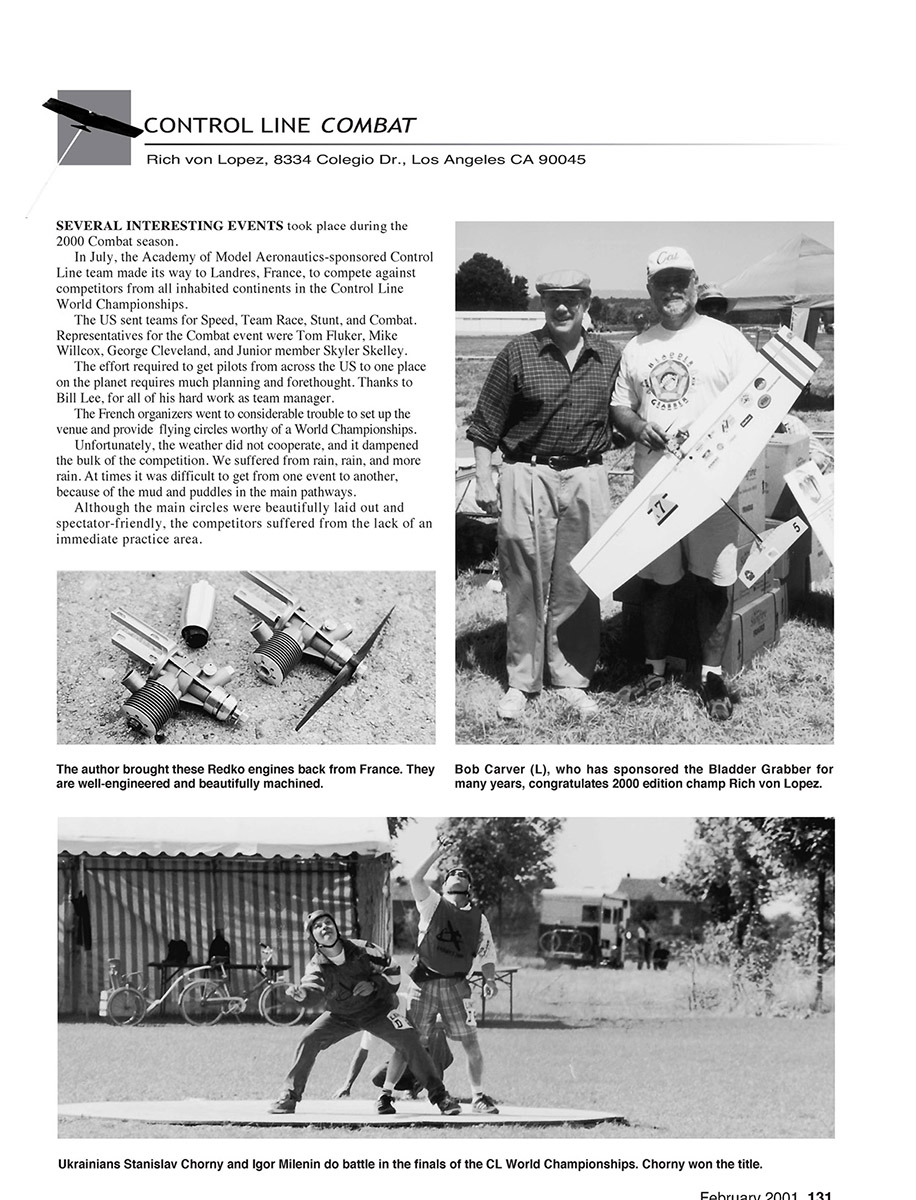

CONTROL LINE COMBAT
Rich von Lopez, 8334 Colegio Dr., Los Angeles CA 90045
2000 World Championships — Landres, France
Several interesting events took place during the 2000 Combat season. In July, the Academy of Model Aeronautics-sponsored Control Line team traveled to Landres, France, to compete against pilots from all inhabited continents in the Control Line World Championships.
The US sent teams for Speed, Team Race, Stunt, and Combat. Representatives for the Combat event were:
- Tom Fluker
- Mike Willcox
- George Cleveland
- Junior member Skyler Skelley
The effort required to get pilots from across the US to one place on the planet required much planning and forethought. Thanks to Bill Lee for all of his hard work as team manager.
The French organizers went to considerable trouble to set up the venue and provide flying circles worthy of a World Championships. Unfortunately, the weather did not cooperate and it dampened much of the competition. The meet suffered from rain, mud, and numerous delays. At times it was difficult to get from one event to another because of the mud and puddles in the main pathways. Although the main circles were beautifully laid out and spectator-friendly, competitors suffered from the lack of an immediate practice area.
The organizers did provide a practice site approximately ten minutes from the main flying area. To use it you had to pack up your gear, drive out, set up at the practice site, then return it to the main field. Combat pilots were told they could not use the fields next to the Combat circles, and that the contest circles could not be used for practice during the lunch break. While you must be ready when you arrive for a World Championships, practice sites are needed all day long within walking distance of the main circles.
The American team had an unfortunate incident early one morning before the day’s flying. Mike Willcox had the last flight one day and was first on the list to fly the following day. He had damaged models from his last bout and needed to clean out his front-line engines, so he was happy to have the night to get ready. Mike decided to put up a couple of test flights before his match. Since no test-flying was permitted on the contest circles and the practice field did not open until 8 a.m.—the same time as Mike’s match—he went out to the countryside for a couple of quick flights. A high-ranking organizer spotted Mike test-flying and, using his authority, confiscated Mike’s models. Mike protested his 8:00 match so he could regain possession of his impounded airplanes. After a great deal of worrying and a very diplomatic apology, he was able to continue later that day.
Mike looked comfortable while flying and put together a string of five straight wins before two losses put him out. His effort was good enough for a tie for sixth place. With three wins, Tom Fluker finished in a tie for 13th place. George Cleveland and Skyler Skelley earned one win apiece, tying for 33rd place. Skyler represented himself well and was impressive during all his bouts.
Models, Engines, and Equipment
There was nothing revolutionary in model airframe design or technology at this contest. Many pilots used store-bought Czechoslovakian- and Ukrainian-made models — presumably a time- and cost-saving choice rather than building them from scratch. Toward the end of the contest, you could buy a variety of models for $20–$35. Some were neatly finished and rigged; others were more crudely done. Transporting models back to the US was the real problem.
Notable observations:
- Mike Willance of Great Britain used all-foam models with plenty of wing area; they performed comparably to the Russian-style models. His father, Stan, builds and supplies him with models used as whackers — and Mike often scored two whacks per bout.
- Fuel sold locally in France had different oil and nitro content than US fuels, so many pilots recommended bringing your own fuel.
Available engines in France included Redko 2.5s and some older Russian types. The Redko engines are well engineered and beautifully machined; the author brought a pair back from the meet.
Team Finland hired former World Champion Slava Believ and his son Sergei to pit and chase streams. It was strange not to see them participating as pilots.
Finland’s number-one pilot, Jari Valo, always has some of the fastest models at the World Champs. He works very hard at getting the most out of each engine and takes great care with the details. Jari finished with only one win. Boris Faizov of Russia is another consistently fast pilot with very clean equipment; however, speed is not everything and Boris went out early with no wins.
There were plenty of newly designed engines to view and purchase — if you could produce the gearbox. The trend was to put the venturi on the inboard side of the engine, facing forward. Cyclon engines advertised on the Internet had inboard venturis facing rearward, but the versions for sale in Landres were forward-facing. Zorro, KTN (Moscow), and Redko engines were also sporting this new look. The Redko went one step further by incorporating an integral engine-mount backplate and doing away with mounting lugs. Defending Junior World Champion Alexander Gussev used the new Redko.
The author was most impressed by the KTN and the more conventional Fenom engine from the Ukraine; a couple of these seemed to be developing more torque and were being given propellers with more pitch than usual.
Imports and Vendors
George Cleveland is the owner of GRS Models:
- GRS Models, 2121 North Causeway Blvd., Metairie LA 70001
- Tel.: (504) 443-4640
George has been importing models and other hobby items from the Ukraine; the quality and price have been good. He is supposed to import the Fen and make it available in the United States. The author purchased two of the new Redkos from Alexander Redko and reports the design is unique and produces a great deal of power on a variety of propellers.
Competition Results and Highlights
The Ukrainians dominated the World Championships, placing first and second. Igor Milenin fell to his teammate Stanislav Chorny in the final. Zorro engine-builder Igor Zolnerkevitch of Belarus took third place. Former World Champion Loet Walkerman looked as though he might make the finals but fell short.
During the lunch break on the final day there was a ladies’ Combat demonstration by Luun Leino and Monique Walkerman — both very talented. Sergio Demeniev of Moldova finished in a tie for 10th place and was awarded the Junior World Champion title.
The competition was overall well-run, although rain delays made it difficult to schedule viewing of particular pilots.
Stunt pilot Paul Walker turned in an incredible effort with a four-engine B-17 bomber in the Stunt event, an event judged subjectively like Olympic diving or gymnastics. Paul stole the show; he flip-started an OS .MAX 15 on one flip almost every time and flew better than the ninth-place finish the judges awarded him. The French had not seen a B-17 flyer on their soil in many years, and the aircraft had a memorable impact on spectators.
To add to the drama, Bill Wewarga flew a spectacular Republic Thunderbolt to sixth place.
Other Contests and Notes
- The author won the Bladder Grabber.
- Gary Perkins won the Riverside triple-elimination Fast Combat contest.
- Mike Willcox won the Houston Combat Classic.
Transcribed from original scans by AI. Minor OCR errors may remain.

