
CONTROL LINE COMBAT - 2001/04
Rich von Lopez, 8334 Colegio Dr., Los Angeles CA 90045
THIS YEAR the world will experience a new competition: the World Air Games (WAG). It will include model and full-scale aircraft competitions. The host country is Spain, and the event is in late June.
The Combat community is in the process of establishing some sort of selection competition for the members who will represent the United States. The funding on the part of the Academy of Model Aeronautics (AMA) is not certain. If you have the money and the time, this will be a good way to spend your vacation. Not only will you be able to see the best modelers from each country, you will be able to see the best sportsmen in the area of air sports. I don't know if I will be able to attend, but I will make the effort.
The National Model Airplane Championships (Nats) has been a hot topic of conversation on the Internet recently. The Nats in years past have been the pinnacle of modeling achievement. Although I never attended one of the Navy-sponsored Nats, I have attended many of these events since 1974.
There was a large number of Combat contestants in 1974. The high entry levels continued for many years, until the big triple-elimination Fast Combat contests took over in popularity. I can think of many reasons for the dropoff in Nats participation. In general, there are fewer Combat pilots in the United States overall, and that directly translates to fewer competitors.
It also requires quite an effort to attend a Nats these days. As the median age of Combat pilots moves to the middle-age bracket, the competitors' priorities change. Vacation days become a valued commodity, and the needs of children and a spouse come into play. The distance one has to travel to get to a Nats can influence a decision to attend. At one time, you could count on the contest rotating to your neck of the woods every four or five years; this allowed the pilots with limited budgets and opportunity to experience the Nats a couple times during their active modeling years.
However, this has not been an option for some time—since AMA made its home in Muncie, Indiana. Now that the Nats is held there every year, participation in the Combat events has dropped off even more.
There have been some valiant efforts to make the Nats attractive by offering cash prizes. Larry Skelley secured substantial donations from various people for the 1999 Nats. With low entry levels, the title of National Champion has lost some of its luster and significance. Fast Combat at the 2000 Nats had a total of eight entries and Slow drew four total entries. Most of the top pilots would rather win the Top Gun, Houston Classic, or Bladder Grabber than the Nats.
There are questions we must ask:
- Do we want to make the Nats the premier contest in the nation?
- Who needs to take the lead in elevating the status of this competition so it will draw entries from across the country?
- Do we want to take the Nats on the road again?
- How do we talk more people into attending?
- Where do we get the manpower to stage a first-class contest?
- Does the Miniature Aircraft Combat Association (MACA) take the lead or do we let the Academy of Model Aeronautics handle the whole operation?
I don't pretend to know the answers, but I have an opinion on who should be at the front of the line to give answers and take the responsibility. MACA is the officially recognized Special Interest Group for the AMA. As such, we need to take on all the organizational responsibilities and the lead in offering suggestions and plans to make necessary changes. We also need to support MACA in whatever projects it becomes involved.
If you are not a member, now is as good a time as any to join. Send a check to:
- MACA c/o Gene Berry, 4610 89th St., Lubbock TX 79424.
- $15 for one year; $30 for a two-year membership.
When you become a member, you will need to be active and write in occasionally. Opinions and observations are welcome, as are requests for help. There are many very knowledgeable pilots out there who will help someone who asks.
I spend a great deal of column space on the competitive angle of Combat. I also know that there are many sport fliers in the United States who like to fly quick and responsive models simply because they are fun to fly. These sport fliers like to know what the best equipment is and how they can get their hands on it.
This is one of the few hobbies left in which you can purchase the best of the best at a price that won't send you to the poorhouse. Modeling at our level can be done in a limited space with a small investment in tools. These tools can be justified to one's spouse as having household applications.
I hope that you veteran contest pilots will let the local sport pilots have a ride with a good Combat model. You never know which of them will get hooked and try a hand at the next contest. Let them fly one of your lesser models, and one that you don't mind getting dirty.
I have been going through my engine drawers and thinning them out. Some of my excess equipment went to South Africa with Charlie Johnson last year. The modelers over there were happy to get good, serviceable equipment at a reasonable price. Let someone get use and enjoyment out of older equipment. I currently have more stuff than I will be able to use in this lifetime. Many of you may find yourselves in the same situation.
Consider giving a damaged but reparable model to a sport flier in your club or to a friend who is into radio control. This person may surprise you and show up at the field ready to have a go at it.
Slow Combat is an item that needs to be addressed, and we must decide what its role will be in the future. With the Howie contest in hibernation, there are few competitions in the country in which this event can be flown. One thought is to keep Slow Combat on the books and let lack of interest cause its death.
A better format would be 75 or 80 mph Combat with a variety of skill classes. This way, a novice could stand a chance of winning a trophy once in a while. The pilots in the New England states have a good thing going in a series of set contests throughout the year that feature skill categories. Their version of 75 mph Combat is called Formula GX. The results of many of these contests are featured in the MACA newsletter, so the participants can get a little recognition. This may be the class that revives participation in the Nats.
The single-elimination contests of years gone by allowed a pilot to enter many events with a minimum number of models. Because of the slower speeds, the 75 or 80 mph contests allow a participant to fly many rounds without destroying too many models.
There are very few places left in the United States where groups of active Slow pilots exist. However, there is a growing number of areas where 75 and 80 mph events are gathering strength. We should encourage this popularity and support it when we can.
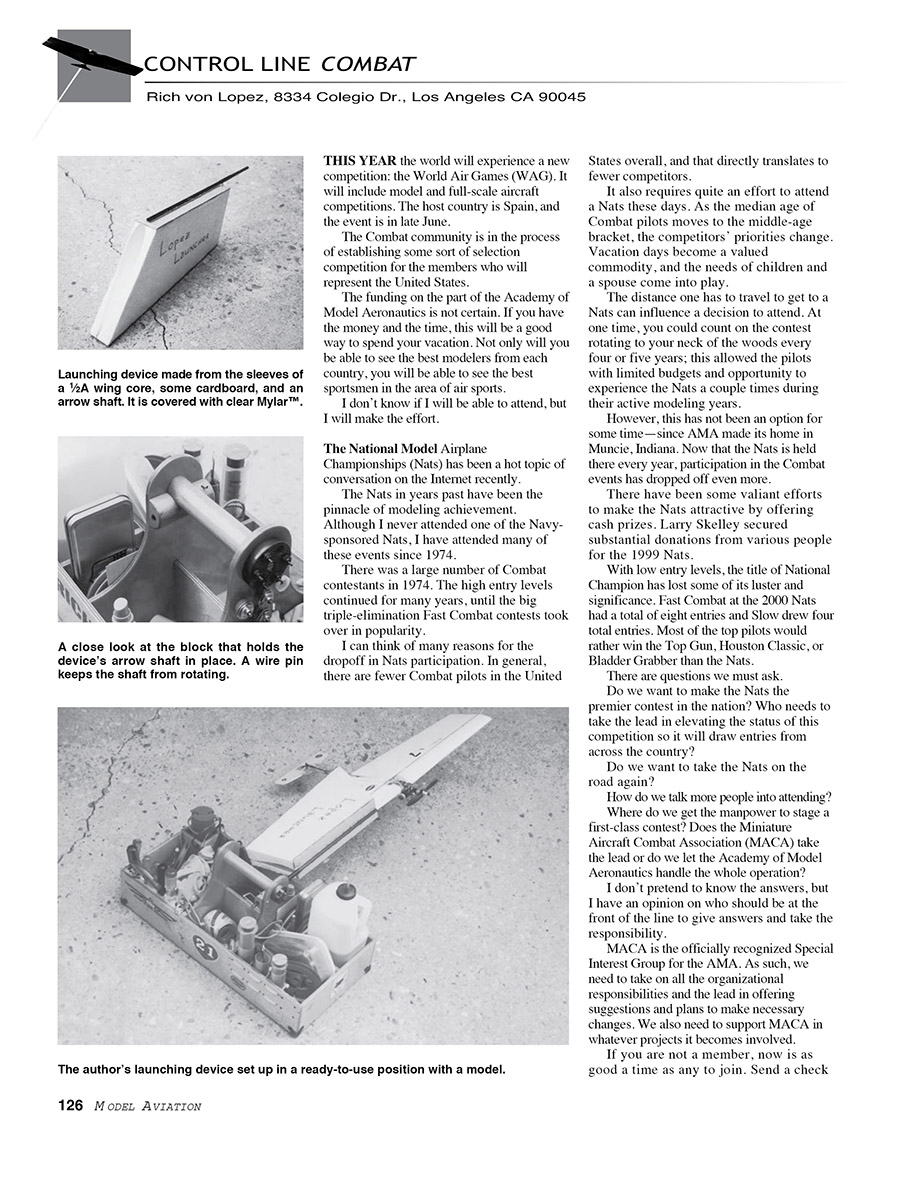
A couple columns ago (October 2000), I discussed a launching device Pat Willcox made to fit on my flight box. I am including a couple more photographs to illustrate how it works. I have used this device repeatedly, to test-fly when no one else is available. You may want to consider it for your 1/2A modeling needs.
There has been some talk of changing the line length in 1/2A Combat to 42 feet from the current 35 feet. This talk comes about primarily because of the availability of the powerful Cyclon .049 engine. This little engine has changed the way the event is flown. The power the .049 puts out is far above what our old Cox Tee Dee .049 and .051 engines could produce. On 35-foot lines, a Cyclon-powered model is traveling so fast that it is hard to have a good match without getting into line tangles.
Since this engine is considerably heavier than the older 1/2A engines, the models need to be bigger. Another item to consider in the request for longer line is the availability of the inexpensive Norvel BigMig .061 engine, which a number of new pilots are using. The Norvel engines are able to keep a model out on the lines quite well. The longer lines give a pilot a little more time to think before moving the handle.
A bunch of us in the Los Angeles area would still like to use the old 1960s-design Cox Tee Dee engines for sport-flying and local competitions. We already have plans for our December 31 Beach Brunch and Fly event. I have hosted this event for a number of years—so many that now it is a tradition. We start with a brunch at my house, then go to our beach flying site to determine who gets the last kill of the year and who is the last one to be killed.
For the past three years, I have made a small trophy to commemorate the last kill of the year. We have lots of fun, and restrict the event to Cox Tee Dee engines. I can think of no better way to end a year of flying.
Transcribed from original scans by AI. Minor OCR errors may remain.

