
CONTROL LINE COMBAT
Rich von Lopez 8334 Colegio Dr., Los Angeles, CA 90045
Riverside Combat Challenge
This past summer was busy for me because of a number of consecutive contests that I attended and in which I participated. This year the Riverside Combat Challenge was moved to the last weekend in June to get some slightly cooler weather.
The number of participants dropped, not because of the date change but because the F2D Combat Team Trials was the following weekend. Most pilots have to be selective when scheduling vacation time and buying airline tickets.
Bill Maywald puts in a great deal of effort to make certain that the Riverside, California, contest is a pleasant experience so that pilots will return the following year. The American Youth Soccer Organization fields in Riverside provide one of the finest sites for Combat in the United States.
This seventh year of the contest, Frank Tomicich of San Diego, California, pulled all of his skill and luck together to take his first major win ever. The caliber of flying was high throughout the weekend. Greg Hill, also of San Diego, finished the contest in second place. Steve Stewart of Arizona was third, and contest organizer Bill Maywald finished a respectable fourth.
Results:
- 1st: Frank Tomicich
- 2nd: Greg Hill
- 3rd: Steve Stewart
- 4th: Bill Maywald
USA F2D Team Trials — Muncie, Indiana
Immediately after Riverside I began packing my bags for the USA F2D Team Trials in Muncie, Indiana, during the Fourth of July weekend. These trials drew roughly 41 entries from across the United States.
This was my first trip to Muncie for a competition or to visit AMA Headquarters. I will no doubt return in the future. If you have never been there, I suggest that you make it a priority on your list of spots to visit. I have seen photographs and read articles about the AMA museum, but it is a much better experience to be there in person. I went back two or three times during my short stay in Muncie.
I found it best to ship my models to Muncie ahead of time to avoid any oversize-luggage charges. The airlines are extremely careful these days and will hit the big boxes with a charge of $75. On the other hand, the post office will charge anywhere from $15 to $34 per box, depending on the weight and optional insurance.
I arrived in Muncie Friday morning, rented an all-wheel-drive Subaru, and drove straight to the motel. The management was kind enough to get me into my room well ahead of check-in time. This made it easy to set up the models, find fellow Californians, and go out to the field for some test flying. The wind was blowing strong, causing extra-fast flying downwind. Only those pilots who had their models fully trimmed dared fly upwind.
Andrew Nadein, Mack Henry, and David Owen used AKM engines, which seemed to have a slight advantage over other brands. Pilots who used Zorro engines also looked good. Almost every make of engine was used. The new Cyclon PC6 proved that it had plenty of steam to stay in contention.
The Team Trials traditionally has a pilots’ meeting Friday night, and Event Director Pat Willcox had one scheduled. A thunderstorm and tornado warnings changed those plans; it hit the area really hard. Saturday morning was wet, with a great deal of standing water. The pilots decided to fly in the rain. For those of us who wear corrective lenses, visibility was a challenge. Rain makes something as simple as filling a bladder an adventure. The castor oil in the fuel mixed with water, making fuel fittings and tubing difficult to hold onto. Pilots and mechanics were slipping and sliding on the wet grass. A couple of hours into the contest we got a bit of a break in the weather. I was fortunate not to have to fly in the driving rain, although I did have to pit during a downpour.
Sunday proved to be quite a bit better, with all but the last couple of matches flown before it got dark. Driving off the field was difficult for all who were in two-wheel-drive vehicles. Many were stuck axle-deep in mud. We saw many good matches and no one pilot could say that he was a shoe-in to make the team.
One of the best matches was between Chuck Rudner and Andrew Nadein. Andrew had a slight advantage with approximately three minutes to go in the match and was still towing a knot. These guys fought it out until Chuck got the knot just seconds before the end of the match.
Ron Colombo looked calm and relaxed in the circle, taking cuts almost at will to get the job done. Andy Minor flew well all weekend and earned the right to be the first alternate. It is quite an honor to make the US team, given the high caliber of flying.
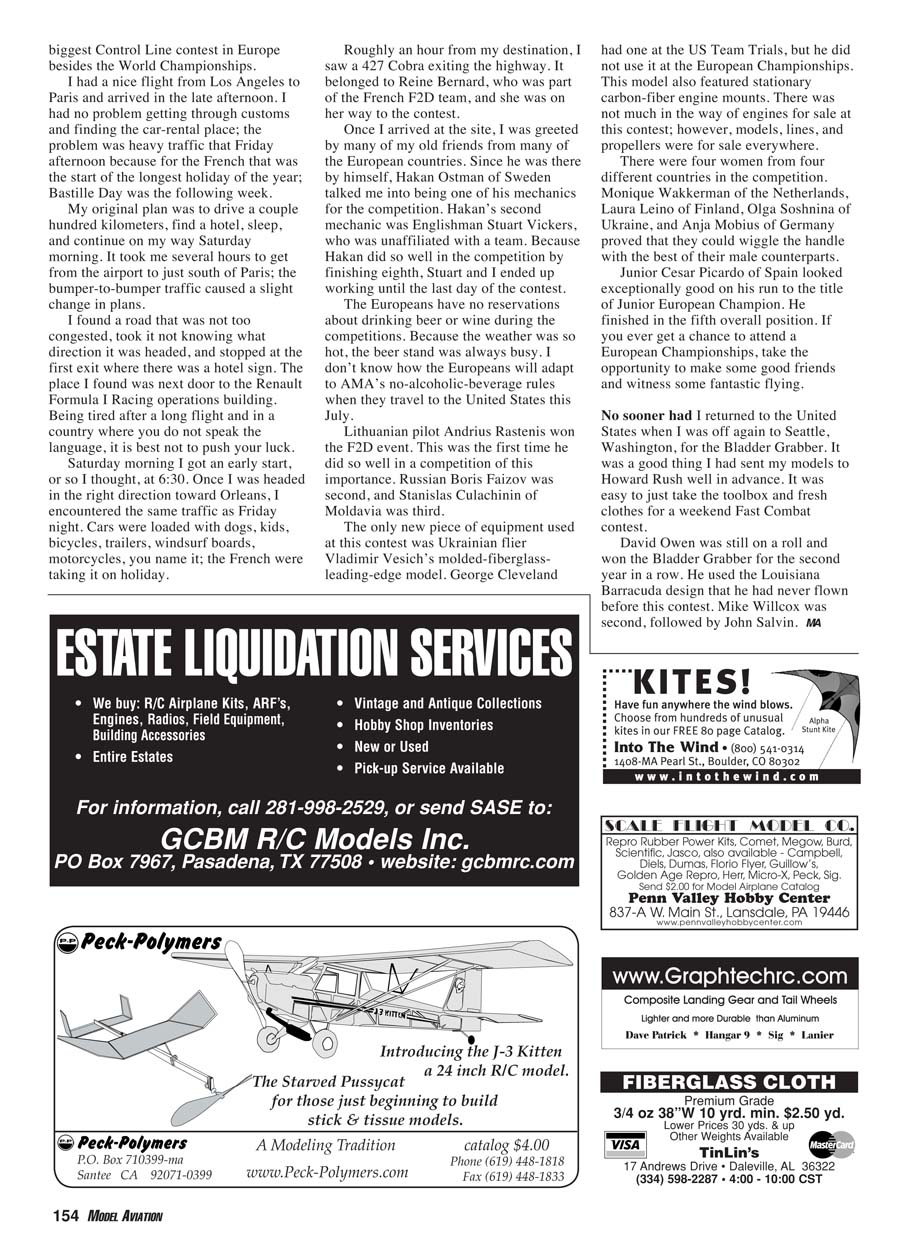
When all was said and done, the results determined that former Junior World Champion Mark Rudner and former team members David Owen and Ron Colombo, along with Junior Holden Hill, will join defending World Champion Mike Willcox to represent the United States at the Control Line World Championships in 2004. I wish these guys well.
Team Trials results (selected):
- Mike Willcox (defending World Champion)
- Mark Rudner
- David Owen
- Ron Colombo
- Alternate: Andy Minor
European Championships — Rouen, France
I only stayed in Muncie through Monday; I had another airline ticket to go to the European Championships in Rouen, France, that Thursday. I had never been to a Euro Champs, but I decided to go because it is the biggest Control Line contest in Europe besides the World Championships.
I had a nice flight from Los Angeles to Paris and arrived in the late afternoon. I had no problem getting through customs and finding the car-rental place; the problem was heavy traffic that Friday afternoon because for the French that was the start of the longest holiday of the year — Bastille Day was the following week.
My original plan was to drive a couple hundred kilometers, find a hotel, sleep, and continue on my way Saturday morning. It took me several hours to get from the airport to just south of Paris; the bumper-to-bumper traffic caused a slight change in plans. I found a road that was not too congested, took it not knowing what direction it was headed, and stopped at the first exit where there was a hotel sign. The place I found was next door to the Renault Formula 1 operations building. Being tired after a long flight and in a country where you do not speak the language, it is best not to push your luck.
Saturday morning I got an early start, or so I thought, at 6:30. Once I was headed in the right direction toward Orléans, I encountered the same traffic as Friday night. Cars were loaded with dogs, kids, bicycles, trailers, windsurf boards, motorcycles — the French were taking it on holiday.
Roughly an hour from my destination, I saw a 427 Cobra exiting the highway. It belonged to Reine Bernard, who was part of the French F2D team, and she was on her way to the contest.
Once I arrived at the site, I was greeted by many old friends from across Europe. Since he was there by himself, Håkan Östman of Sweden talked me into being one of his mechanics for the competition. Håkan's second mechanic was Englishman Stuart Vickers, who was unaffiliated with a team. Because Håkan did so well in the competition by finishing eighth, Stuart and I ended up working until the last day of the contest.
The Europeans have no reservations about drinking beer or wine during the competitions. Because the weather was so hot, the beer stand was always busy. I don't know how the Europeans will adapt to AMA's no-alcohol rules when they travel to the United States.
Lithuanian pilot Andrius Rastenis won the F2D event. This was the first time he did so well in a competition of this importance. Russian Boris Faizov was second, and Stanislas Culachinin of Moldova was third.
The only new piece of equipment used at this contest was Ukrainian flier Vladimir Vesich's molded fiberglass leading-edge model. George Cleveland had one at the US Team Trials, but he did not use it at the European Championships. This model also featured stationary carbon-fiber engine mounts. There were not many engines for sale at this contest; however, models, lines, and propellers were for sale everywhere.
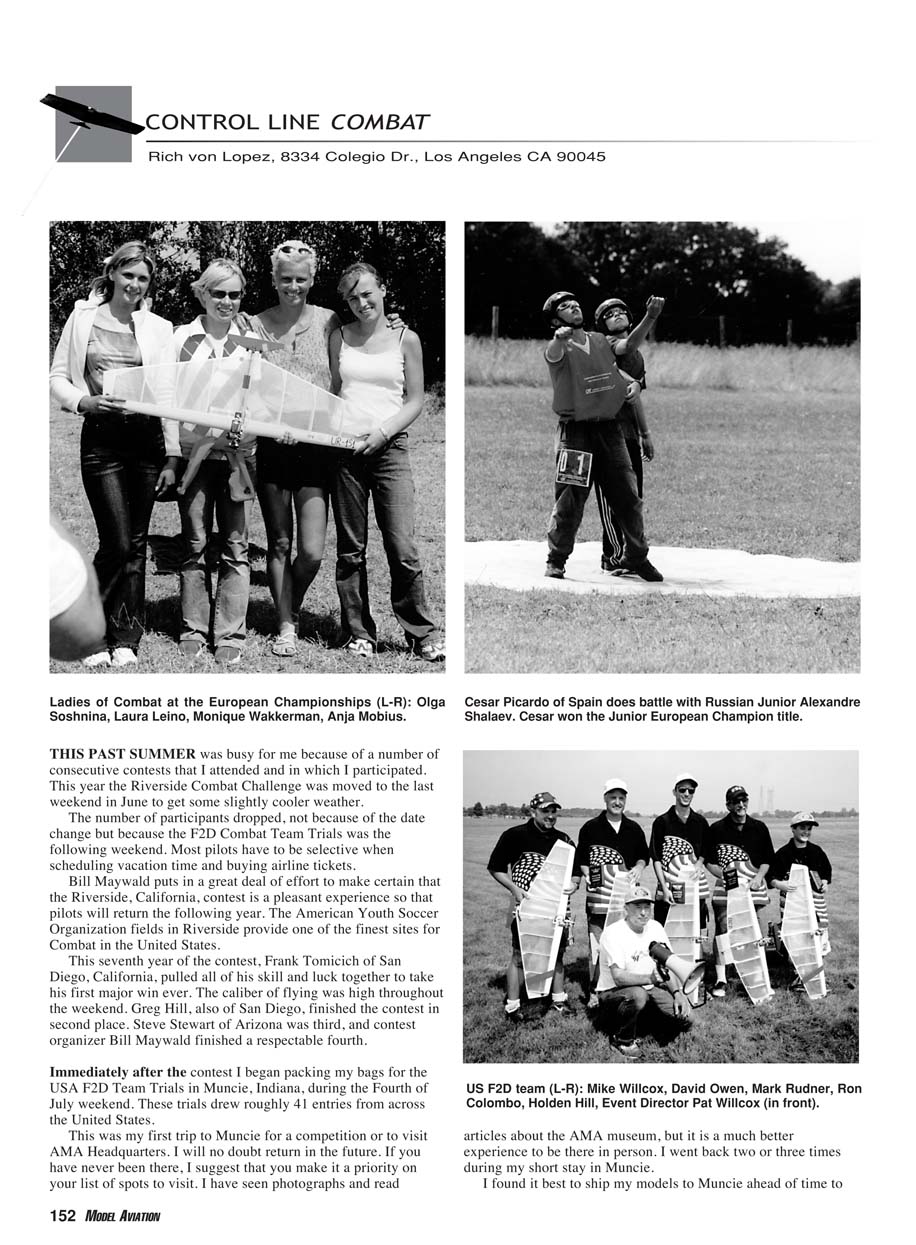
There were four women from four different countries in the competition. Monique Wakkerman of the Netherlands, Laura Leino of Finland, Olga Soshnina of Ukraine, and Anja Möbius of Germany proved that they could wiggle the handle with the best of their male counterparts.
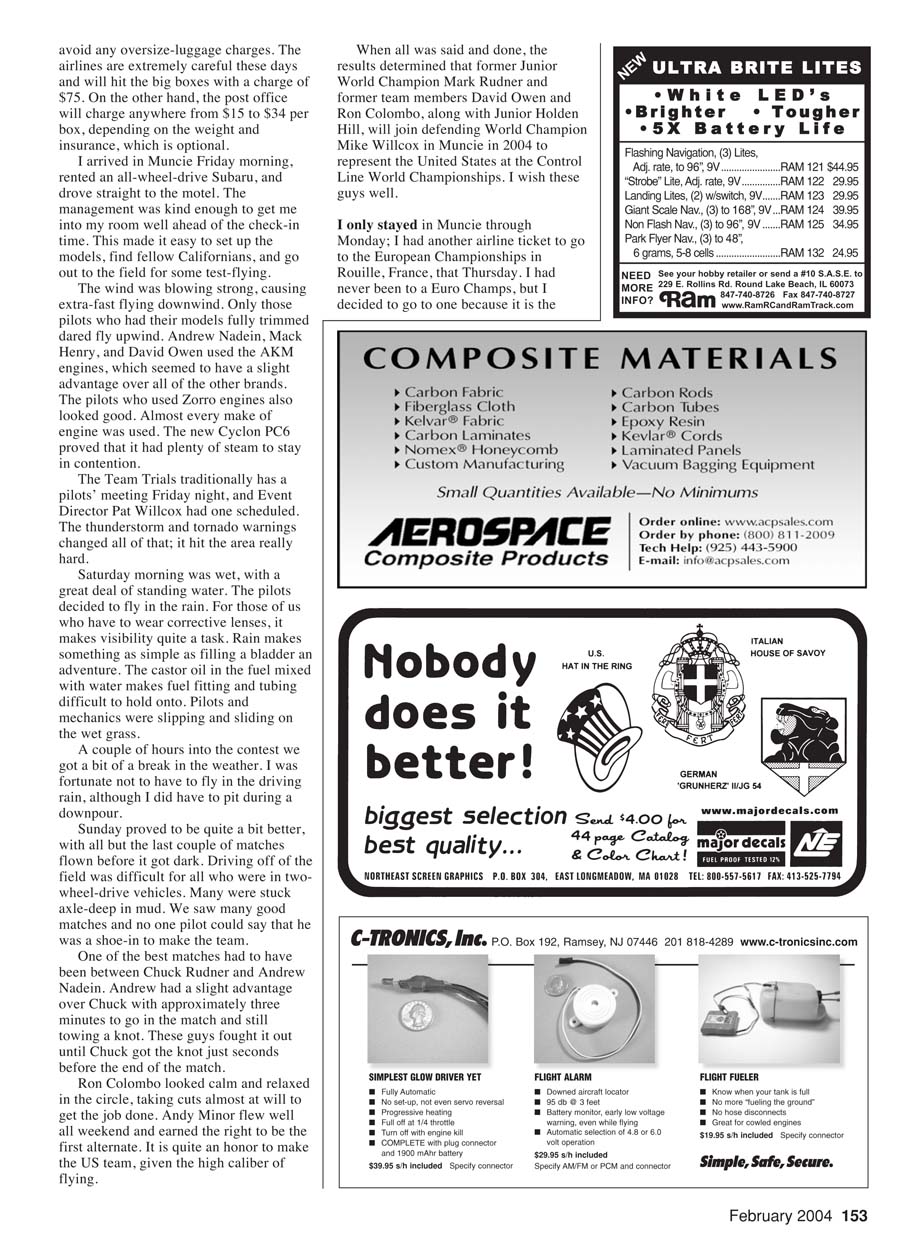
Junior César Picardo of Spain looked exceptionally good on his run to the title of Junior European Champion. He finished fifth overall.
European Championships results:
- 1st: Andrius Rastenis (Lithuania)
- 2nd: Boris Faizov (Russia)
- 3rd: Stanislas Culachinin (Moldova)
- Junior Champion: César Picardo (Spain)
Bladder Grabber — Seattle, Washington
No sooner had I returned to the United States when I was off again to Seattle, Washington, for the Bladder Grabber. It was a good thing I had sent my models to Howard Rush well in advance. It was easy to just take the toolbox and fresh clothes for a weekend Fast Combat contest.
David Owen was still on a roll and won the Bladder Grabber for the second year in a row. He used the Louisiana Barracuda design that he had never flown before this contest. Mike Willcox was second, followed by John Salvin.
Bladder Grabber results:
- 1st: David Owen
- 2nd: Mike Willcox
- 3rd: John Salvin
Transcribed from original scans by AI. Minor OCR errors may remain.

