
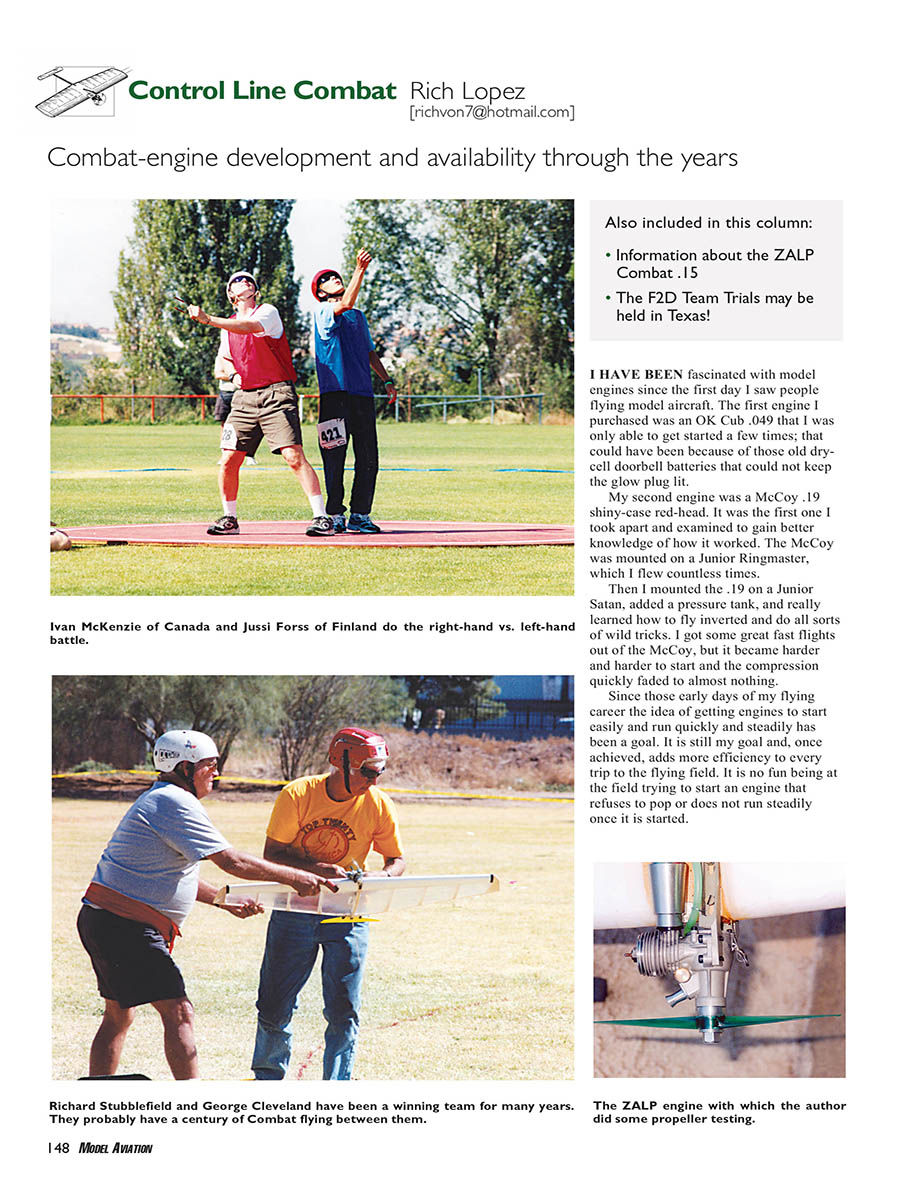

Combat-engine development and availability through the years
Rich Lopez [richvon7@hotmail.com]
I have been fascinated with model engines since the first day I saw people flying model aircraft. The first engine I purchased was an OK Cub .049 that I was only able to get started a few times; that could have been because of those old dry-cell doorbell batteries that could not keep the glow plug lit.
My second engine was a McCoy .19 shiny-case red-head. It was the first one I took apart and examined to gain better knowledge of how it worked. The McCoy was mounted on a Junior Ringmaster, which I flew countless times.
Then I mounted the .19 on a Junior Satan, added a pressure tank, and really learned how to fly inverted and do all sorts of wild tricks. I got some great fast flights out of the McCoy, but it became harder and harder to start and the compression quickly faded to almost nothing.
Since those early days of my flying career, the idea of getting engines to start easily and run quickly and steadily has been a goal. It is still my goal and, once achieved, adds more efficiency to every trip to the flying field. It is no fun being at the field trying to start an engine that refuses to pop or does not run steadily once it is started.
The running-fast part of the equation is what most Combat pilots look for continuously. During the days when Fast Combat was the main event, fliers experimented using Dremel-tool artistry on the engines’ internal parts, trying different propellers and adding exotic chemicals to their fuel. These days engine availability is so good, in terms of variety and reliability, that it is no problem, even for the rank beginner, to get the engine started and needled properly for good runs.
There has been a big change in how an interested person obtains engines. That first OK Cub I mentioned was purchased at a discount toy store in San Francisco that had a hobby section. The McCoy .19 came from Zaharis’ combination hobby and television-repair shop, which also served as the host site for the San Francisco Piston Poppers Model Airplane Club. It was customary at the time to display available engines in a glass counter or in bubble packs hung on a rack. There were plenty of sizes and manufacturers’ brands available.
All this was happening in the 1960s. Hobby shops were plentiful and could be found in every neighborhood of the city. There were multiple modeling clubs that could be found attached to or affiliated with a particular hobby shop. When a certain engine was in high demand, the hobby-shop owner might set one aside for you and even call to let you know it was available.
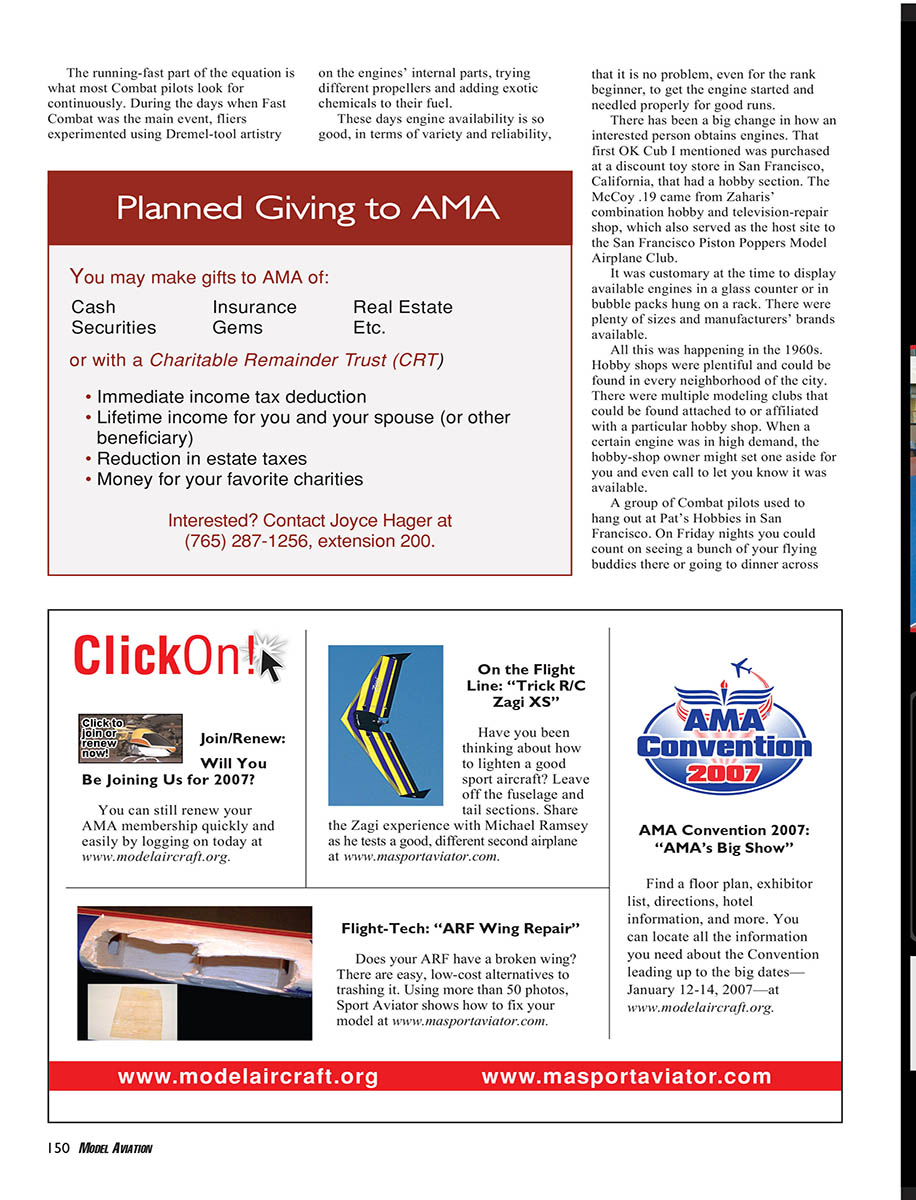
A group of Combat pilots used to hang out at Pat’s Hobbies in San Francisco. On Friday nights you could count on seeing a bunch of your flying buddies there or going to dinner across the street at Mel’s Diner. When the shop opened Saturday morning, you would often find people waiting for the owner to arrive. It was common to have someone bring in doughnuts and coffee for anyone who was interested. I suppose it helped that the flying field at Crocker Amazon Park was less than a mile away. If you needed a replacement propeller or an extra glow plug, you could run back to the hobby shop and return to the flying field in less than 15 minutes. Since many of us were still in high school, our funds were limited and we did buy glow plugs one or two at a time.
The Condor Legion club out of Redwood City, California, included Mike Petri, Norm McFadden, Rich Brasher, Jerry Cook, Paul Leuty, and others who were often found at J&M Hobbies in nearby San Carlos, California. Shop owner Joe White catered to Combat pilots and kept a huge stock of SuperTiger and Fox parts on hand.
In the 1960s those brands were the most popular—and prone to breaking when run on high-nitromethane fuels and with propellers that operated well above their design limitations. This phenomenon of pilots and clubs affiliated with hobby shops is now hard to find in the United States.
The current method of obtaining top-level equipment is knowing the source of a particular engine. You also need to have either seen the equipment operating at a contest or have contact with a competitor whose recommendations you trust.
In previous columns I have mentioned the open-air markets that are quickly put up at European contests by various competitors or the people who travel with them. Although there can be a variety of interesting-looking equipment, the buyer must beware of any purchases unless the source is known. I have been pleasantly surprised by some of my purchases and completely disappointed with others.
The Internet is a good place to start to get an idea of what is available. James E. Dunkin has put together an incredible reference book of international .15 cu. in./2.5 cc model-airplane engines. He must have the largest collection of this size engine in the world. Jim gives as much information as he has on each engine, such as the country of origin, the manufacturer or builder, and the year(s) of production. I am not sure how much he is charging for his book; send him an e-mail at dunkin@discoverynet.com. The book has more than 250 pages of good-quality photographs of each engine. There are four engine photos and descriptions per page.
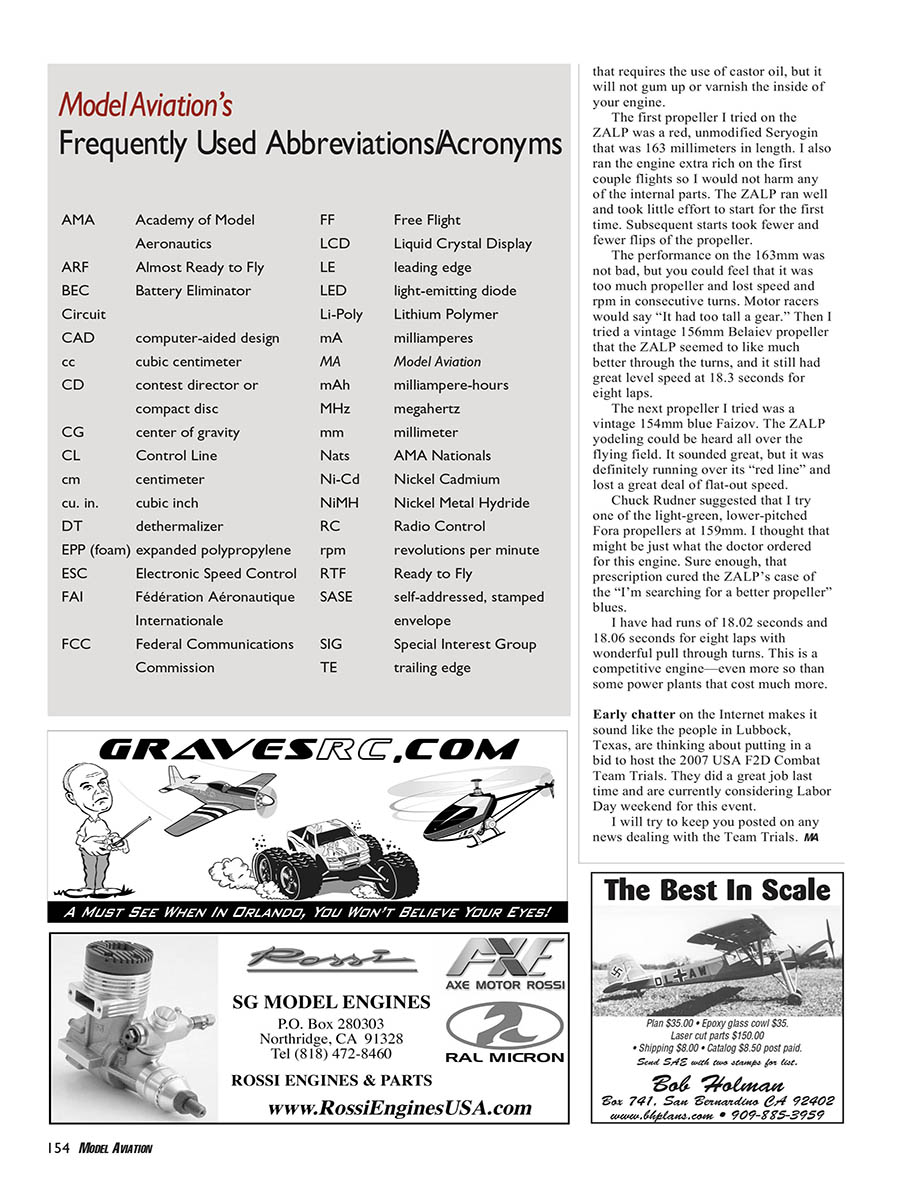
I am currently experimenting with a ZALP Combat .15 engine that has its origins in Zaporozhia, Ukraine. The letters ZALP are the initials of the Zaporozhye Aeroplane Laboratory Polyot. This is a relatively unknown make of engine in the United States and is not a brand that is widely used in international Combat contests. I did not see any flown at the 2006 World Championships in Spain, but there were some for sale.
Bob Whitney (954) 983-3624; e-mail: F2Dracer@aol.com, a member of the US World Championships Team Race team, acquired a couple of ZALP engines and sent one to me to run and evaluate. Bob is the contact person if you want to obtain these power plants. Don't hold me to this, but the price is approximately $160.
I have been pleasantly surprised by how well the ZALP starts and runs. It weighs 122 grams with muffler and glow plug. The machining is excellent and it has a good "feel" — by this I mean that with the propeller on and a glow plug inserted there is good compression when you flip the propeller and the bottom end feels free.
I did all my testing with 10% nitromethane fuel with 20% Klotz synthetic oil. This is my standard, everyday fuel that I make myself. It is not the legal FAI fuel, which requires the use of castor oil, but it will not gum up or varnish the inside of your engine.
The first propeller I tried on the ZALP was a red, unmodified Seryogin that was 163 mm in length. I also ran the engine extra rich on the first couple of flights so I would not harm any of the internal parts. The ZALP ran well and took little effort to start for the first time. Subsequent starts took fewer and fewer flips of the propeller.
The performance on the 163 mm was not bad, but you could feel that it was too much propeller and it lost speed and rpm in consecutive turns. Motor racers would say "it had too tall a gear." Then I tried a vintage 156 mm Belaiev propeller that the ZALP seemed to like much better through the turns, and it still had great level speed at 18.3 seconds for eight laps.
The next propeller I tried was a vintage 154 mm blue Faizov. The ZALP yodeling could be heard all over the flying field. It sounded great, but it was definitely running over its "red line" and lost a great deal of flat-out speed.
Chuck Rudner suggested that I try one of the light-green, lower-pitched Fora propellers at 159 mm. I thought that might be just what the doctor ordered for this engine. Sure enough, that prescription cured the ZALP's case of the "I'm searching for a better propeller" blues.
I have had runs of 18.02 seconds and 18.06 seconds for eight laps with wonderful pull through turns. This is a competitive engine—even more so than some power plants that cost much more.
Early chatter on the Internet makes it sound like the people in Lubbock, Texas, are thinking about putting in a bid to host the 2007 USA F2D Combat Team Trials. They did a great job last time and are currently considering Labor Day weekend for this event.
I will try to keep you posted on any news dealing with the Team Trials.
MA
Transcribed from original scans by AI. Minor OCR errors may remain.

