
Control Line: Combat
Charlie Johnson
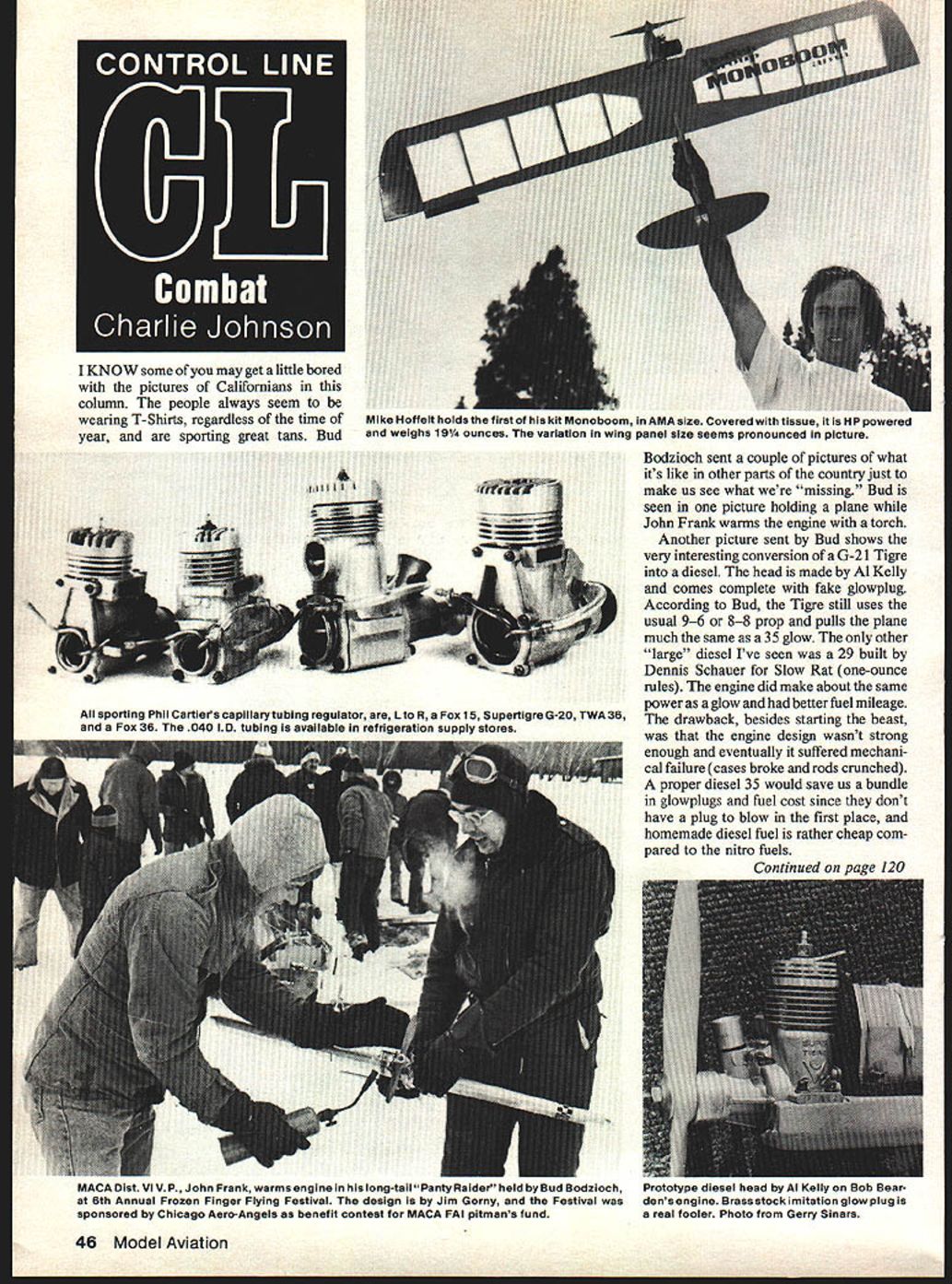
I know some of you may get a little bored with the pictures of Californians in this column. The people always seem to be wearing T-shirts, regardless of the time of year, and are sporting great tans. Bud Bodzioch sent a couple of pictures showing what it's like in other parts of the country, just to remind us what we're "missing." In one picture Bud is seen holding a plane while John Frank warms the engine with a torch.
Another picture Bud sent shows the interesting conversion of a G-21 Tigre into a diesel. The head is made by Al Kelly and comes complete with a fake glowplug. According to Bud, the Tigre still uses the usual 9-6 or 8-8 prop and pulls the plane much the same as a .35 glow.
The only other "large" diesel I've seen was a .29 built by Dennis Schauer for Slow Rat (one-ounce rules). The engine produced about the same power as a glow and had better fuel mileage. The drawback, besides starting the beast, was that the engine design wasn't strong enough and eventually it suffered mechanical failure (cases broke and rods crunched). A proper .35 diesel would save us a bundle in glowplugs and fuel costs since they don't have a plug to blow in the first place, and homemade diesel fuel is rather cheap compared to nitro fuels.
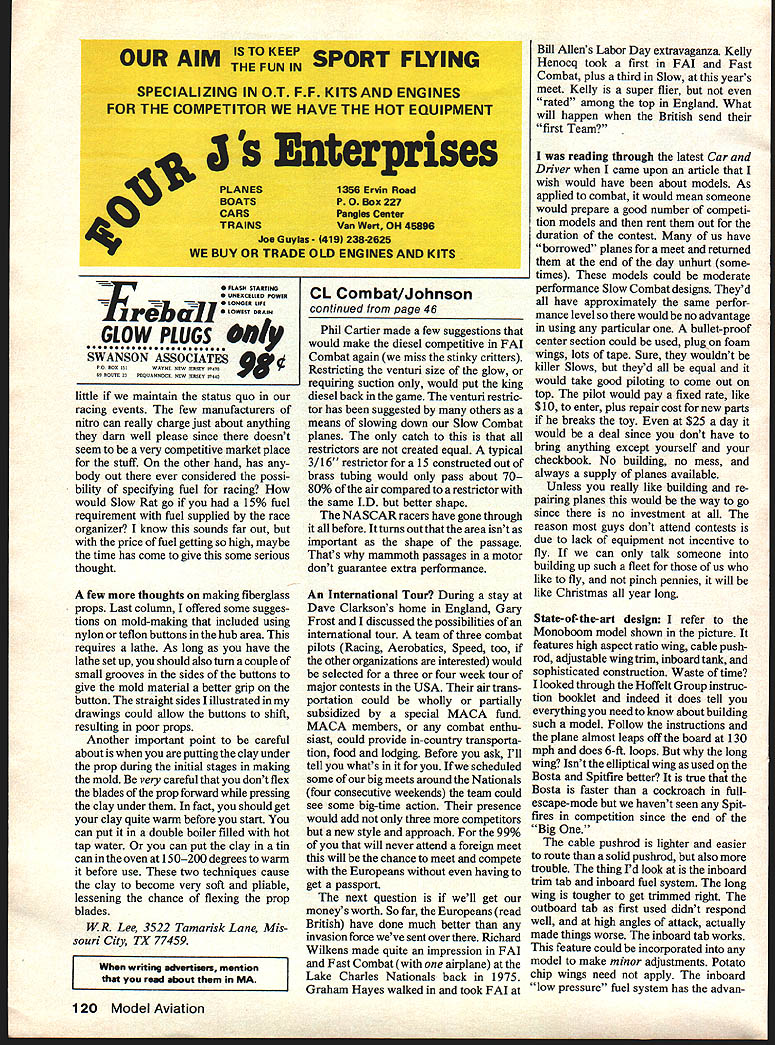
Phil Cartier made a few suggestions that would make diesels competitive in FAI Combat again. Restricting venturi size (so glow engines require more suction) would return diesels to competitiveness. Venturi restrictors have been suggested; other means of slowing down Slow Combat planes have been proposed as well. A typical 3/16-inch restrictor constructed out of brass tubing would pass about 70–80% of the air compared to a restrictor of the same I.D. but with a better shape. NASCAR racers have gone through this before — it turns out area isn't as important as the shape of the passage. That's why mammoth passages or more motor don't guarantee extra performance.
An International Tour
During my stay at Dave Clarkson's home in England, Gary Frost discussed the possibilities of an international tour team of three combat pilots. Racing, Aerobatics, Speed and other organizations interested would select three for a four-week tour of major contests. U.S. air transportation could be wholly or partially subsidized by a special MACA fund for MACA members.
Transcribed from original scans by AI. Minor OCR errors may remain.

