
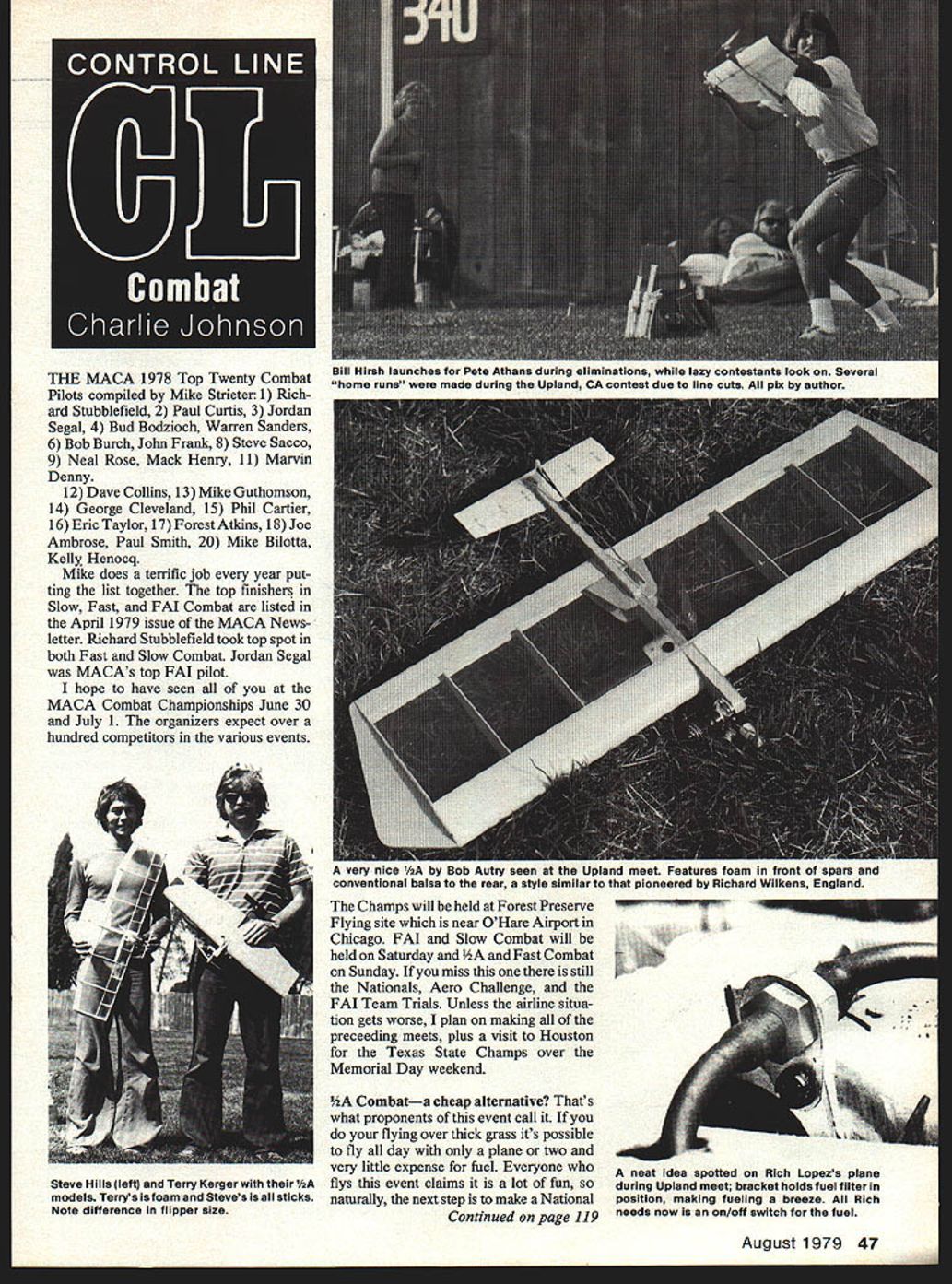
Control Line: Combat
Charlie Johnson
MACA 1978 Top Twenty Combat Pilots compiled by Mike Strieter:
- Richard Stubblefield
- Paul Curtis
- Jordan Segal
- Bud Bodzioch
- Warren Sanders
- Bob Burch
- John Frank
- Steve Sacco
- Neal Rose
- Mack Henry
- Marvin Denny
- Dave Collins
- Mike Guthomson
- George Cleveland
- Phil Cartier
- Eric Taylor
- Forest Atkins
- Joe Ambrose
- Paul Smith
- Mike Bilotta
Also mentioned: Kelly Henocq
Mike does a terrific job every year putting the list together. The top finishers in Slow, Fast, and FAI Combat are listed in the April 1979 issue of the MACA Newsletter. Richard Stubblefield took top spot in both Fast and Slow Combat. Jordan Segal was MACA's top FAI pilot.
I hope to have seen all of you at the MACA Combat Championships June 30 and July 1. The organizers expect over a hundred competitors in the various events.
The Champs will be held at the Forest Preserve flying site near O'Hare Airport in Chicago. FAI and Slow Combat will be held on Saturday and 1/2A and Fast Combat on Sunday. If you miss this one there is still the Nationals, Aero Challenge, and the FAI Team Trials. Unless the airline situation gets worse, I plan on making all of the preceding meets, plus a visit to Houston for the Texas State Champs over the Memorial Day weekend.
CL Combat
1/2A Combat — a cheap alternative? That's what proponents of this event call it. If you do your flying over thick grass it's possible to fly all day with only a plane or two and very little expense for fuel. Everyone who flies this event claims it is a lot of fun, so naturally, the next step is to make a national event out of it so it can be ruined.
Diesels — a better alternative?
No one in the U.S.A. would have thought twice about the stinky diesel a couple years ago. Aren't they hard to start, use exotic fuel and hard to handle? That's what the Americans think about diesel and that's exactly what the Europeans thought about glows.
Let's go back in time to the 1974 British Nationals. I took over a Nemesis powered by a K&B 40 on 60% nitro for some exhibition flights. The thing made lots of noise, was fast and turned a lot better than we expected (although nothing like some of the models today), and just to spite everyone, the motor started every time on the first flick and ran flawlessly. At that time it was 12–1 diesels vs. 7 glows in the first round of the Nationals, but it took only two years to turn around the odds. The popularity of combat has been on the decline ever since the glow took over. The disposable, throwaway model hasn't helped either; lightweight diesel models did their part too. The diesel-powered model must have something going for it, so I've listed a few of the good points.
- Diesel fuel is cheap compared to nitro fuels, especially since the latest price increase to over $2.00 per gallon.
- Diesels have no glow plugs to burn out or go bad. The price will soon skyrocket for glow plugs, so buy yours now while they're cheap.
- Diesels run best on clipped 8x6 nylon props which lasted the life of the engine. For this reason the diesel pilot could just land his model when he was tired of flying or when the match was over. Try this with an AMA model for $1.50 a prop.
- The amount of equipment necessary to operate a diesel is less. The guys usually took a plastic bottle of fuel, the plane and a set of lines. The Laystrate lines lasted forever too. Think of barbed wire without the barbs and you get an idea of the toughness of those Laystrates.
- Model destruction wasn't nearly what it is in the AMA events or the glow version of FAI Combat. A half dozen models lasted a season. Modelers usually changed to something new because of design improvements rather than having everything smashed to bits.
- Because of the stronger nature of the diesel model, it afforded a different flying style. Hitting the ground was not only fun but a tactical maneuver. Rather than give away a cut the smart flier sometimes landed. Pit work was fast and reliable; sometimes only a couple seconds elapsed.
- The performance was such that the "luck-out" factor was greatly diminished. It was rare to see an upset of one of the really good pilots and it was common to see matches with 4 or 5 cuts per pilot.
On the minus side of the diesel we find:
- They are indeed stinky.
Probably the most often asked question has been how to make a Fox run on suction. So far, there hasn't been a totally satisfactory answer and you'll not get one here either. As I've said before, you have to seal up the stock restrictor or all the air goes around the restrictor rather than through it. Some balsa wedged in will do or you can use 5-minute epoxy (a little heat will make it fall right out).
I carved down a piece of fairly hard wood to fit in the square opening, then drilled a 1/4" hole down the center. Stick it in the engine and drill a hole for the spraybar. Find a nice cone-shaped bit for your Dremel and make a nice venturi shape on both ends. The hardwood can extend out of the stock venturi to give a ram effect or just look weird. Be sure to coat the inside of the wood with epoxy or the fuel soon melts your venturi. If you find the 1/4" venturi draws just fine (it should), then you can bore it out to the next drill size; sooner or later, you'll get too big and all you've lost is a piece of hardwood. Go back one drill size and you're in business.
Charlie Johnson 3716 Ingraham St. San Diego, CA 92109
Transcribed from original scans by AI. Minor OCR errors may remain.

