
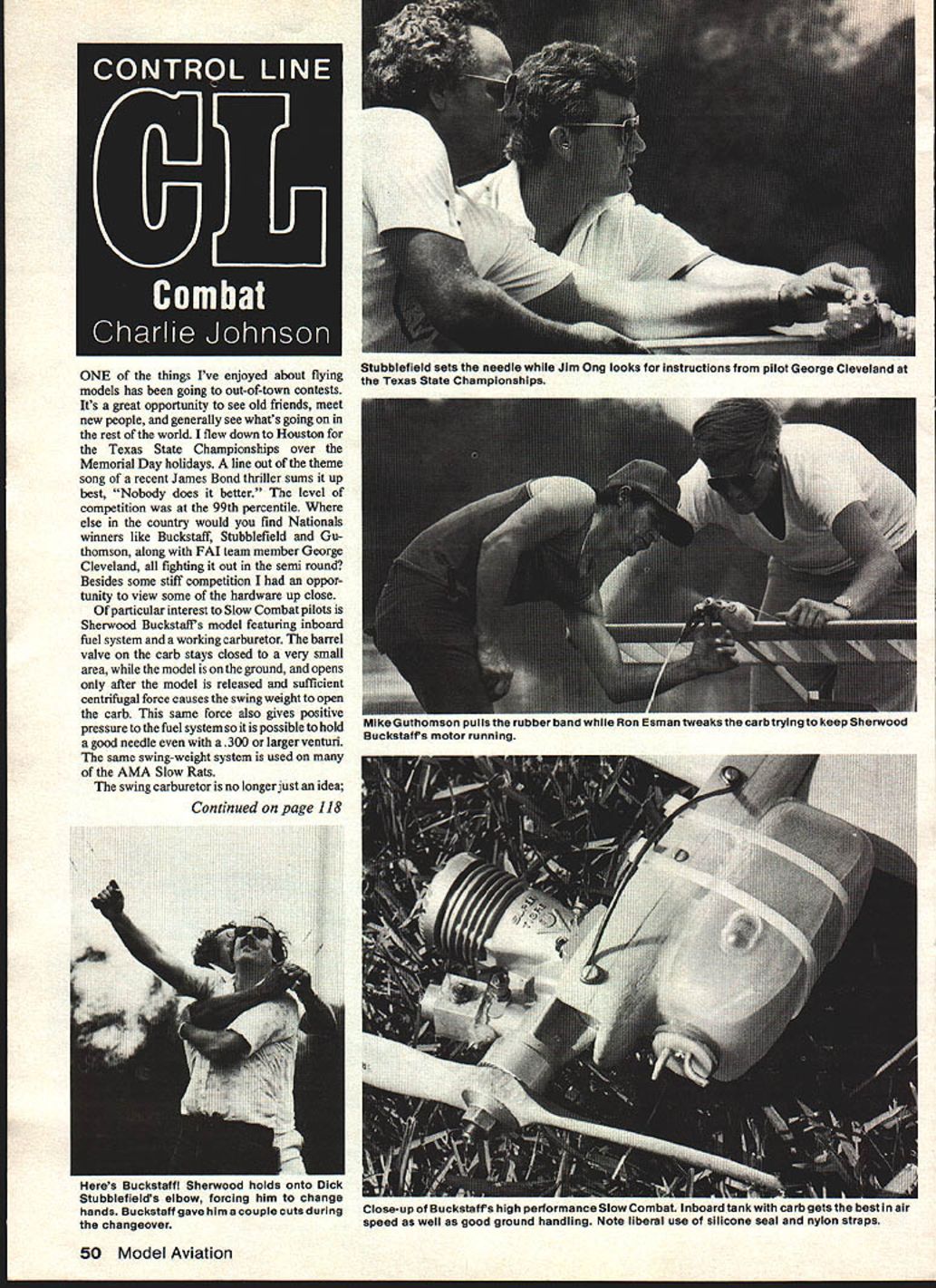
Control Line: Combat
Charlie Johnson
One of the things I've enjoyed about flying models has been going to out-of-town contests. It's a great opportunity to see old friends, meet new people, and generally see what's going on in the rest of the world. I flew down to Houston for the Texas State Championships over the Memorial Day holidays. A line out of the theme song of a recent James Bond thriller sums it up best: "Nobody does it better." The level of competition was at the 99th percentile. Where else in the country would you find Nationals winners like Buckstaff, Stubblefield and Guthomson, along with FAI team member George Cleveland, all fighting it out in the semi round? Besides some stiff competition I had an opportunity to view some of the hardware up close.
Of particular interest to Slow Combat pilots is Sherwood Buckstaff's model featuring an inboard fuel system and a working carburetor. The barrel valve on the carb stays closed to a very small area while the model is on the ground, and opens only after the model is released and sufficient centrifugal force causes the swing weight to open the carb. This same force also gives positive pressure to the fuel system so it is possible to hold a good needle even with a .300 or larger venturi. The same swing-weight system is used on many of the AMA Slow Rats.
The swing carburetor is no longer just an idea; Buckstaff is the first I've seen to make it perform. If you look closely at Buckstaff's model you'll see a liberal use of silicone seal and nylon straps to hold on the tank. This setup is not only fast but works as well as any other method. No rubber bands to break and no solder joints to come undone. Other than Buckstaff's trick tank/carb setup, the rest of the equipment was just well-executed combat flying material.
Matches in Texas are three minutes rather than the usual five we're used to. This is a real advantage in Fast where everyone puts in enough fuel for the full three minutes and thus no pitting is required unless you crash. Three minutes for Slow and 15-size Combat didn't seem enough.
Tom Zon tried a new innovation in combat flying, the Un-Contest. The Un-Contest was held at Whittier Narrows, near Los Angeles, and publicity was by word of mouth, no expensive flyers. There were no judges, officials, or any results. Just 20 guys having a ball and doing a lot of flying. The name of the game was "fly Combat" and the troops seemed to be self-regulating enough to know where to park their airplanes and coordinate flying matches. I'd say there were about three times as many matches flown than at a regular meet, and with far less loss of equipment. If the streamer was cut down to the knot, the pilots just let them run out of fuel and put on a new one. Terry Kerger flew 20 matches with one airplane and had to finally retire it with easily repairable damage. Peer pressure at these local meets seems to be more effective than all the intricate rules in the world. Good show, Tom.
During the flying session, Mike Hoffelt and I had trouble keeping his Rossi FAI motor running. About a third of the way through, the motor would go lean — something in the needle valve. If you turned the needle open, fuel would once again spurt out at the proper rate but soon would clog. The problem turned out not to be any known contaminant like dirt, weeds, or sludge of some sort. The fuel had a dusty look to it and after running through the small jet these "things" somehow latched onto each other and plugged up the needle. The Fox .36, with the needle screwed out a lot farther than the Rossi, didn't suffer from the same problem. Straining the fuel through a coffee filter solved the problem, although we didn't isolate the actual goo — it vanished into the filter. We're looking for a really good filter to put in the fuel can that will do a better job than the rock strainer we were using. Apparently there was something in the alcohol, nitromethane, or Blendzall that caused the goo in the needle; so far we don't know which to blame.
I know that everyone out there must have gotten a new camera for Christmas, so why don't you take a few pictures of the local fliers or interesting innovations in equipment and send them to me. Besides becoming well known for your great photo efforts, you'll receive $5 from Model Aviation for every picture printed.
Charlie Johnson 3716 Ingraham St., San Diego, CA 92109 (714) 273-6530
Transcribed from original scans by AI. Minor OCR errors may remain.

