
Control Line: Combat
Charlie Johnson
Field testing and timing
I actually did what I said I was going to do last column: some "scientific testing." I had several offers for the loan of hot-air-powered wind tunnels but decided to go with my trusty camera, a height pole and an expendable airplane or two. The camera makes a permanent film record of the proceedings; the expendable airplane is nice because you can just "crash it" when you finish a testing sequence. The height pole is not really necessary if you use the film dimensions to figure everything.
At 52 feet my camera with a 58-mm lens covers an area 30 feet by 20 feet. You can mark any convenient building or curb with 1-foot increments using a magic marker. This master slide or negative is then projected on your enlarger baseboard or dining room wall where you transfer the grid. All this fun and games may make you forget model airplanes and take up photography as a full-time occupation.
From the testing we now know that even a doggy FAI will turn 60 loops per minute with less than 8-foot radius loops. Get the picture? This plane was a real dog! This combination means that the plane only covered about 3,014 feet in one minute (about 36 mph average). Well, its top speed was only about 75 mph anyway. Any plane that turns at less than 100 loops per minute is certainly not going to set the world on fire.
A good AMA-type combat plane ran through our course at 100 loops per minute at about a 4-foot radius. Looked pretty good, but that's only 2,512 feet in a minute (3.14 times the diameter of 8 feet, times 100 loops). Before deciding to reprogram my calculator where a mile would equal less than 5,280 feet, we tried doing bigger loops. It still could do 100 loops per minute at the larger 6-foot radius. Looks easy enough to pick a couple loop diameters, count the loops per minute and plot a performance curve just like the big-time engineers. I bought a French curve to help in making those neat curvy graphs you see in engineering magazines.
Tips for testing
- Don't do a minute's worth of loops. Use a stopwatch and time 10 loops and figure from there.
- A camera with a winder is not really necessary. Get some slow ASA 25 film and stop the lens way down, plus neutral density filters so you can use a shutter speed of about 1/2 second. Late afternoon when the sun is setting is ideal, but you have to hurry through your tests. Set the exposure for the background and the plane will be an underexposed blur zooming around.
- You can get a very good idea if you just fly loops using a height pole and an observer.
- If you use the camera method, the camera should be right next to you in the circle, or outside the circle, with the plane exactly halfway between it and the pilot and also high enough to avoid parallax problems. The roof of a motor home or pickup truck is perfect.
What will all this newfound knowledge do for you? Nothing directly. It's how you apply the knowledge. All the best pilots already have this knowledge, although they might never be able to tell you what loop radius or speed they're flying at. Their ability to get a plane through maneuvers the fastest way possible is due to their seat-of-the-pants flying skill, but very easily matched by a computer once the performance curve is programmed in. Imagine a super-Atari combat flight simulator, where you pick your favorite electronic model, and something like line tension could even be programmed. Could be that all this is boring to the average combat hacker, so before you start checking the density of Hot Stuff with your new micrometer, I'll move on to something else I know you'll like.
New materials and models
New spar material from Hi-Flite Model Products, 43225 Whittier Ave., Hemet, CA 92343. It is a foam/carbon-fibre laminate called Slight-Spar that they claim is as light as spruce but many times stronger. They list five different sizes, each size available in 36" or 48" lengths. The samples (not full length) were really rigid, possibly the hot tip for holding together that ultimate design in your workshop. No price info with the samples either, but they claim the spars should be in your hobby shop by the time you read this.
What's new in the almost-ready-to-fly-'em category? Phil Cartier announced a new 24-oz., 400-sq.-in. slow ship which features replaceable wings (foam) that can be changed in about 10 minutes. I have one on order and hope to do a performance test for next column (the flying part, not changing wings). Price should be around $30–35.
CL Combat/Johnson
Speed Pattern (proposed event)
I've been hearing more about the new proposed event called "Speed Pattern." Oh God, not another event, you say! Sounds less destructive than Combat and easier than Speed with the precision maneuvers of Aerobatics. Bob Hunt and Mike Hoffelt are promoting the event and I think it would be a good idea for the two of them to promote it at this year's Nationals.
The event goes something like this: your uncowled .40-powered model is circulating at astounding speeds on 60-foot lines. You signal the judge that you are ready, and as your model streaks by the downwind marker, the judge starts the stopwatch. As you finish this first timed lap you do strafing inside loops and continue around for one more level lap and do three outside loops at the same downwind area. The same level lap is used between the next three horizontal eights and vertical eights with the watch being stopped at the marker following the level lap after the vertical eights.
All maneuvers would be done in a designated "window" downwind to keep the pilot from flying all over the sky. Horizontal acceleration is generated by the lift of the wings.
The Dog FAI did the course in 24 seconds, the AMA plane in 15 (of course, the FAI had less distance to travel).
Forces and accelerations (example: Big Goodyear)
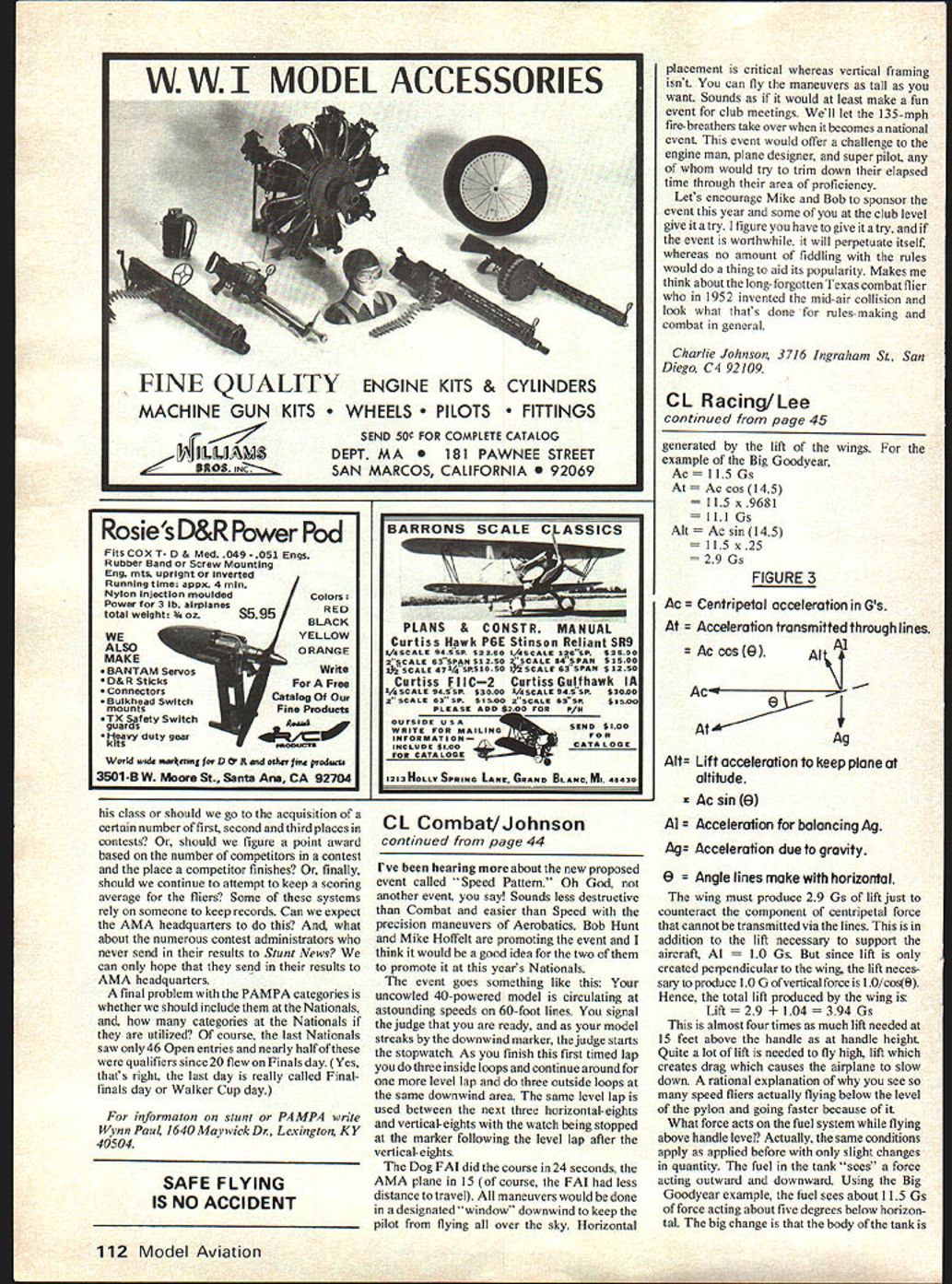
Ac = 11.5 Gs At = Ac cos(14.5°) = 11.5 × 0.9681 = 11.1 Gs Alt = Ac sin(14.5°) = 11.5 × 0.25 = 2.9 Gs
Figure 3
- Ac = Centripetal acceleration in G's.
- At = Acceleration transmitted through the lines.
- Alt = Lift acceleration to keep the plane at altitude (Alt = Ac sin θ).
- Ag = Acceleration due to gravity.
- θ = Angle the lines make with the horizontal.
The wing must produce 2.9 Gs of lift just to counteract the component of centripetal force that cannot be transmitted via the lines. This is in addition to the lift needed to support the aircraft, Al = 1.0 G. But since lift is only created perpendicular to the wing, the lift necessary to produce 1.0 G of vertical force is 1.0 / cos(θ). Hence, the total lift produced by the wing is:
Lift = 2.9 + 1.04 = 3.94 Gs
This is almost four times as much lift needed at 15 feet above the handle as at handle height. Quite a lot of lift is needed to fly high, which creates drag and causes the airplane to slow down. This is a rational explanation of why we see so many speed fliers actually flying below the level of the pylon and going faster because of that.
What forces act on the fuel system while flying above handle level? Actually, the same conditions apply as before with only slight changes in quantity. The fuel in the tank "sees" a force acting outward and downward. Using the Big Goodyear example, the fuel sees about 11.5 Gs of force acting about 14.5 degrees below horizontal. The big change is that the body of the tank is subjected to those combined forces and must be designed to withstand them.
Transcribed from original scans by AI. Minor OCR errors may remain.

