
Control Line: Combat
Charlie Johnson
A few months ago I proposed a new event called Speed Pattern. The idea behind the event was to be a way of directly comparing the performance of combat models and piloting skills. It appears that a lot of other people had the same idea—many of them, including MA’s Gene Hempel, Rich Porter, the Northwest Terror, and numerous combat fans, expressed their views.
Responses and suggestions
- Gene Hempel called as soon as he got the magazine. Seems many of the Texas Speed fliers had discussed just such an event. They favored having a fixed landing gear on the model and a more simplified pattern. Their idea was to start timing from the moment of launch, as is done in Proto Speed events, with the added feature of being able to fly the event over asphalt since the planes would have wheels. Gene also thought it would be a good idea to limit the power package to suction only.
- Rich Porter sent along graphs, diagrams, and various accessories for measuring turn radius and instructions for same. Being primarily a stunt flier (part-time combat), he was more interested in the quality of the maneuvers. Stunt fliers are well ahead of the combat world in measuring performance levels of their planes. We rate our combat models by how fast they go in level flight and the turning is usually described as either “tight” or “wide.” Both Rich and Gene seemed to prefer the profile-type airplane, but for different reasons.
- Many combat fans wrote in with their opinions and suggestions.
What’s it going to be? Class I Speed Pattern with unlimited airplanes, hand launches, and full-blown motors, or Class II with Slow Combat–style planes with suction motors, ROG, and other restrictions? I’m sure we’ll have little trouble thinking up restrictions, if needed.
Recommended newsletter
I’ve come across a really neat newsletter called Flying Lines, put out by John Thompson and Mike Hazel. It’s a quality product featuring articles on Combat (of course), plus Racing, Carrier, Stunt, and Speed. The copies I’ve received so far have all had at least a page of clear photographs. The issue with coverage of the Bladder Grabber had two full pages of pictures. All the articles are written by competitors and are up-to-the-minute in techniques. If you’d like to subscribe, send John $6.00 for 12 issues:
John Thompson 1411 Bryant Ave. Cottage Grove, OR 97424
Muffler/pipe developments
It is sometimes strange how restrictive rules make for an even faster event. In Australia they were required to run mufflers on their pylon racers, since that’s one of the rules in the FAI event. We all know a muffler will cost some horsepower if it’s going to be effective, right? Seems they’ve come up with a compact tune-pipe arrangement that not only meets the noise restriction and fits in the airplane, but actually increases horsepower.
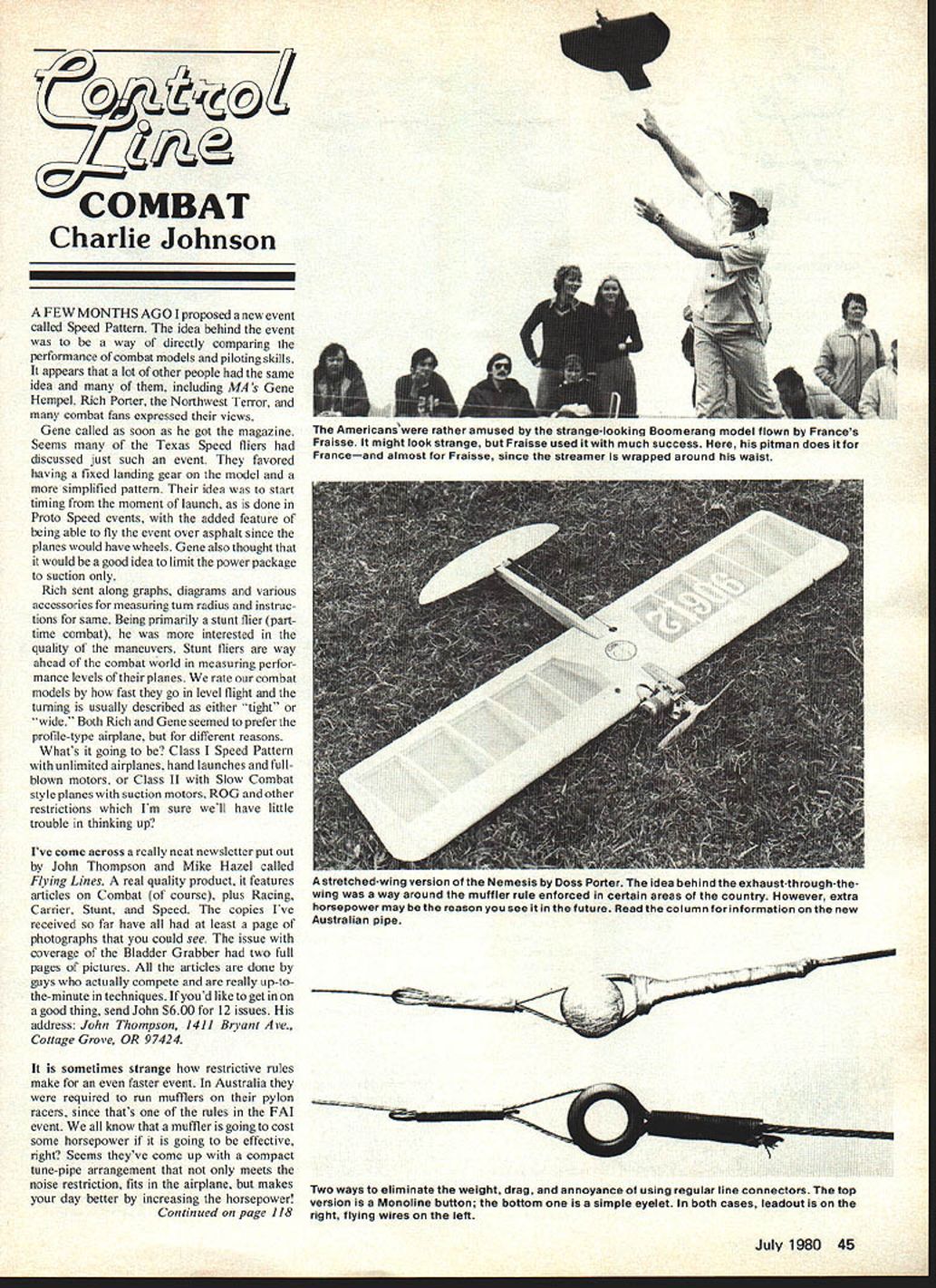
The muffler/pipe works like the catadioptric lenses used on some cameras in that it folds the pressure waves back and forth. From the sketches I’ve seen, one of these contraptions would fit inside a model such as Doss Porter’s stretched Nemesis. I’ve seen pipes on combat models before, and any benefit in level speed was often lost in the turns when the engine rpm fell below the effective range of the pipe. According to my source, this new arrangement has a very wide power band—something like a couple thousand rpm. Just the hot tip for the Unlimited Speed Pattern event.
Shipping and claims
Word from several kit and ARF manufacturers is that many models are being broken during shipment, and worse yet, many arrive after a long delay or not at all. After watching some delivery-service employees, I’m convinced they take great delight in destroying anything labeled fragile. When you send money for a product, be sure to note the date, check number or money order receipt, etc. If UPS is handling shipment and they destroy the merchandise, you can file a claim. Don’t let it go—manufacturers usually insure delivery, and you’ve invested your money in a product that’s supposed to arrive in good condition. Long delays are almost always caused by fickle postal or delivery services.
Nationals, testing, and measurements
I’ll be at the Nationals this year, as well as the Canadian Nationals. I’d like to get pictures and information on the really “new” combat models in all categories. When I say new, I don’t mean a disguised Ringmaster. We’re getting our test procedures down so maybe we can really compare some of the top models in various performance modes. Thanks to Rich Porter I have a handy device to help measure turn radius without resorting to photography or marking barriers. We’ll use my stopwatch to determine top speed and your reflexes to put the model through its paces.
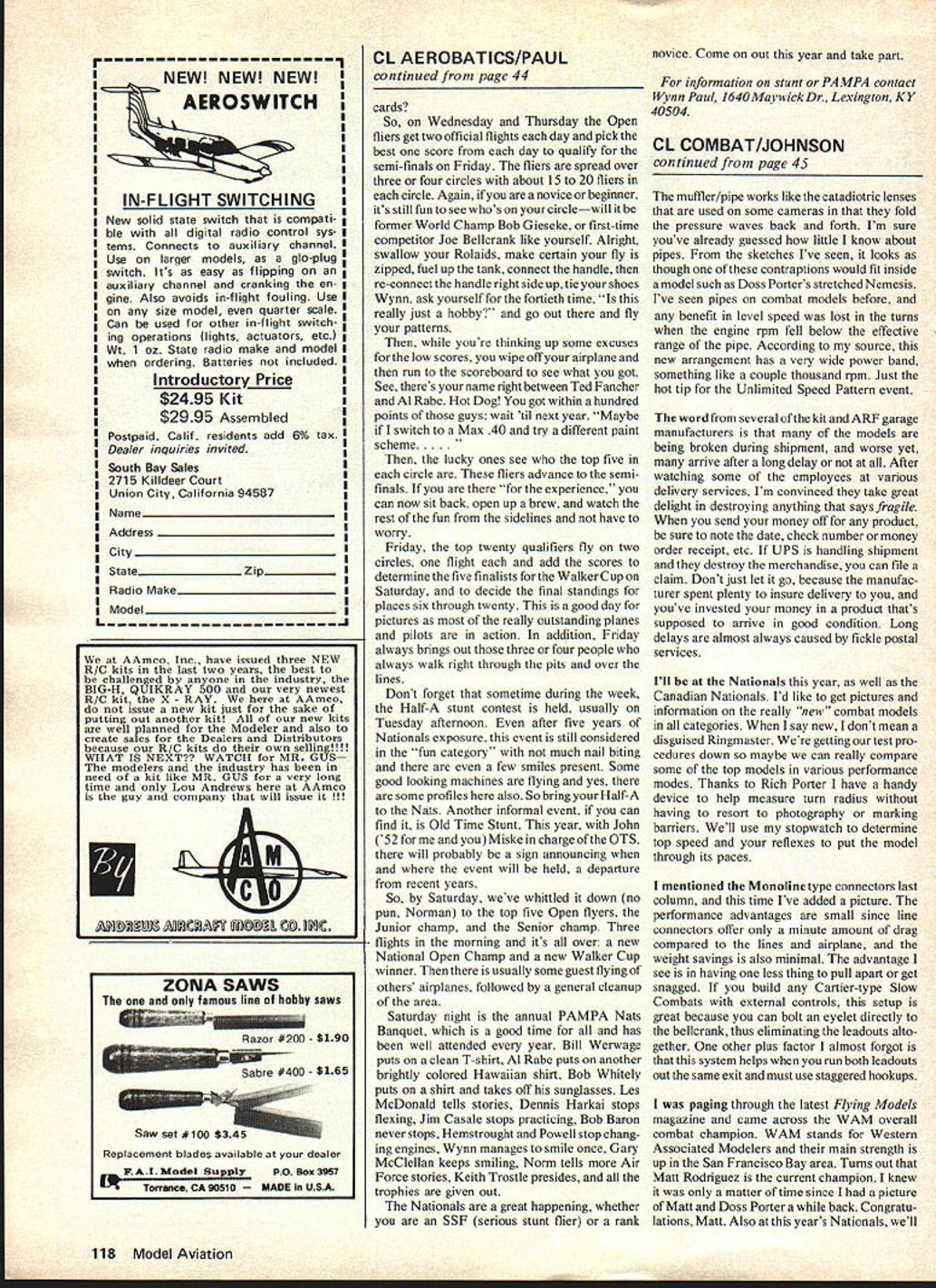
I mentioned Monoline-type connectors last column, and this time I’ve added a picture. The performance advantages are small since line connectors offer only a minute amount of drag compared to the lines and airplane, and the slight weight savings is minimal. The advantage I see is having one less thing to pull apart or get snagged. If you build any Carter-type Slow Combats with external controls, this setup is great because you can bolt an eyelet directly to the bellcrank, thus eliminating the leadouts altogether. One other plus: this system helps when you run both leadouts out the same exit and must use staggered hookups.
Champions and rumors
I was paging through the latest Flying Models magazine and came across the WAM overall combat champion. WAM stands for Western Associated Modelers and their main strength is in the San Francisco Bay area. Turns out that Matt Rodriguez is the current champion. I knew it was only a matter of time since I had a picture of Matt and Doss Porter a while back. Congratulations, Matt.
Also at this year’s Nationals we’ll have the reigning Combat World Champion. We won’t know until the middle of July whether it’ll be Phil Granderson, George Cleveland, or Sherwood Buckstaff. Rumor has it that, although Cleveland and Buckstaff are using the usual Texas-style plane and Fox engines, their third team member, Granderson, is going to use all-new foam models with possibly Ron Young Cox engines. Sure won’t lack for horsepower in any event.
Fuel note and a cautionary tale
I’ve got a good one for doing it the hard way. In some Southwestern racing events there is a tank size limit. Xylene has proven to be a good mileage ingredient and someone found out that STP gas treatment contains mostly xylene. So they go out and buy a case of STP gas treatment at $1.50 per can rather than buy a gallon of xylene for $3.50 at the chemical store. Reminds me of the fuel manufacturer who recommends spiking home brew with his 40% nitro blend. Even with nitro prices around $20 a gallon, this doesn’t seem like a very good solution—although I saw the guy with all the STP at the local hobby dealer buying up all the 40% in stock.
Unofficial Speed Pattern
Drop me a line if you’re interested in the unofficial Speed Pattern at the summer Nationals. We’ll try the unlimited type for sure and maybe the Slow Combat style, if anyone is interested.
Charlie Johnson 3716 Ingraham St. San Diego, CA 92109
Transcribed from original scans by AI. Minor OCR errors may remain.

