
Control Line: Combat
Charlie Johnson
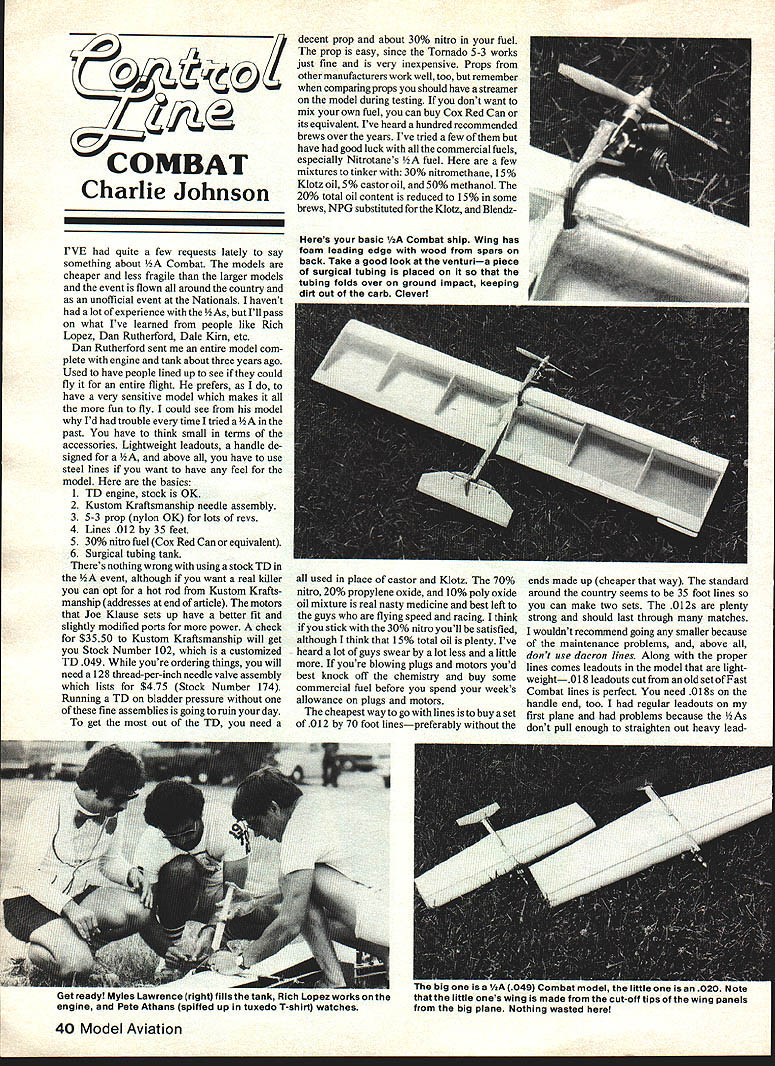
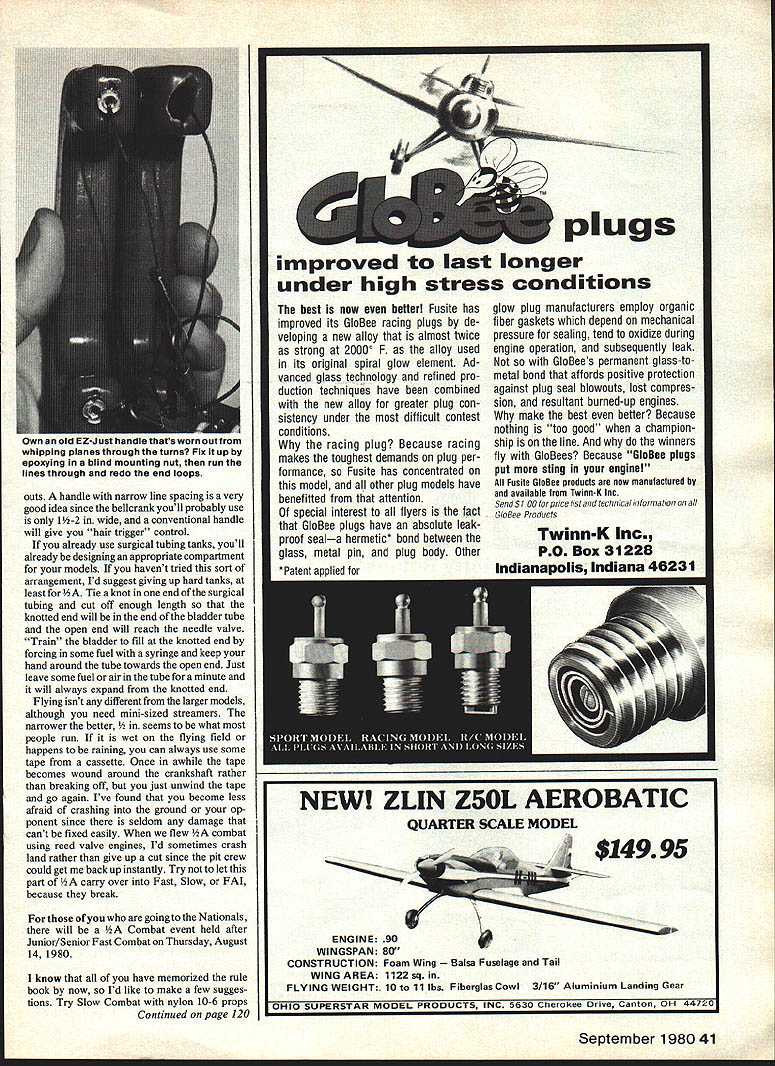
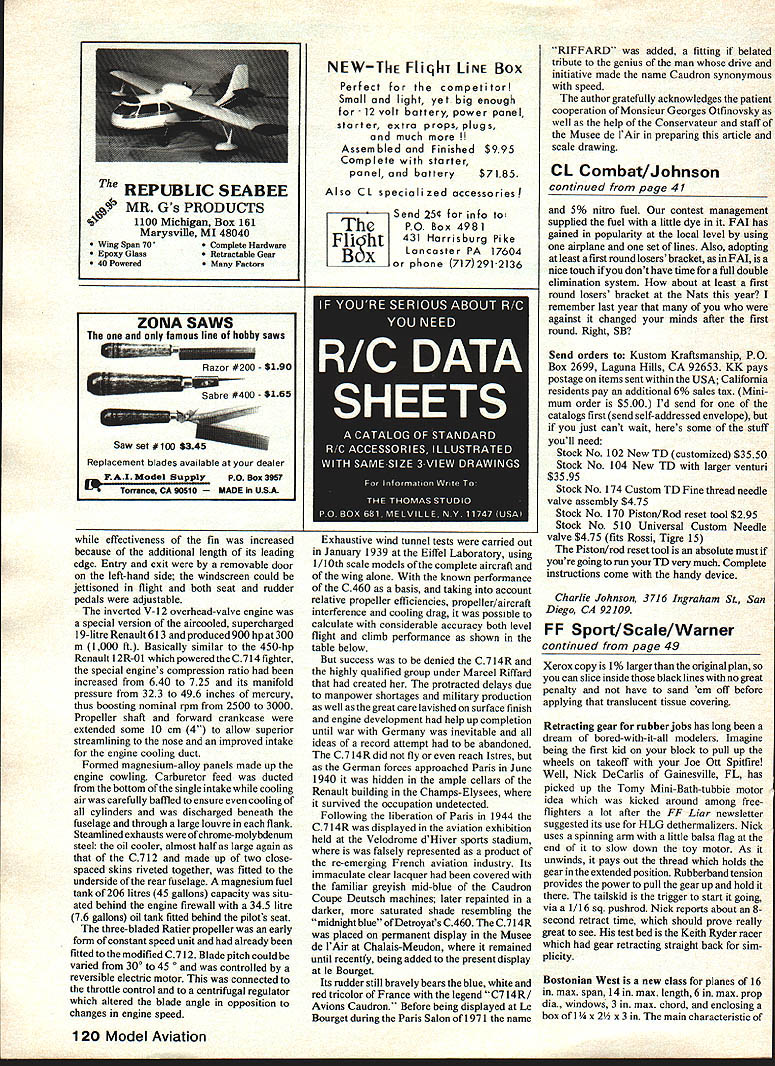
I've had quite a few requests lately to say something about 1/2A Combat. The models are cheaper and less fragile than the larger models, and the event is flown all around the country and as an unofficial event at the Nationals. I haven't had a lot of experience with the 1/2As, but I'll pass on what I've learned from people like Rich Lopez, Dan Rutherford, Dale Kim, and others.
Dan Rutherford sent me an entire model complete with engine and tank about three years ago. He used to have people lined up to see if they could fly it for an entire flight. He prefers, as I do, to have a very sensitive model which makes it all the more fun to fly. I could see from his model why I'd had trouble every time I tried 1/2A in the past. You have to think small in terms of the accessories: lightweight leadouts, a handle designed for a 1/2A, and above all, you have to use steel lines if you want to have any feel for the model.
Basics
Here are the basics:
- TD engine — stock is OK.
- Kustom Kraftsmanship needle assembly.
- 5-3 prop (nylon OK) for lots of revs.
- Lines: .012 by 35 feet.
- 30% nitro fuel (Cox Red Can or equivalent).
- Surgical tubing tank.
There's nothing wrong with using a stock TD in the 1/2A event, although if you want a real killer you can opt for a hot rod from Kustom Kraftsmanship. The motors that Joe Klause sets up have a better fit and slightly modified ports for more power. A check for $35.50 to Kustom Kraftsmanship will get you Stock No. 102, which is a customized TD .049. While you're ordering things, you will need a 128 thread-per-inch needle valve assembly which lists for $4.75 (Stock No. 174). Running a TD on bladder pressure without one of these fine assemblies is going to ruin your day.
To get the most out of the TD, you need a decent prop and about 30% nitro in your fuel. The prop is easy, since the Tornado 5-3 works just fine and is very inexpensive. Props from other manufacturers work well, too, but remember when comparing props you should have a streamer on the model during testing.
If you don't want to mix your own fuel, you can buy Cox Red Can or its equivalent. I've heard a hundred recommended brews over the years. I've tried a few of them but have had good luck with all the commercial fuels, especially Nitrotane's 3/4 fuel. Here are a few mixtures to tinker with:
- 30% nitromethane, 15% Klotz oil, 5% castor oil, 50% methanol (20% total oil content).
- 30% nitromethane, 15% total oil (some brews reduce oil to 15%).
- NPG substituted for Klotz; Blendz oils used in place of castor and Klotz.
The 70% nitro, 20% propylene oxide, and 10% poly oxide oil mixture is real nasty medicine and best left to the guys who are flying speed and racing. I think if you stick with the 30% nitro you'll be satisfied, although I think 15% total oil is plenty. I've heard a lot of guys swear by a little less or a little more. If you're blowing plugs and motors, you'd best knock off the chemistry and buy some commercial fuel before you spend your week's allowance on plugs and motors.
Lines and leadouts
The cheapest way to go with lines is to buy a set of .012 by 70-foot lines—preferably without the ends made up (cheaper that way). The standard around the country seems to be 35-foot lines so you can make two sets. The .012s are plenty strong and should last through many matches. I wouldn't recommend going any smaller because of the maintenance problems, and above all, don't use dacron lines.
Along with the proper lines comes leadouts that are lightweight. .018 leadouts cut from an old set of Fast Combat lines are perfect. You need .018s on the handle end, too. I had regular leadouts on my first plane and had problems because the 1/2As don't pull enough to straighten out heavy leadouts.
A narrow line spacing is a very good idea. You'll probably use a 1-1/2" wide conventional handle — it will give you hair-trigger control.
Tanking and fueling
Since you'll probably use surgical tubing tanks you'll already be designing an appropriate compartment for the model. I haven't tried hard tanks in this sort of arrangement; I'd suggest giving up hard tanks at least.
Tie a knot in the end of the surgical tubing and cut off enough length so the knotted end will be at the bladder tube's open end and will reach the needle valve. Train the bladder by filling it with the knotted end, forcing some fuel in with a syringe. Keep your hand around the tube toward the open end. Just leave some fuel and air in the tube a minute — it will help expand the knotted end.
Flying and streamers
Flying isn't different from larger models although you need mini-sized streamers — narrower is better; it's what people run. If the flying field happens to be wet or raining you can always use some tape on the cassette. Once in a while tape becomes wound around the crankshaft rather than breaking off; just unwind the tape and go again. I've found I've become less afraid of crashing into the ground or into an opponent since.
For those of you who are going to the Nationals, there will be a 1/2A Combat event held after Junior/Senior Fast Combat on Thursday, August 14, 1980.
Contest suggestions
I know that all of you have memorized the rule book by now, so I'd like to make a few suggestions:
- Try Slow Combat with nylon 10-6 props and 5% nitro fuel.
- Our contest management supplied the public with a little variety in it.
- FAI has gained in popularity at the local level by using one airplane and one set of lines.
- Adopting at least a first-round losers' bracket, as in FAI, is a nice touch if you don't have time for a full double-elimination system.
How about at least a first-round losers' bracket at the Nats this year? I remember last year that many of you who were against it changed your minds after the first round.
Ordering (Kustom Kraftsmanship)
Send orders to: Kustom Kraftsmanship P.O. Box 2699 Laguna Hills, CA 92653
- KK pays postage on items sent within the USA; California residents pay an additional 6% sales tax.
- Minimum order is $5.00.
- I'd send for one of the catalogs first (send a self-addressed envelope), but if you just can't wait, here's some of the stuff you'll need:
- Stock No. 102 — New TD (customized) — $35.50
- Stock No. 104 — New TD with larger venturi — $35.95
- Stock No. 174 — Custom TD fine thread needle valve assembly — $4.75
- Stock No. 170 — Piston/Rod reset tool — $2.95
- Stock No. 510 — Universal Custom Needle valve (fits Rossi, Tiger 15) — $4.75
Charlie Johnson 3716 Ingraham St. San Diego, CA 92109
Transcribed from original scans by AI. Minor OCR errors may remain.

