
Control Line: Combat
Charlie Johnson
This year Neal Rose got the honor of compiling the results of all WAM and AMA sanctioned contests into the Miniature Aircraft Combat Association (MACA) Top Twenty. This is no easy task — paging through the results of hundreds of contests that featured Combat events in order to pick not only the Top Twenty, but also the Top Ten in Fast Combat, FAI Combat, and Slow Combat.
The Top 20 Combat Fliers in the U.S.A.
- Dick Stubblefield
- George Cleveland
- Tom Fluker
- Marvin Denny
- Jordan Segal
- Bob Burch
- Paul Smith
- Bud Bodzioch
- Lloyd Seymour
- Gary Fentress
- Dick Imhoff
- Steve Sacco
- Mack Henry
- Paul Curtis
- Phil Cartier
- Greg Strombeck
- Gary Frost
- Joe Ambrose
- Ed Brzys
- John Frank
The top three Fast Combat pilots were Bob Burch, Lloyd Seymour, and Steve Sacco. In Slow Combat, it was Dick Stubblefield, Marvin Denny, and Jordan Segal. FAI Combat found Dick Stubblefield once again in top spot, followed by Paul Smith and George Cleveland. If you were at a local meet and were beaten by one of the above, now you know why. If you beat them in the match, then consider yourself lucky!
MACA: History and the Newsletter
Back in the early '70s, Howard Rush got the MACA organization started. With the help of Bill Allen, Tom Southern, Gary Frost, Patty and Ben Sasnett, to name a few, it has matured into the top organization it is today. Back in the old days, MACA's goals were to run Combat at the Nationals, conduct the FAI team selections, and help in sending a team to the World Championships. These goals have been met, but there is still a lot to be done in the area of workable rules and promoting Combat in general. One of the best tools at our disposal is the MACA Newsletter.
If you care what's going on in the world of Combat, you should get the newsletter. If you're too shy to write in and brag or complain, you can still be the first on your block to know the latest about engines, contest results, or the hot tip of the month. Treat yourself to a MACA membership. It also makes a great gift.
Slow Combat: Airframes and Engines
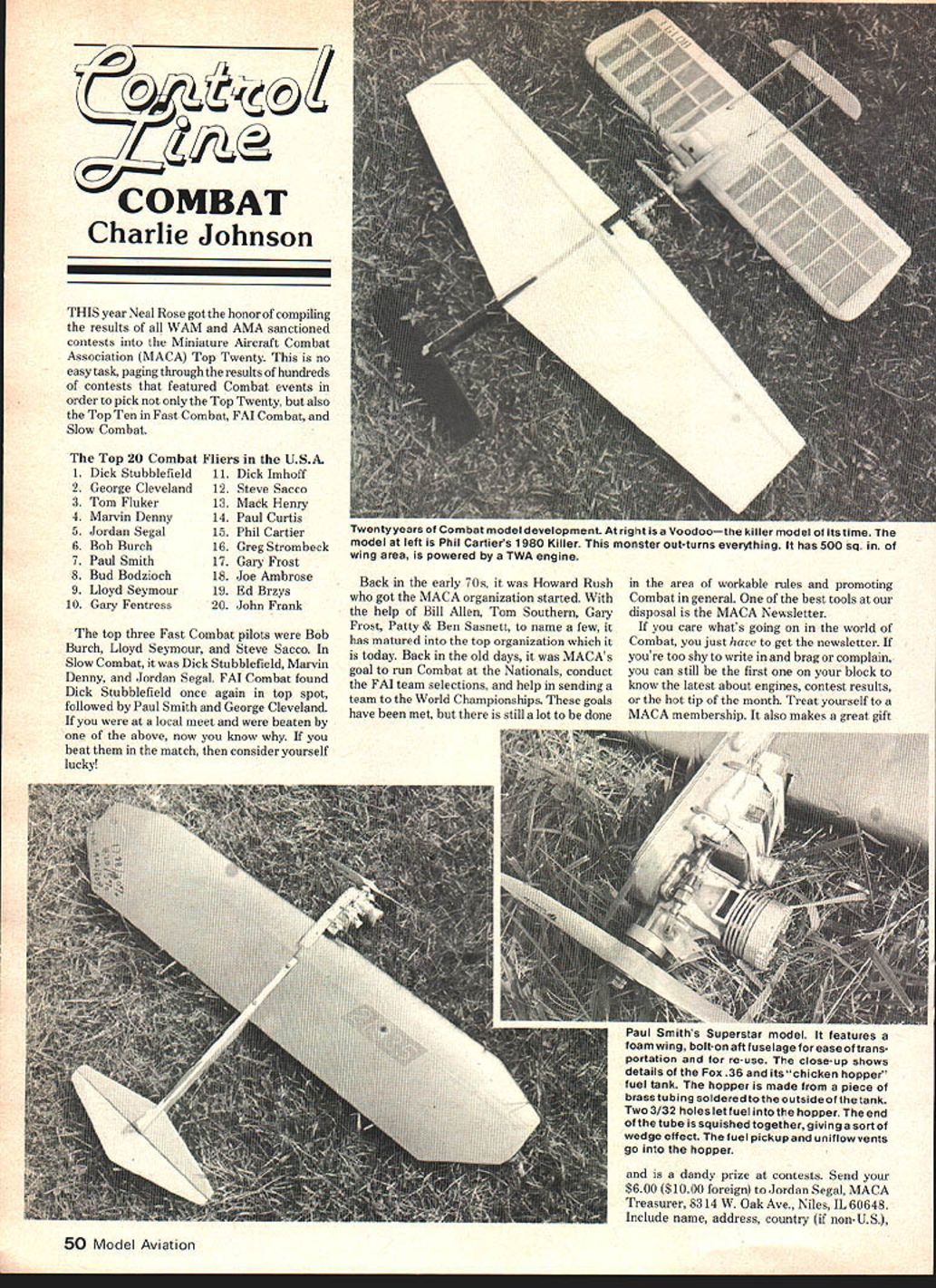
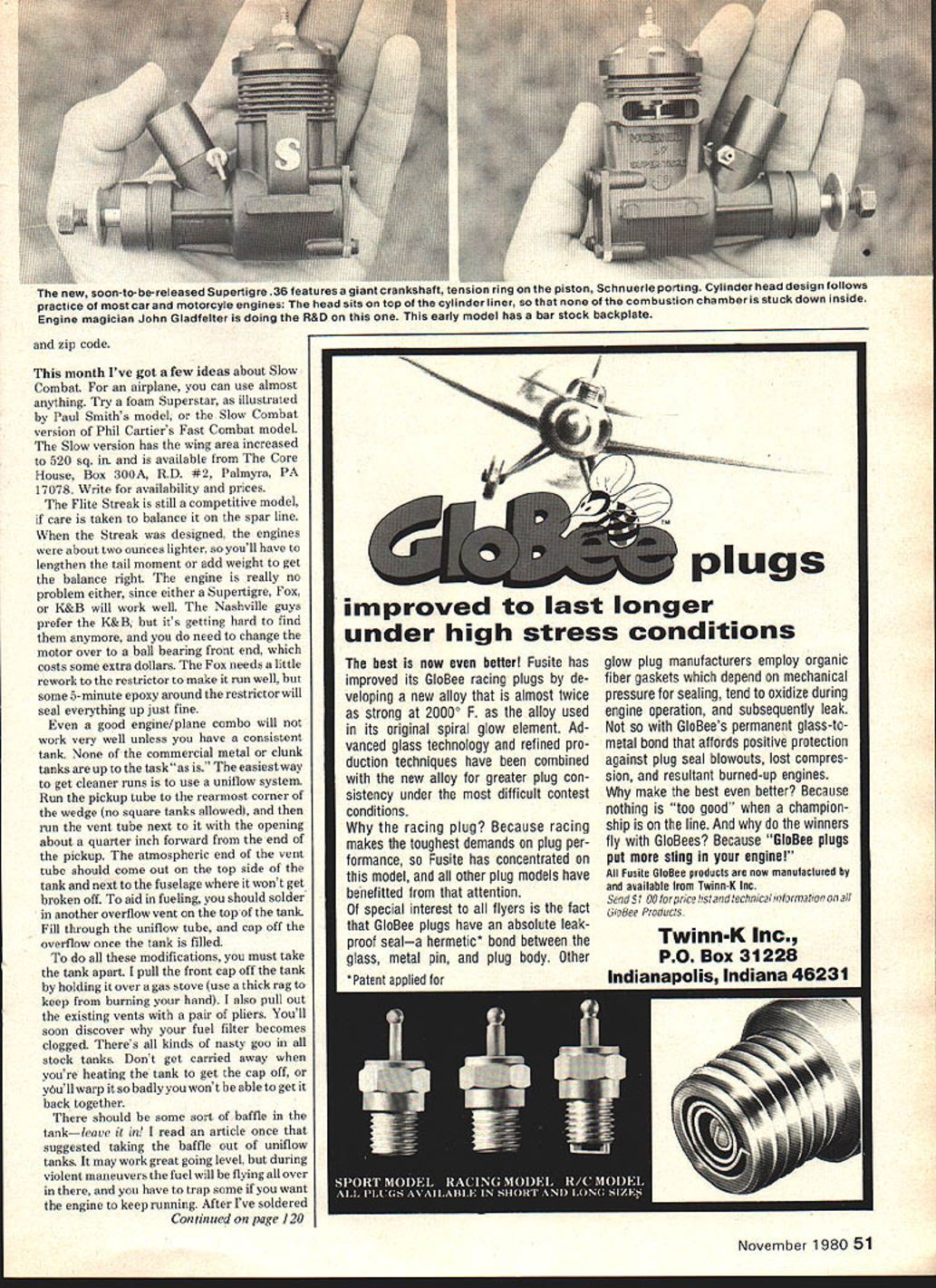
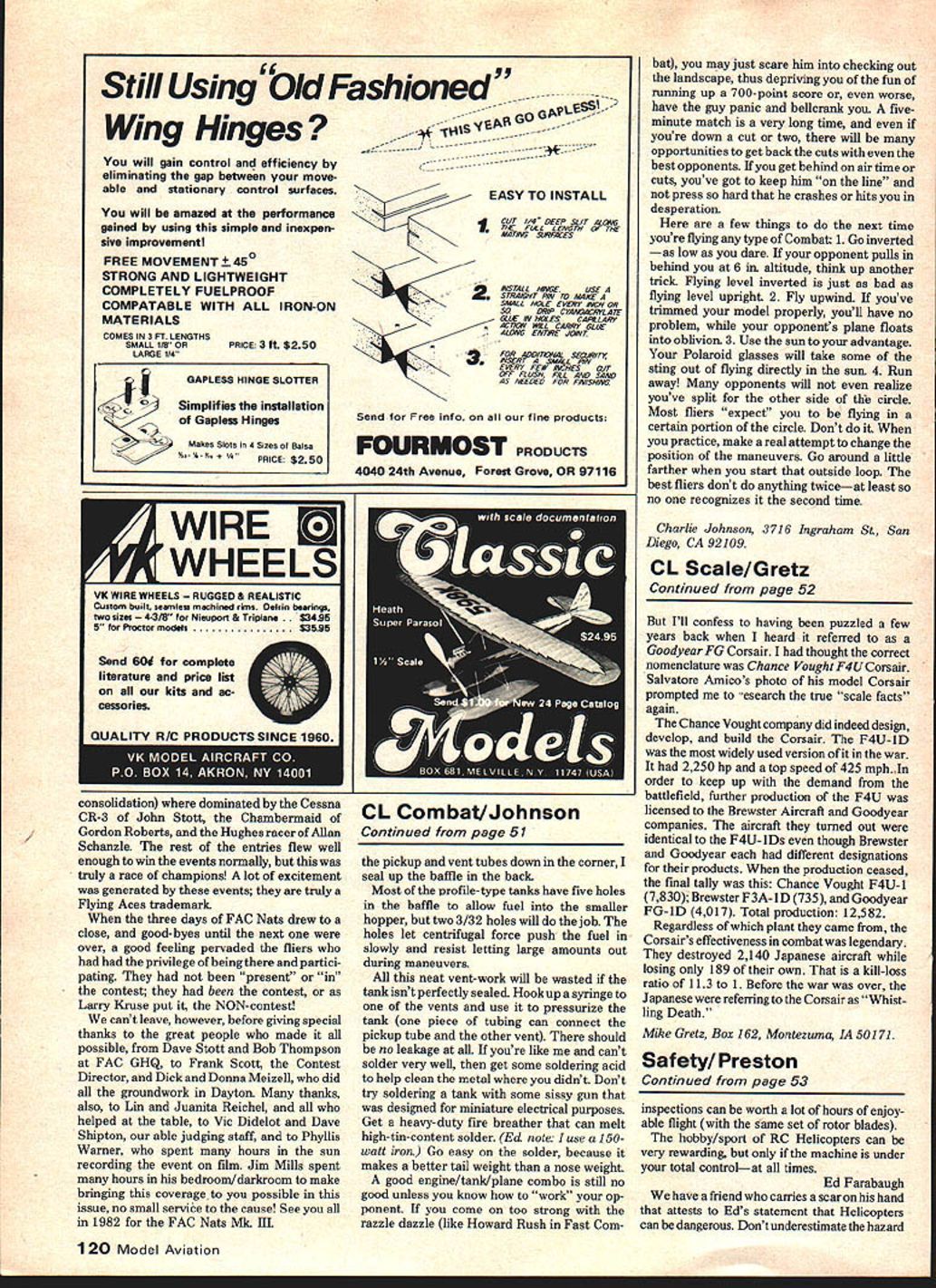
For an airplane, you can use almost anything in Slow Combat. Try a foam Superstar, as illustrated by Paul Smith's model, or the Slow Combat version of Phil Cartier's Fast Combat model. The Slow version has the wing area increased to 520 sq. in., and is available from The Core House, Box 300A, R.D. #2, Palmyra, PA 17078. Write for availability and prices.
The Flite Streak is still a competitive model if care is taken to balance it on the spar line. When the Streak was designed, the engines were about two ounces lighter, so you'll have to lengthen the tail moment or add weight to get the balance right. The engine is really no problem either, since a Supertigre, Fox, or K&B will work well. The Nashville guys prefer the K&B, but it's getting hard to find them anymore, and you do need to change the motor over to a ball-bearing front end, which costs some extra dollars. The Fox needs a little rework to the restrictor to make it run well, but some five-minute epoxy around the restrictor will seal everything up just fine.
Tanks and Fueling (Uniflow and Modifications)
Even a good engine/plane combo will not work very well unless you have a consistent tank. None of the commercial metal or clunk tanks are up to the task as is. The easiest way to get cleaner runs is to use a uniflow system. Run the pickup tube to the rearmost corner of the wedge (no square tanks allowed), and then run the vent tube next to it with the opening about a quarter inch forward from the end of the pickup. The atmospheric end of the vent tube should come out on the top side of the tank and next to the fuselage where it won't get broken off. To aid in fueling, you should solder in another overflow vent on the top of the tank. Fill through the uniflow tube, and cap off the overflow once the tank is filled.
To do all these modifications, you must take the tank apart. I pull the front cap off the tank by holding it over a gas stove (use a thick rag to keep from burning your hand). I also pull out the existing vents with a pair of pliers. You'll soon discover why your fuel filter becomes clogged — there's all kinds of nasty goo in stock tanks. Don't get carried away when you're heating the tank to get the cap off, or you'll warp it so badly you won't be able to get it back together.
There should be some sort of baffle in the tank — leave it in! I read an article once that suggested taking the baffle out of uniflow tanks. It may work great going level, but during violent maneuvers the fuel will be flying all over in there, and you have to trap some if you want the engine to keep running. After I've soldered the pickup and vent tubes down in the corner, I seal up the baffle in the back.
Most profile-type tanks have five holes in the baffle to allow fuel into the smaller hopper, but two 3/32" holes will do the job. The holes let centrifugal force push the fuel in slowly and resist letting large amounts out during maneuvers.
All this neat vent work will be wasted if the tank isn't perfectly sealed. Hook up a syringe to one of the vents and use it to pressurize the tank (one piece of tubing can connect the pickup tube and the other vent). There should be no leakage at all. If you're like me and can't solder very well, then get some soldering acid to help clean the metal where you didn't. Don't try soldering a tank with some sissy gun designed for miniature electrical purposes. Get a heavy-duty "fire breather" that can melt high-tin-content solder. (Ed. note: I use a 150-watt iron.) Go easy on the solder, because it makes a better tail weight than a nose weight.
Combat Tactics and Match Strategy
A good engine/tank/plane combo is still no good unless you know how to "work" your opponent. If you come on too strong with the razzle-dazzle (like Howard Rush in Fast Combat), you may just scare him into checking out the landscape, thus depriving you of the fun of running up a 700-point score or, even worse, have the guy panic and bellcrank you. A five-minute match is a very long time, and even if you're down a cut or two, there will be many opportunities to get back the cuts with even the best opponents. If you get behind on air time or cuts, you've got to keep him "on the line" and not press so hard that he crashes or hits you in desperation.
Here are a few things to do the next time you're flying any type of Combat:
- Go inverted — as low as you dare. If your opponent pulls in behind you at 6 in. altitude, think up another trick. Flying level inverted is just as bad as flying level upright.
- Fly upwind. If you've trimmed your model properly, you'll have no problem while your opponent's plane floats into oblivion.
- Use the sun to your advantage. Your Polaroid glasses will take some of the sting out of flying directly in the sun.
- Run away! Many opponents will not even realize you've split for the other side of the circle. Most fliers "expect" you to be flying in a certain portion of the circle. Don't do it. When you practice, make a real attempt to change the position of the maneuvers. Go around a little farther when you start that outside loop. The best fliers don't do anything twice—at least so no one recognizes it the second time.
Charlie Johnson 3716 Ingraham St. San Diego, CA 92109
Transcribed from original scans by AI. Minor OCR errors may remain.

