
Combat
Charlie Johnson
SOME SAY that Combat is all luck. The guys that win all the time claim it is 100% skill that put them on top. Both points are well taken but if you're good enough you can make your own luck, aided by technical knowledge, a bit of cunning, and a sometimes large outlay of cash. Let's assume that nationally competitive fliers like Howard Rush and Dan Stubblefield are flying at a 90% luck-free state, then maybe the rest of us are at the 50% level and the novice still struggling to eliminate 75% of the chance. Obviously, these figures are for the sake of the following argument and that is that your first move in becoming a better Combat flier is not to put all your hopes in super engines and airplanes. It is in developing your physical, emotional and intellectual capacities. You'll have a lot more to gain here than by adding 2 mph or decreasing the turn radius one foot. Go to your local public library and borrow a good book on becoming a race car driver. Model airplane flying requires many of the same skills, sometimes greater, even though the penalty for error is losing a match or airplane as opposed to wrecking your car.
Your eventual level of competitiveness will be determined by how much time, money, and effort you will put into this activity; nothing in return is guaranteed. If you think flying Combat is your way of self expression and have fun doing it but have the determination to become better then follow these steps:
1) Admit to yourself that your equipment is better than you are. A decently built Nemesis flies better than 90% of the fliers in the country are capable of flying it. There are many other planes that share this claim too; just find one you fancy and build lots of them because this is the easy part.
2) Put your body in shape. Start a regular exercise program and work on your co-ordination. Fat, sluggish bodies with little endurance aren't going to make it. If you're serious about becoming the best you'll do it. 3) Work on your concentration. After a five-mile run try flying the AMA stunt Pattern with your best Combat ship. Develop the ability to block out pain and exhaustion and think only about making the correct decision. Fly enough practice going both upright and inverted to overcome a tendency to become dizzy.
The beginner or intermediate that goes this route will find that progress is somewhat slower and more tedious than if he just built a bunch of planes and went out to bash everybody, but in the end he will acquire a far greater level of proficiency. Professionals practice first then compete.
Combat events
A low cost and fun event can be found in the 1/2A class. Rules vary throughout the country but basically all use .049 engines and from 25- to 40-foot lines. In California we fly with only one rule but nobody knows what it is. These little devils require a lot of patience at times and are not suggested for the ulcer-prone (the author has many .049's for sale).
A very sophisticated event is found in FAI Combat as flown at the international level. In the U.S. it is flown more like 1.5-size AMA Combat but this will change as World Championships, including Scale Combat, are held and the scramble for a place on the U.S. Team gets underway. The third class was proclaimed by decree as the Sunday flier special.
Slow Combat is generally the easiest place to start for the beginner, .45 is often left for the Junior and Senior age contestants. Slow Combat will soon become the new battle ground for the model designer because it's a place where a better plane is an advantage and not a more spectacular splatter.
Fast Combat is a high power and high appeal event because it is the last of the AMA events with really no restrictions. Once the engine- and airplane-hacker's delight, this event has lost some of its appeal because high horsepower ultra-trick airplanes became synonymous with big-hole-in-ground and falling pieces. If you decide to design your own plane be sure to give it a trick name. You can even name it after yourself if you win the Nationals.
While getting your body, mind, and airplanes in shape you can decide which classes to compete in and also how involved you'll become. There are regional and national meets every year throughout the country as well as a Nationals. If you are really into flying then you might consider attending an international meet like the British National Championships or Dutch International in Spaandam. We have great regional differences in the U.S. but nothing like Europe. By attending an international meeting you'll be well rewarded with experiences that will give you a whole new perspective on flying. In 1974 the Europeans got a look at American horsepower when I took my K&B 40-powered Nemesis over for some exhibition flights. The Yanks got a first hand look at an
Control Line: Combat
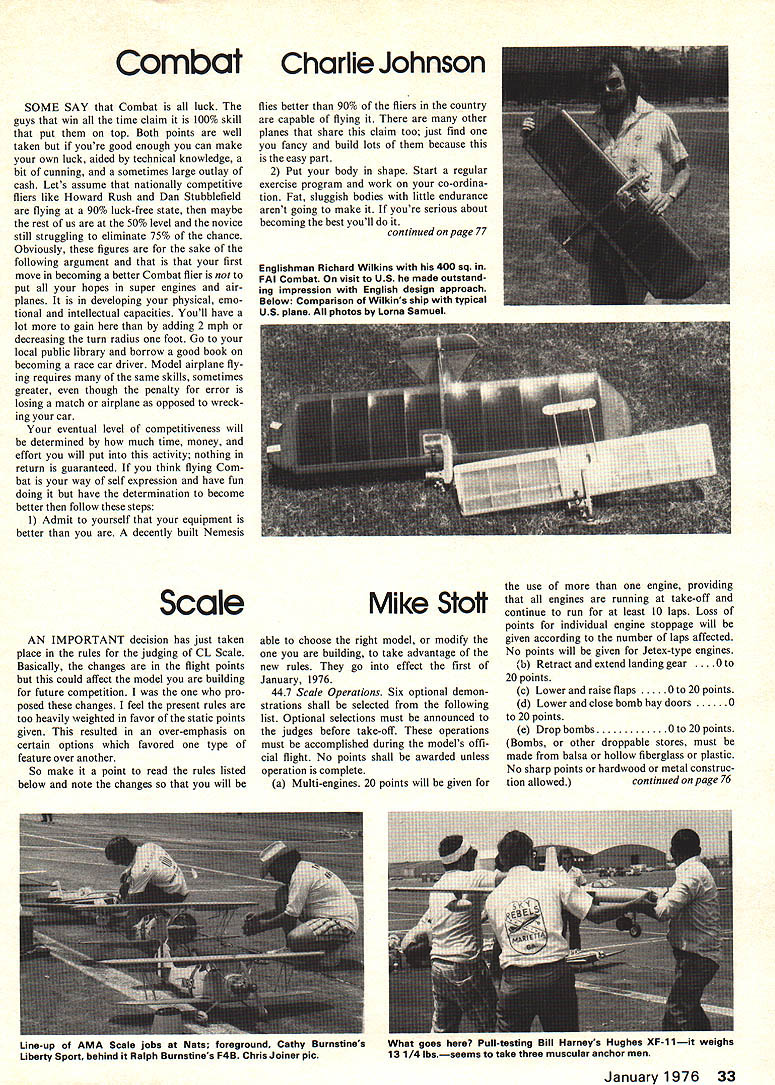
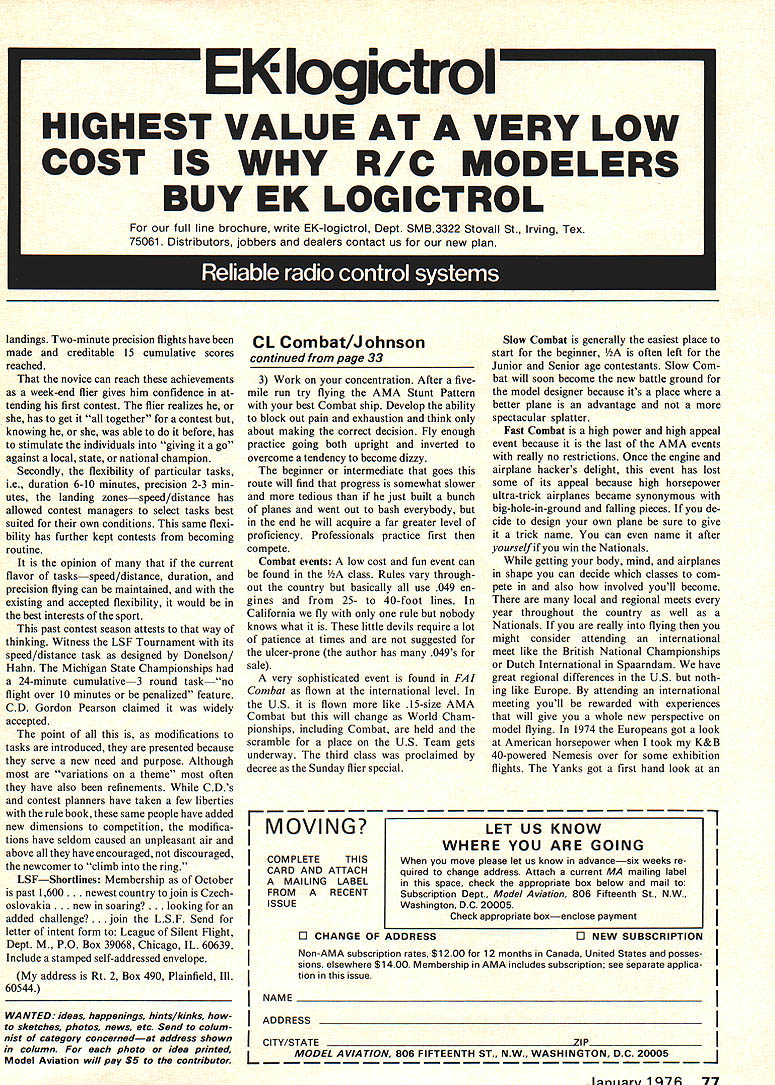
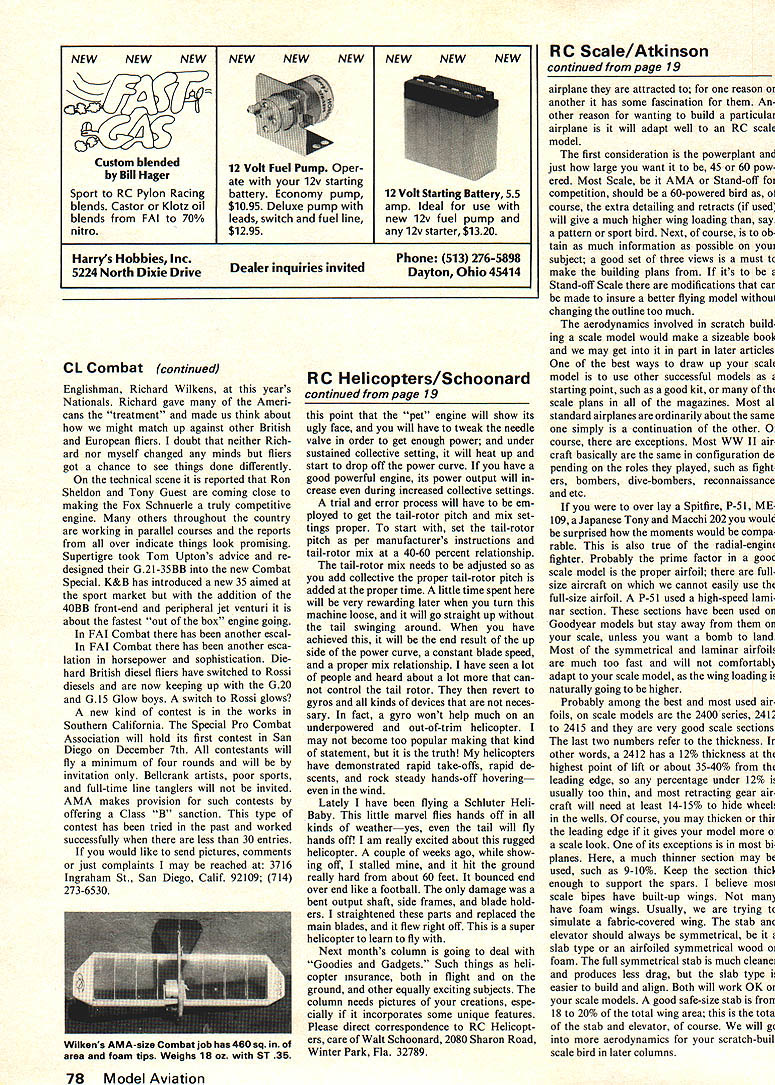
Englishman, Richard Wilkens, at this year's Nationals. Richard gave many of the Americans the "treatment" and made us think about how we might match up against other British and European fliers. I doubt that either Richard or myself changed any minds, but fliers got a chance to see things done differently.
On the technical scene it is reported that Ron Sheldon and Tony Guest are coming close to making the Fox Schneller a truly competitive engine. Many others throughout the country are working on similar courses and the reports from all over indicate things look promising. Super Tigre took Tom Upton's advice and redesigned their G.21-35BB into the new Combat Special. K&B has introduced a new .35 aimed at the sport market but with the addition of the 40BB front-end and peripheral jet venturi it is about the fastest "out of the box" engine going.
In FAI Combat there has been another escalation in horsepower and sophistication. Diehard British diesel fliers have switched to Rossi diesels and are now keeping up with the G.20 and G.15 glow boys. A switch to Rossi glows?
A new kind of contest is in the works in Southern California. The Special Pro Combat Association will hold its first contest in San Diego on December 7. All contestants will fly a minimum of four rounds and will be by invitation only. Bellcrank artists, poor sports, and full-time line tanglers will not be invited. AMA makes provision for such contests by offering a Class "B" sanction. This type of contest has been tried in the past and worked successfully when there are less than 30 entries.
If you would like to send pictures, comments or just complaints I may be reached at: 3716 Ingraham St., San Diego, Calif. 92109; (714) 273-6530.
Transcribed from original scans by AI. Minor OCR errors may remain.

