
Control Line: Combat
Charlie Johnson
The impact of super adhesives
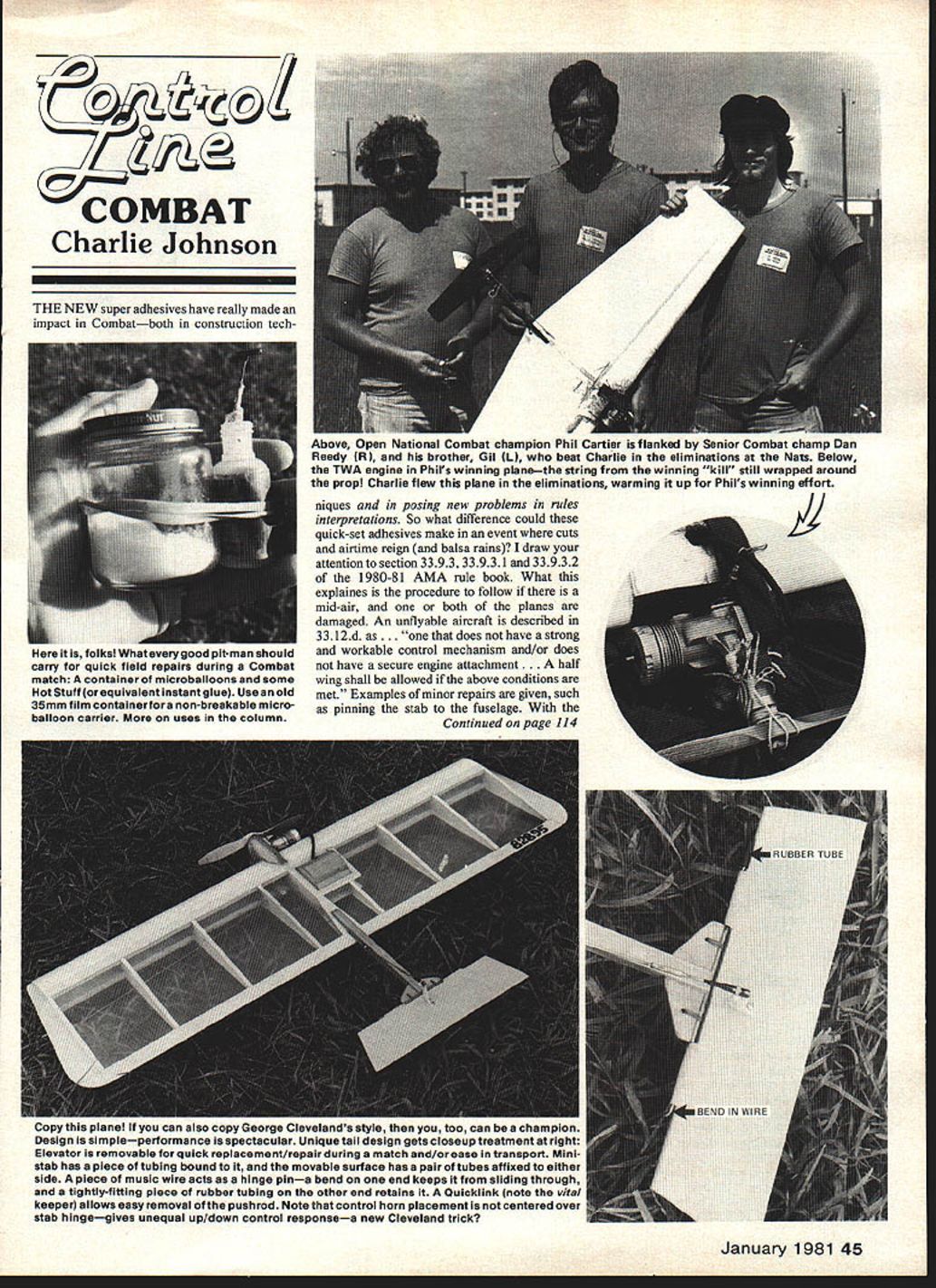
The new super adhesives have really made an impact on Combat — both in construction techniques and in posing new problems for rules interpretations. What difference could these quick-set adhesives make in an event where cuts and airtime reign (and balsa rains)? I draw your attention to section 33.9.3, 33.9.3.1 and 33.9.3.2 of the 1980–81 AMA rule book. These explain the procedure to follow if there is a mid-air and one or both of the planes are damaged.
An "unflyable" aircraft is described in 33.12.d as "one that does not have a strong and workable control mechanism and/or does not have a secure engine attachment ... A half wing shall be allowed if the above conditions are met." Examples of minor repairs are given, such as pinning the stab to the fuselage. With the introduction of super glues, it is now possible to repair just about any problem with a model — in fact, almost-total reconstruction jobs have been performed.
The Starting Judge dilemma
Here's where the Starting Judge gets into a bind. Before super glues, just about any broken part, such as a stab, put the plane out of commission and everyone accepted their fate. Today, if your opponent goes down because of a mid-air and he's ahead on points, it is reasonable to expect him to repair a severely damaged plane in order to get back in the match. Lately I've seen some heated arguments on the subject.
The pilot who was still flying may be outraged that the downed pilot wouldn't repair his plane and continue combat. Conversely, the downed plane may have suffered major crumpling but still be a "no-sweat job" with some super glue and a little reinforcing tape. The Starting Judge can't force the grounded pilot to repair the plane — but he can let the match continue and allow the flying contestant the extra air points.
The rules seem to allow anything that is safe to continue in competition (half-wings, etc.). What is missing, I think, is recognition that the downed pilot should have the option of whether to continue with a damaged plane — after all, he will be at a disadvantage with such a model. If the down-pilot chooses not to go back up, then the match should be terminated if the damage to the model is severe enough to hamper its performance (it is understood that the conditions for being safe are met). There has to be something done to keep the Starting Judge from having to be the "heavy," and also make the event oriented toward flying and not quick repair jobs.
I remember a fellow named Frank Smart of the British Outlaws Combat team. Frank's job, besides doing some excellent flying, was to repair the other team members' models between rounds. Give Frank a tattered model and by the time you were up in the next round he had it back in flying order.
Field repairs: what to carry and how to use it
If you want to carry on in the tradition of the Outlaws and try to repair the model regardless of condition, the job is even easier now with super glues and microballoons. A good pit kit will include:
- Super adhesives (brands such as Zap and Hot Stuff)
- Microballoons (or an improvised filler)
- Reinforcing tape
- Spruce sticks in various sizes for splints and reinforcement
- A small container (an old 35mm film canister works well as a non-breakable microballoon carrier)
Super adhesives like Zap and Hot Stuff are great for cracks — dribble some glue into the plane's wound; if it doesn't "go off" or there is too large a gap, dab on microballoons (or fine dirt, if you don't care to keep up appearances). Reinforcing tape is also great for holding on parts — especially on foam models, where super glues can melt the foam. Thick super glue formulations work better in quick-and-dirty operations because there isn't time to make the precise joints the thin stuff requires.
A difficult repair is the typical sheeted leading edge where little leading edge remains. If you take along some 1/64-inch plywood, you can cut an appropriately sized piece, rip away the covering on adjacent wood, and form the plywood around the remaining leading edge. Secure it with an extra-thick super glue.
Celastic and other materials
Another product that I haven't seen in a while is Celastic. It looks like lightweight cardboard; you use it by soaking a piece briefly in thinner. It becomes very soft and pliable and can be shaped to almost any contour. On hot days the thinner will evaporate fast enough to harden the material during a five-minute match — er, rebuild — period. Its best use would be between rounds so it has fully hardened for maximum strength.
Design and quick-replacement features
Design: simple — performance spectacular. One useful idea is a removable elevator for quick replacement/repair during a match and for ease of transport.
Ministab design example:
- A piece of tubing is bound to the movable surface with a pair of tubes affixed to either side.
- A piece of music wire acts as a hinge; a pin or a bend in the end keeps it from sliding through a tightly fitting piece of rubber tubing.
- The other end retains the Quicklink.
- A vital keeper allows easy removal of the pushrod.
- Note: control horn placement centered over the stab hinge gives unequal up/down control response — a Cleveland trick.
3/4A Combat and engine tuning
Great response to my comments on 3/4A models for fun and practice. I saw many outstanding matches at the Nationals in 3/4A, and at a local meet two weeks ago the matches were head and shoulders above other events.
Many competitors are not satisfied to run stock engines anymore. Mildly tuned motors are available from Kustom Kraftsmanship. For all-out 1/2A Combat fliers, here is some information I received from Gene Hempel recently for Cox TD .049 parts and prices. Write P&G Metal Shop, 301 North Yale Dr., Garland, TX 75042. (Add $1.50 for postage and handling.)
- Blank cylinders — $5.50 each
- Piston & rod assembly — $3.25 each
- New style case — $5.50 each
- Crankshafts (left or right) — $5.50 each
- Cox flywheels — $6.95 each
- Metal thrust washer — $0.40 each
- Plastic housing — $1.20 each
- Chrome plate crankshaft and main case — $15.00
- Chrome plate piston — $5.50
(Chrome plating increases longevity, and rpm increases when the case is bored out of the shaft.)
Modelers are just learning that proper fits are more important than other radical engine modifications. I've had a couple of motors with chrome liners and can report a vast improvement in engine life.
Closing note
One last thing — if you haven't received your latest MACA Newsletter, write Jordan Segal.
Transcribed from original scans by AI. Minor OCR errors may remain.

