

Control Line: Combat
Charlie Johnson
Big-money winner — 1980
Howard Rush turned out to be the big-money winner for 1980 with his victory at the Bladder Grabber in Washington. Howard rounded up about $2,000 in prizes in the 5th Annual Fast Combat Meet. Previous big-money winners were:
- Dan Rutherford (1976)
- Howard Rush (1977)
- Rich Brasher (1978)
- Mike Petri (1979)
The Carver Corporation stereo system Howard won is reported to be so powerful that it drowned out the sound of his 28,000 rpm Fox.
Buckeye Regionals (Buckeye, AZ)
A strange contest is coming up at the Buckeye Regionals in Buckeye, AZ. Because the flying site has only desert sand and asphalt, contest management rounded up rolls of old carpet and will carpet the entire flying circle. This is intended as a backup if their grass-growing project fails; even the pit area will be fully carpeted. Lead time being what it is, only those AMA members who get advance copies of the magazine will find out about the "rug" at Buckeye—the meet will be held January 31 and February 1. I'll be on the spot for coverage and will have a full report in the next column.
1975 FAI Combat winners — perspective on design thinking
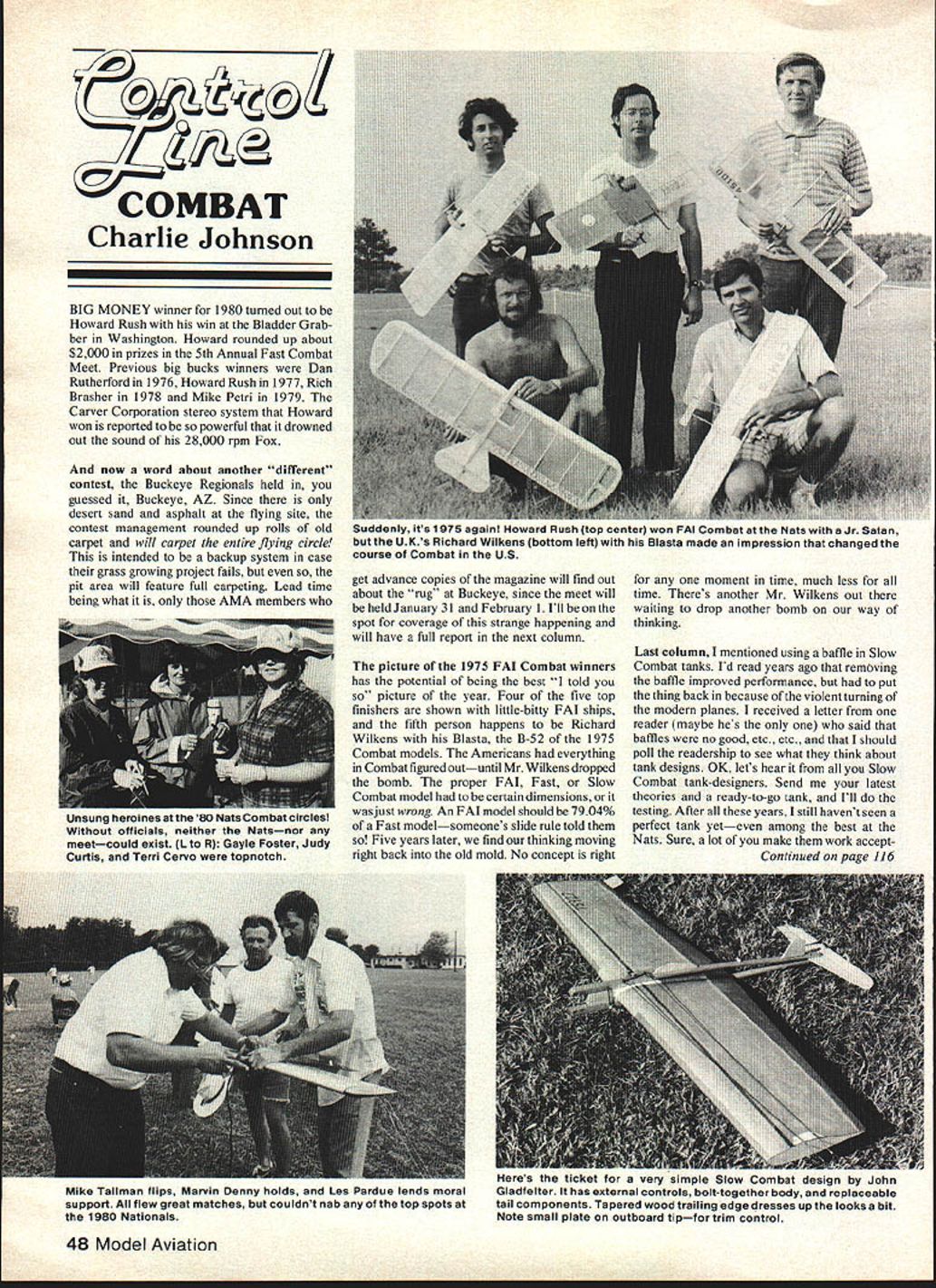
The picture of the 1975 FAI Combat winners is a great "I told you so" moment. Four of the five top finishers are shown with tiny FAI ships, and the fifth is Richard Wilkens with his Blasta, the B‑52 of the 1975 Combat models. For a while it seemed Americans had everything in Combat figured out—until Mr. Wilkens dropped the bomb. At one time the proper FAI, Fast, or Slow Combat model had to be certain dimensions or it was simply wrong. Someone's slide rule even dictated that an FAI model should be 79.04% of a Fast model. Five years later we find our thinking moving back into old molds. No concept is right for all time; there's always another Mr. Wilkens out there ready to drop a bomb on our assumptions.
Tank design and Slow Combat baffles
Last column I mentioned using a baffle in Slow Combat tanks. Years ago I'd read that removing the baffle improved performance, but I had to reinstall it because of the violent turning of modern planes. I received a letter from a reader who said baffles were no good and suggested polling the readership on tank designs. OK — let's hear it from all you Slow Combat tank designers. Send me your latest theories and a ready-to-go tank, and I'll do the testing. After all these years I still haven't seen a perfect tank yet—even among the best at the Nats. Sure, a lot of you make them work acceptably, but a whole bunch of pretty good fliers can't.
Don't fool yourself by using a SuperTigre .46 to check out your tank — a Coors beer can with a fuel line stuck in it will draw with a high-suction motor like that. Try your tank with a Fox or a SuperTigre with an enlarged venturi and on a plane that turns very tight. If you intend to try a baffle, take the front off the tank and solder the rear portion of the baffle to the back of the tank. Most baffles have five holes through them to let fuel into the baffled section; the holes are too big. I drill them out and install 1/32" brass tubing as restrictors. That seems to help.
The location of the tank in the fuselage is critical. If the tank is right behind the firewall the feeds will be steady under positive‑G turns but will vapor-lock under negative‑G. Place the tank a bit further back and the opposite happens. The answer is to keep the tank vented and pressurized under all conditions. A pulse line with a small ball check will do the job.
Other practical tips:
- Try soldering up two of the holes and using tubing smaller than 5/8‑in. for the feed and vent lines.
- Use the smallest fuel tubing and filter you can find to limit the quantity of fuel that is neither in the tank nor the engine.
All you guys who are against change better stop right here and go build some tanks.
International perspective and future rules suggestions
Also in the mailbag was a letter from Dave Clarkson, now living in South Africa. He has seen the cycle of FAI Combat in Britain and Europe go from the Oliver .15 diesel to racing glow and back again to .10‑sized diesels. FAI is going great guns here in the U.S.A., land of plenty of nitro, but elsewhere things are going downhill.
We're all angry at the auto manufacturers for not seeing the writing on the wall about conservation of fuel and resources, but we go blindly on, flying disposable models by the score and using nitro‑guzzling engines that devour $30‑a‑gallon fuel at alarming rates. Let's look further ahead than this summer's Nats and see what might be in store for FAI Combat years down the road. Dave suggests rethinking the rules to something those outside the U.S.A. can live with, in places where nitro and even diesel components are hard to come by and very expensive.
Assuming methanol and castor oil remain available at reasonable prices (I buy alky for $1.00 a gallon and castor oil for about $9.00 for the same quantity), he suggests:
- Using the .10‑size motor (1.65 cc) as ideal
- Bushing models only — no ball‑bearing racing engines
- Lines: .012s, 45 ft. 11 in. long (≈14 meters)
I'm sending Dave one of the Cipolla .10s advertised in this magazine for him to test, and I plan to pick up one for myself to see what it's like to fly a model with such an engine.
Slow Combat one-design and John Gladfelter
John Gladfelter had a neat Slow Combat ship at the Nats. It featured external controls and very simple construction, an approach similar to Phil Cartier's replaceable‑wing model. It will cost about the same to build, but the great thing is that it won't take much time. Performance is almost as good as a top‑line model and "good enough" for most contests. I know several clubs using a "one‑design" concept to promote Slow Combat at their meets. If everyone uses a ship similar to Gladfelter's, no one is at a disadvantage because of a slightly heavier or draggier plane.
Want list — AAC setup for your Rossi
I'll leave you with something for your want list — an AAC setup for your Rossi: chromed aluminum liner and aluminum piston, all for about $60. Write to: Henry Nelson 729 Valemont Dr. Verona, PA 15147
Be sure to include a stamped, self‑addressed envelope, or Henry probably won't have time to reply. You can write me at the address below, but it won't do much good — I just steam off the stamps and save them up to buy glow plugs and props.
Charlie Johnson 3716 Ingraham St. San Diego, CA 92109
Transcribed from original scans by AI. Minor OCR errors may remain.

