

Control Line: Combat
By Charlie Johnson
Southwest Regionals — Buckeye, AZ
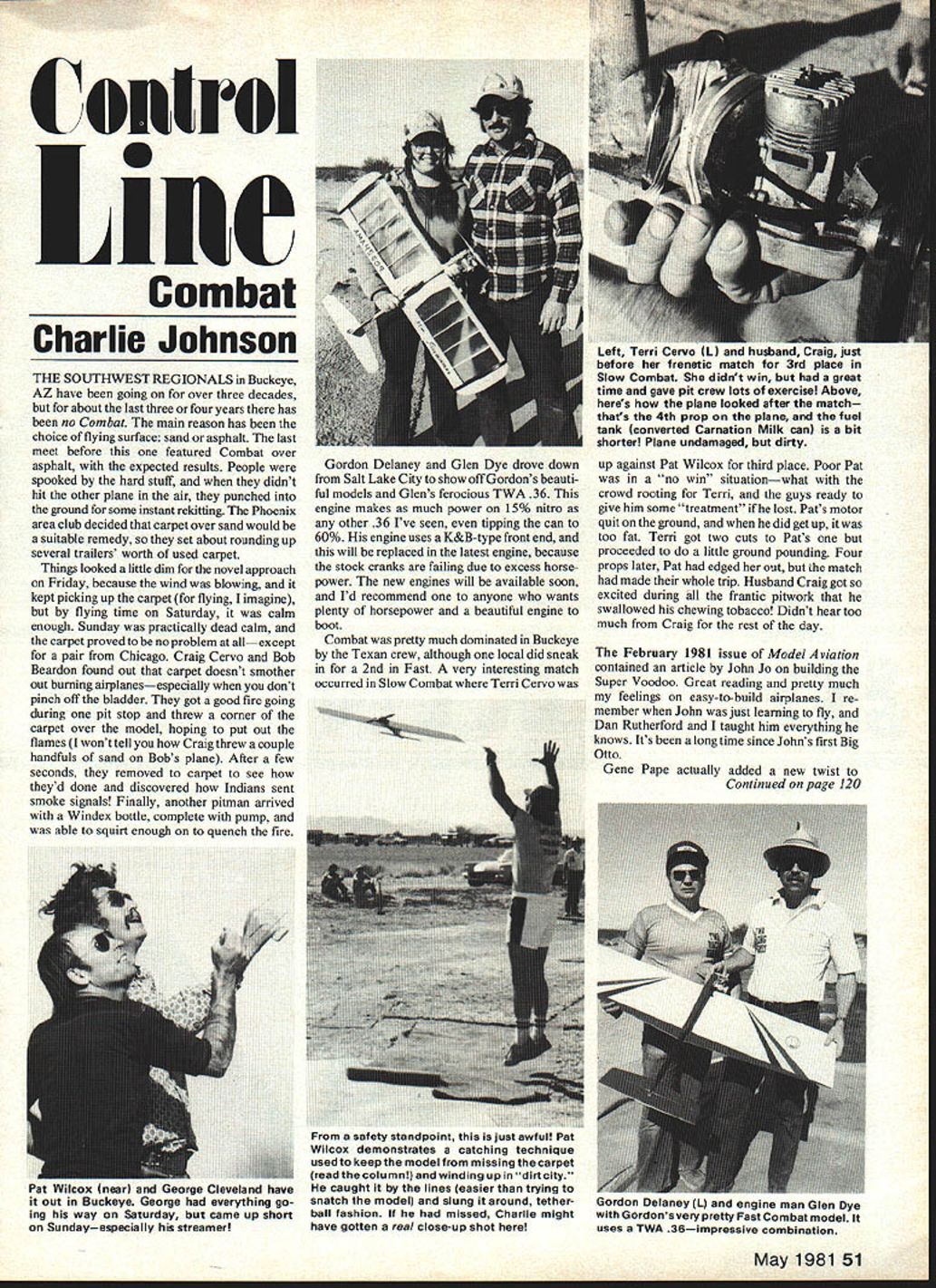
The Southwest Regionals in Buckeye, AZ have been going on for over three decades, but for the last three or four years there has been no Combat. The main reason was the choice of flying surface: sand or asphalt. The last meet before this one featured Combat over asphalt, with the expected results. People were spooked by the hard surface, and when they didn't hit the other plane in the air, they punched into the ground for some instant re-kitting.
The Phoenix area club decided that carpet over sand would be a suitable remedy, so they set about rounding up several trailers' worth of used carpet. Things looked a little dim for the novel approach on Friday because the wind kept picking up the carpet. By flying time on Saturday it was calm enough, and Sunday was practically dead calm. The carpet proved to be no problem at all—except for one incident involving a pair from Chicago.
Craig Cervo and Bob Beardon discovered that carpet doesn't smother burning airplanes—especially when you don't pinch off the bladder. They got a good fire going during a pit stop and threw a corner of carpet over the model, hoping to put out the flames. After a few seconds they removed the carpet and discovered how Indians sent smoke signals. Finally, another pitman arrived with a Windex bottle, complete with pump, and was able to squirt enough on to quench the fire. (I won't tell you how Craig threw a couple handfuls of sand on Bob's plane.)
Competitors and Notable Matches
Gordon Delaney and Glen Dye drove down from Salt Lake City to show off Gordon's beautiful models and Glen's ferocious TWA .36. This engine makes as much power on 15% nitro as any other .36 I've seen, even tipping the can to 60%. His engine uses a K&B-type front end; that front end will be replaced in the latest engines because the stock cranks are failing due to excess horsepower. The new engines will be available soon; I'd recommend one to anyone who wants plenty of horsepower and a beautiful engine to boot.
Combat at Buckeye was pretty much dominated by the Texan crew, although one local sneaked in for second place in Fast Combat. A very interesting match occurred in Slow Combat where Terri Cervo faced Pat Wilcox for third place. Pat was in a "no-win" situation—the crowd was rooting for Terri and the other competitors were ready to give him some "treatment" if he lost. Pat's motor quit on the ground, and when he did get airborne it was too fat. Terri got two cuts to Pat's one but proceeded to do some ground pounding. After four props and frantic pitwork, Pat edged her out, but the match had made their whole trip. Husband Craig got so excited during the pitwork that he swallowed his chewing tobacco! I didn't hear much from Craig for the rest of the day.
Design Notes and Plans
The February 1981 issue of Model Aviation contained an article by John Jo on building the Super Voodoo. Great reading—and pretty much my feelings on easy-to-build airplanes. I remember when John was just learning to fly; Dan Rutherford and I taught him everything he knows. It's been a long time since John's first Big Otto.
Gene Pape added a new twist to John's design by cutting the leading edge into two pieces: one 20 in. long and the other 16 in. The long leading edge goes on the inboard side, and the 16 in. piece goes outboard of the engine. A piece of 1/4 in. basswood gives enough strength to the cutout area. Gene's plane is called the STP (Square-Tipped-Plane), and the tip rib is 3/8 in., which suffices as a wingtip.
If you want the plans to Gene's plane, subscribe to the Flying Lines newsletter. $8.00 a year gets you information, pictures, and plans. Send money to:
- Flying Lines, 1411 Bryant Ave., Cottage Grove, OR 97424
News and Engine Updates
The MACA newsletter seems to be coming out regularly again, so if you're adventurous you might try sending in your membership. Frank McCune spends a lot of time and money finding out the latest from manufacturers and competitors, and does a good job of editing with the limited material sent in by the membership.
Latest from John Gladfelter at World Engines:
- SuperTiger S-36: The new S-36 will have a lapped piston, and its setup gives about 3,000 rpm more than the ringed version seen at the Nationals—more than enough horsepower to compete with the now-dominant Fox .36.
- FAI .15: Soon-to-be-released FAI .15 designed for FAI Combat. Competitive horsepower on lower nitro and ease of handling should make the engine popular.
- Nelson .15s: If you're after every ounce of power, the Nelson .15s will be available in June and are worth considering.
The Fox .36 appears to work better with the new venturi arrangement and liner shim. Shim the liner up for Flying Fast Combat and remove the shim for Slow Combat, where you need more midrange punch for pulling heavier planes on suction. Naturally, you have to move the head to compensate. The new venturi is an improvement partly because of a better fit and partly because the spraybar has been moved outboard somewhat; this helps keep the engine from running over-lean at the end of the tank.
Tanks
Tanks! Do I have a bunch of them. No sooner had the last issue hit the streets than I received a UPS shipment from Randy's Model Aeronautics. There must be a dozen different types of tanks for me to test. Randy's tanks are basically the familiar Don's tanks we all know: well made, some with uniflow venting, all with good solder joints, and nicely cleaned out.
My stove's gas burner is just itching to get at one, since we're all through with the Regionals and I can now get down to testing some of the samples people have sent. How about Craig Cervo's cheap alternative to commercial tanks—Carnation milk cans? Somebody sent me one sample that has more vents and pickup lines than I know what they're for... wait a minute, it's almost April 1st.
Contacts and addresses mentioned:
- Randy's Model Aeronautics, 515 Coleman Blvd., Mt. Pleasant, SC 29464
Charlie Johnson 3716 Ingraham St. San Diego, CA 92109
Transcribed from original scans by AI. Minor OCR errors may remain.

