
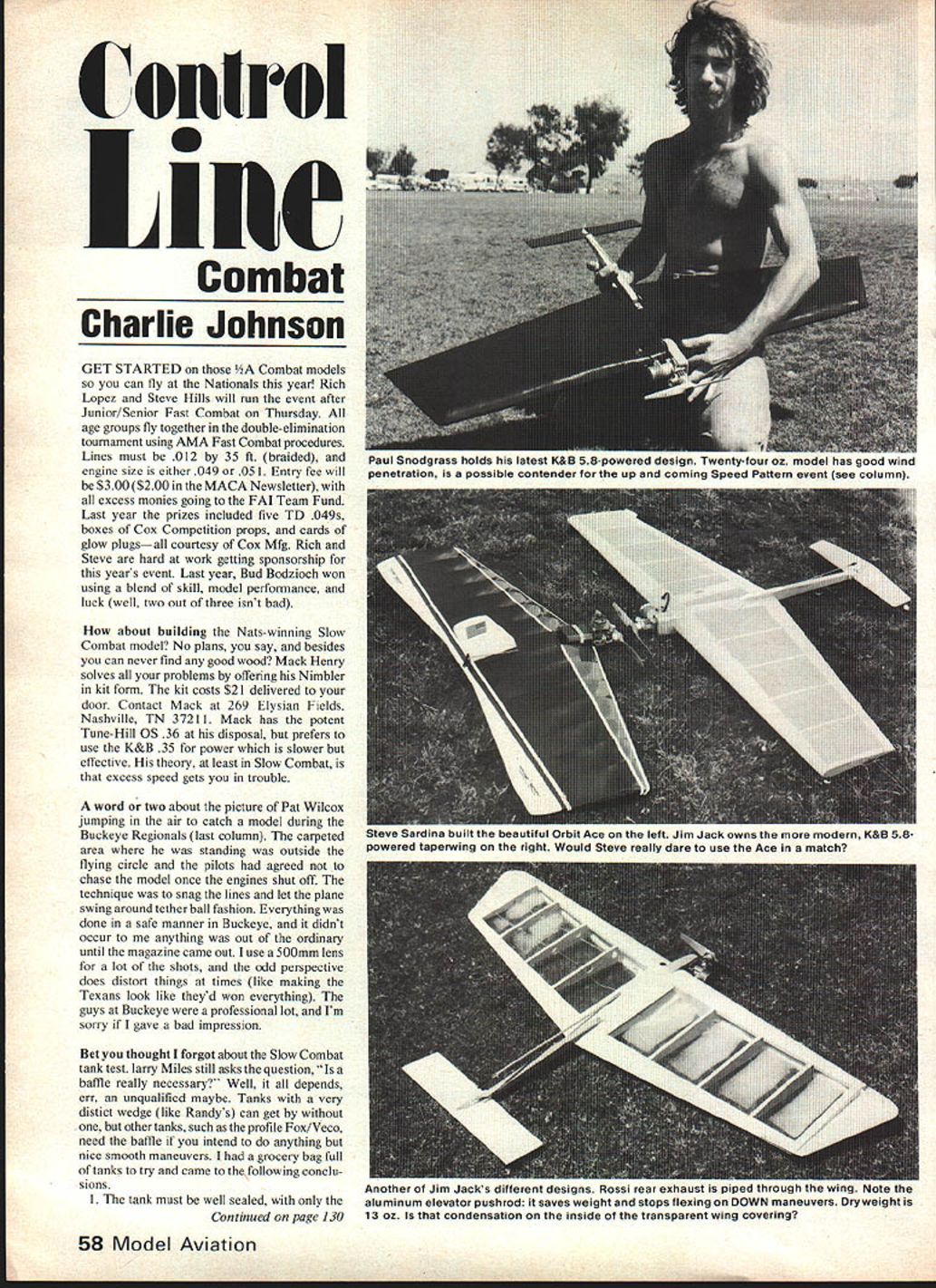
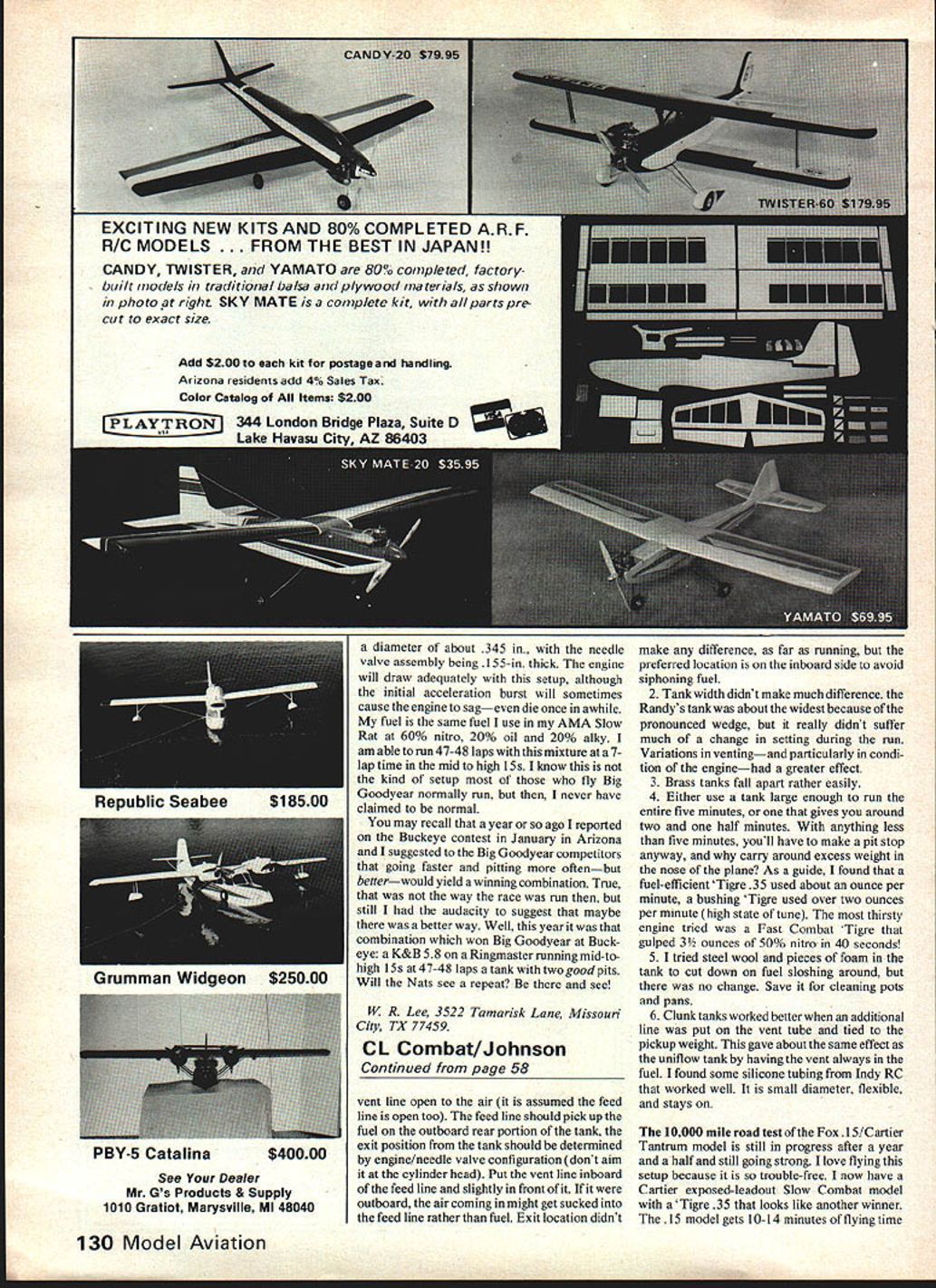
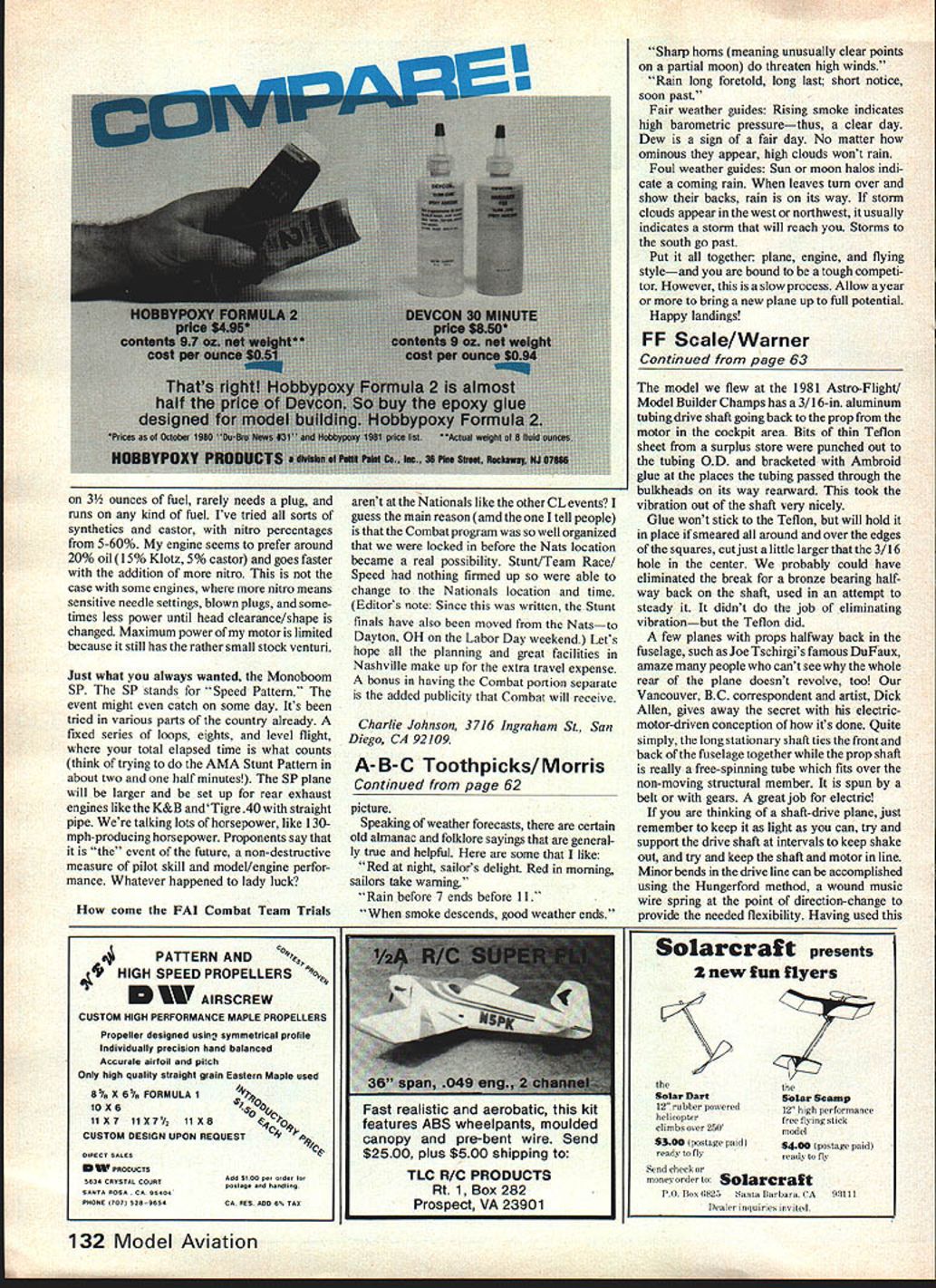
Control Line: Combat
Charlie Johnson
Getting Started
Get started on those 1/2-A Combat models so you can fly at the Nationals this year! Rich Lopez and Steve Hills will run the event after Junior/Senior Fast Combat on Thursday. All age groups fly together in a double-elimination tournament using AMA Fast Combat procedures. Lines must be .012-inch by 35 ft (braided). Engine size is either .049 or .051. Entry fee is $3.00 ($2.00 in the MACA Newsletter), with all excess monies going to the FAI Team Fund.
Last year the prizes included five TD .049s, boxes of Cox Competition props, and cards of glow plugs—all courtesy of Cox Mfg. Rich and Steve are working on sponsorship for this year's event. Last year Bud Bodzioch won using a blend of skill, model performance, and luck (two out of three isn't bad).
Nimbler Slow Combat Kit
Want to build the Nats-winning Slow Combat model but can't find plans or good wood? Mack Henry offers his Nimbler in kit form. The kit costs $21 delivered. Contact Mack at:
- Mack Henry
269 Elysian Fields Nashville, TN 37211
Mack has used a Tune-Hill OS .36 but prefers the K&B .35 for power; it's slower but effective. His theory for Slow Combat is that excess speed gets you in trouble.
Photo Note: Buckeye Regionals
About the picture of Pat Wilcox jumping to catch a model during the Buckeye Regionals: the carpeted area where he was standing was outside the flying circle and the pilots had agreed not to chase the model once the engines shut off. The technique was to snag the lines and let the plane swing around tether-ball fashion. Everything was done safely at Buckeye. I use a 500mm lens for many shots, and the perspective can distort things at times. The Buckeye participants were professional, and I regret if the photo gave a bad impression.
Slow Combat Tank Test
Larry Miles asked, "Is a baffle really necessary?" The answer: it depends—an unqualified maybe. Tanks with a very distinct wedge (like Randy's) can get by without one, but other tanks (such as the profile Fox/Veco) need the baffle if you intend to do anything but smooth maneuvers. I tested many tanks and came to the following conclusions:
- The tank must be well sealed, with only the vent line open to the air (assume the feed line is open too). The feed line should pick up fuel on the outboard rear portion of the tank. The exit position should be determined by engine/needle valve configuration—don't aim at the cylinder head. Put the vent line inboard of the feed line and slightly in front of it. If the vent were outboard, incoming air might get sucked into the feed line rather than fuel. Exit location didn't make much difference for running, but inboard is preferred to avoid siphoning fuel.
- Tank width didn't make much difference. Randy's tank was among the widest because of the pronounced wedge, yet it didn't suffer much change in setting during a run. Variations in venting—and particularly engine condition—had a greater effect.
- Brass tanks fall apart rather easily.
- Either use a tank large enough to run the entire five minutes, or one that gives you around two and a half minutes between pits. With anything less than five minutes you'll have to make a pit stop anyway, so there's no reason to carry excess weight in the nose. As a guide, a fuel-efficient Tigre .35 used about an ounce per minute; a high-state-of-tune Tigre used over two ounces per minute. The thirstiest engine tried gulped 3½ ounces of 50% nitro in 40 seconds.
- I tried steel wool and pieces of foam in the tank to cut down on fuel slosh, but there was no change. Save them for cleaning pots and pans.
- Clunk tanks worked better when an additional line was put on the vent tube and tied to the pickup weight. This gives a similar effect to a uniflow tank by keeping the vent always in the fuel. Silicone tubing from Indy RC worked well—small diameter, flexible, and stays on.
Fox .15 / Cartier Tantrum Road Test
The 10,000-mile road test of the Fox .15/Cartier Tantrum model is still in progress after a year and a half and continues to perform well. I have the Cartier in my Slow Rat because it is so trouble-free. I now also have a Cartier exposed-head Slow Combat model with a Tigre .35 that looks like another winner.
The .15 model gets 10–14 minutes of flying time on 3½ ounces of fuel, rarely needs a plug, and runs on any kind of fuel. I've tried synthetics and castor with nitro from 5–60%. My engine seems to prefer around 20% oil (15% Klotz, 5% castor) and goes faster with more nitro. This is not the case with some engines, where more nitro means sensitive needle settings, blown plugs, and sometimes less power until head clearance or shape is changed. Maximum power of my motor is limited because it still has the rather small stock venturi.
Monoboom SP
Introducing the Monoboom SP—SP stands for "Speed Pattern." The event has been tried in various parts of the country. It uses a fixed series of loops, figure-eights, and level flight where total elapsed time counts (think of doing the AMA Stunt Pattern in about two and a half minutes). The SP plane will be larger and set up for rear-exhaust engines like K&B and Tigre .40 with straight pipe—lots of horsepower and high speeds (130 mph-producing horsepower are mentioned). Proponents say it may become a non-destructive measure of pilot skill and model/engine performance.
FAI Combat Team Trials and the Nationals
Why aren't the FAI Combat Team Trials at the Nationals like the other CL events? The main reason is that the Combat program was so well organized that it was locked in before the Nationals location became a real possibility. Stunt/Team Race/Speed had nothing firmed up, so those events were able to move to the Nationals location and time. (Editor's note: since this was written, the Stunt finals have also been moved from the Nats—to Dayton, OH on Labor Day weekend.) A separate Combat event can provide added publicity, and let's hope the planning and facilities in Nashville make up for extra travel expense.
Contact
- Charlie Johnson
3716 Ingraham St. San Diego, CA 92109
Transcribed from original scans by AI. Minor OCR errors may remain.

