
Control Line: Combat
Charlie Johnson
THE MINIATURE AIRCRAFT COMBAT ASSOCIATION (MACA) announced a dues increase, effective immediately.
- U.S.A. and Canada: $9.00 per year
- Foreign: $15.00 per year
MACA is once again under the leadership of Gary Frost, who was at the helm when MACA had nearly 500 members. Gary promises an on-time newsletter, an updating of the Top Twenty Combat Pilots, and a more active MACA leadership role in matters such as rules changes and the Nationals. Send MACA dues to: Jordan Segal, 8314 W. Oak Ave., Niles, IL 60648.
At the Nationals, the MACA membership voted against joining the National Control Line Coalition (NCC) and adopted a "wait and see" policy. The "wait" is to determine if MACA can continue on its own; the "see" is to find out how good the NCC Gazette would turn out to be. Laird Jackson is the spark plug behind the new coalition and promises pages of pictures and at least a year's worth of effort. Only the Racing and Speed groups have joined so far, but there will be Combat and Aerobatics coverage. The first issue hit the streets at about the end of August and shows good promise, with a very professional look and pictures. No subscription price is available yet, but you can write to Laird Jackson at 1025 Walnut St., Philadelphia, PA 19107. Send along some stamps for return postage if there are current issues available. The NCC Gazette is expected to be the most widespread newsletter or magazine in the market, with copies going to every known country.
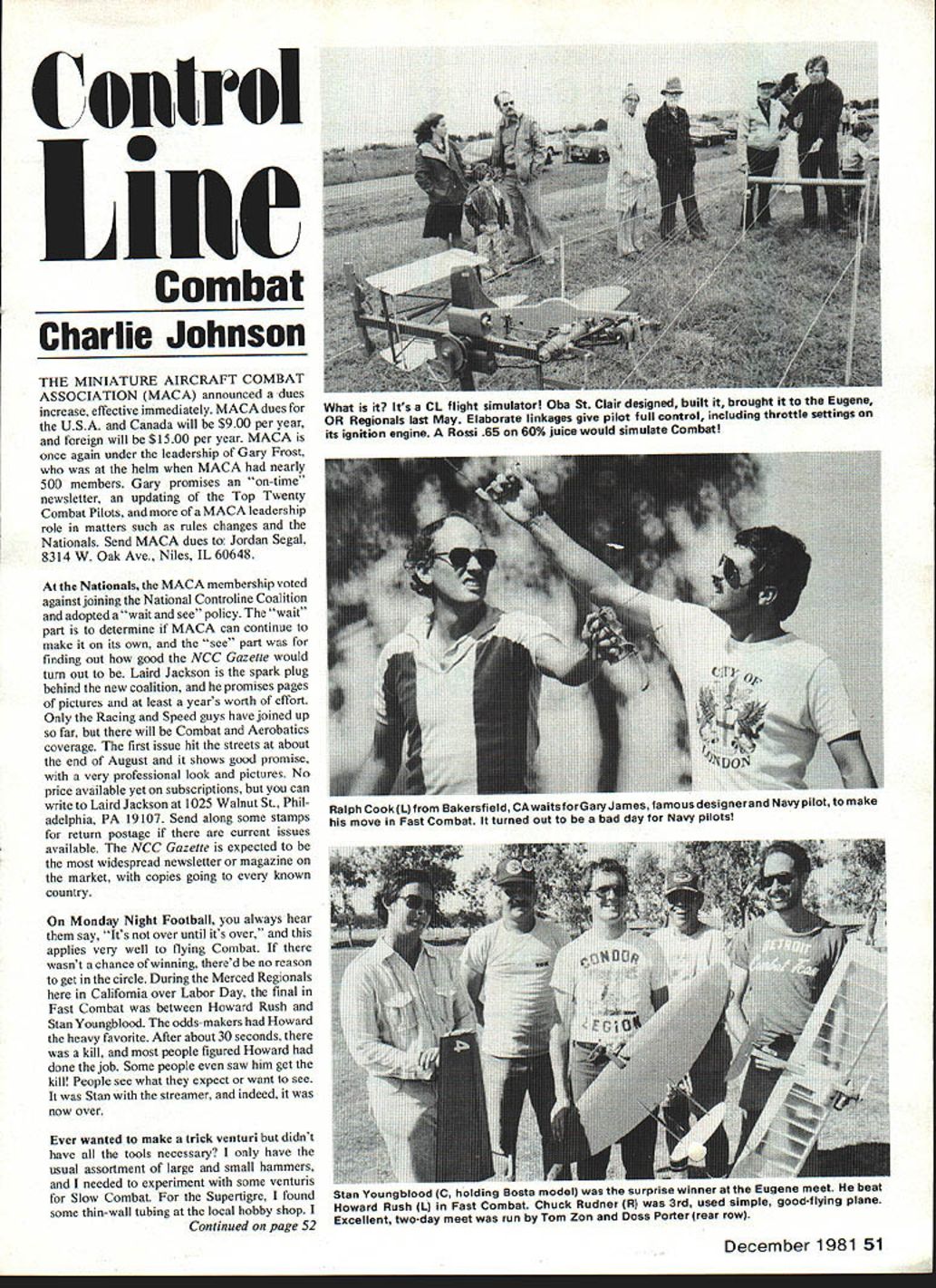
On Monday Night Football you always hear them say, "It's not over until it's over," and this applies very well to flying Combat. If there wasn't a chance of winning, there'd be no reason to get in the circle. During the Merced Regionals in California over Labor Day, the final in Fast Combat was between Howard Rush and Stan Youngblood. The odds-makers had Howard the heavy favorite. After about 30 seconds there was a kill, and most people figured Howard had done the job. Some people even thought they saw him get the kill. People see what they expect or want to see. It was Stan with the streamer, and indeed it was now over.
Ever wanted to make a trick venturi but didn't have all the tools necessary? I only have the usual assortment of large and small hammers, and I needed to experiment with some venturis for Slow Combat. For the Supertigre I found some thin-wall tubing at the local hobby shop. I found some rectangular tube that fit the Fox poorly. Poor fits between case and venturi can be solved with 5-minute epoxy; a little heat, like a cigarette lighter, won't destroy the epoxy and will allow easy removal. With the engine taped over, the bottom tube was filled with Sears steel-filled epoxy, although Devcon HobbyPoxy would do just fine. Decide what size hole you want; use a 5/16 in. drill through the same hole in the needle assembly. The fun part is shaping the inlet and outlet; it can be done with various tapered Dremel stones—an infinite combination of tapers and sizes. You can enlarge the venturi; if the first field job is really botched you can fill it with epoxy and start over.
Miles Lawrence had some AAC liner/piston setups in his motor at Merced that turned it into a real tiger. AAC means an aluminum piston running in a chromed aluminum liner. If the metallurgy is right, the engine has the correct fit at operating temperature but doesn't have to be so tight at starting temperature that it tears itself apart trying to get warm. Making AAC setups is best left to experts like Henry Nelson, who know the secrets of chroming aluminum, which is the difficult part. Henry made some AAC setups for the Rossi a while back which have proved successful.
The first shipment of new Rossi 15s is out and running. The engine lists for around $200, so we probably won't see many in Combat models. The quality is excellent, with giant ports, a 12 mm crank, and a wider case with different hole spacing—so much for dropping one into your current model. Some reports say they really go, while others report so much crank timing that they spit back at anything under 24,000 rpm.
Howard Rush was having trouble with his lightweight boom assemblies falling apart on impact with the ground. That's no way to win at Combat, because you'll be checking out the terrain once in a while. Howard's solution was to use carbon fiber on both sides of his boom. The carbon fiber tape I'd seen was a real pain to work with, but the stuff he had looked more like woven fabric. We'll see how his models do at the Team Trials later this month.
Disguise your Voodoo.
Slip on some foam cores and make your 1960s Voodoo into a real sheep in wolf's clothing. Core out the foam to fit whatever airfoil you have and make the outer shape something exotic. Different airfoils and areas can be easily tested on one model by simply replacing the foam cores. The added weight of the foam would be more than made up for by the increased area and (I hope) a more efficient airfoil.
There seem to be more Juniors and Seniors flying at contests lately. Many of the current crop are sons and daughters of Open-class competitors. It's nice to see a bunch of kids getting back into Combat, but I think we near the danger point where some parents push a little too hard. It would be nice to see the Juniors competing on their own—without parental influence. I can understand a parent not wanting his kid starting a nasty engine by himself, but I wonder if the kid is any more capable of holding onto the beast once Dad starts it for him?
Charlie Johnson 3716 Ingraham St., San Diego, CA 92109.
Transcribed from original scans by AI. Minor OCR errors may remain.

