
Control Line: Combat
Charlie Johnson
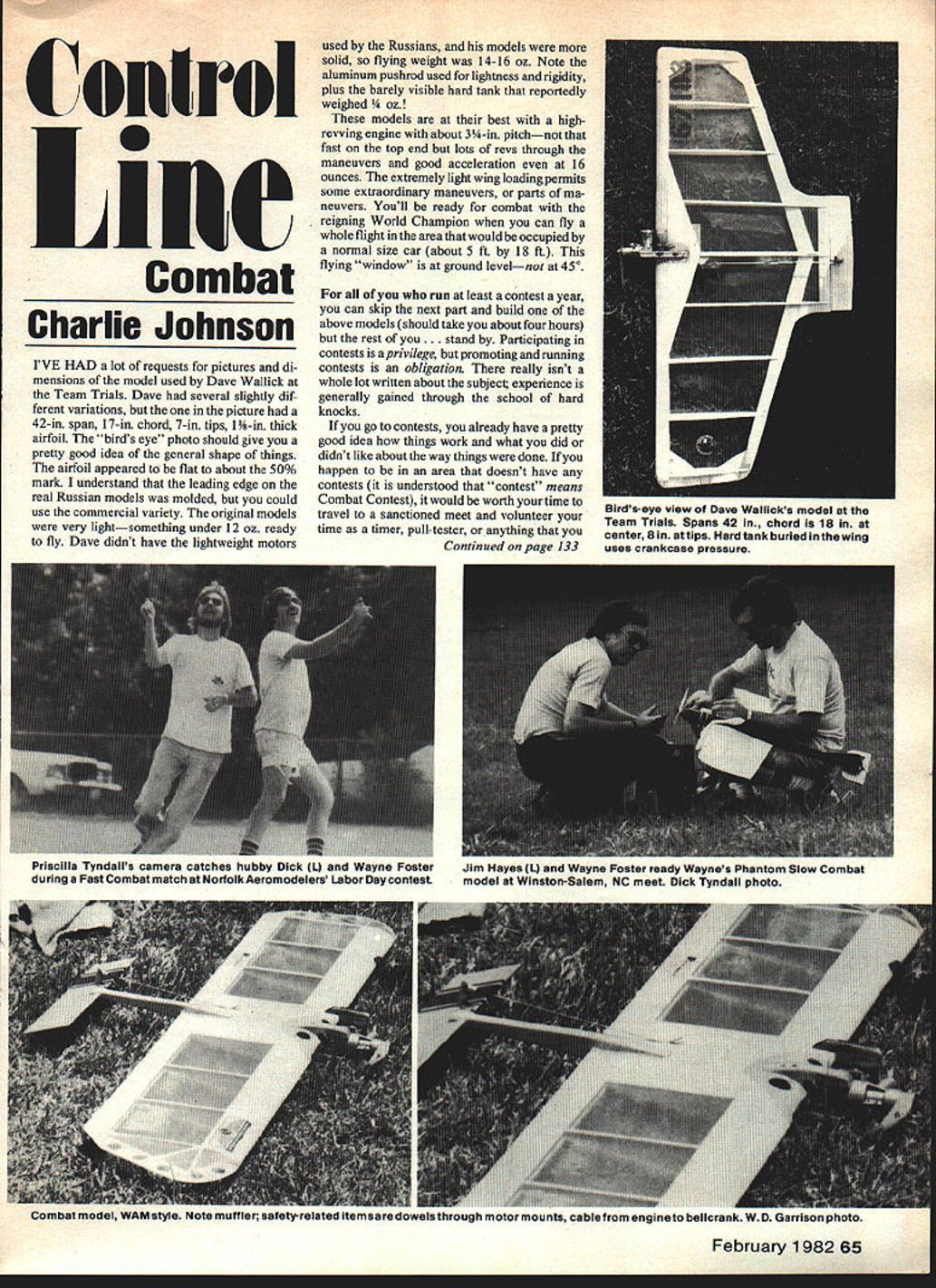
Model used by Dave Wallick (Team Trials)
Dave Wallick used several slightly different variations, but the model pictured had the following characteristics:
- 42-in. span
- 17-in. chord
- 7-in. tips
- 1-1/8-in. thick airfoil (appeared flat to about the 50% mark)
- Aluminum pushrod for lightness and rigidity
- Barely visible hard tank (reported weight: 1/4 oz.)
Notes:
- The leading edge on the real Russian models was molded, but a commercial variety can be used.
- The original Russian models were very light—under 12 oz. ready to fly. Dave's versions, lacking the lightweight motors used by the Russians, flew at about 14–16 oz.
Flying characteristics and engine choice
- These models perform best with a high-revving engine and about a 3-3/4-in. pitch—providing lots of revs through maneuvers and good acceleration even at 16 oz.
- Extremely light wing loading permits extraordinary maneuvers or parts of maneuvers.
- Aim to be able to fly a whole flight within about a 5 ft. by 18 ft. area—the flying "window" is at ground level, not at 45°.
Building note
- If you fly at least one contest a year, you can build one of these models in about four hours. For others, read on about promoting and running contests.
Promoting and sanctioning contests
- Participating in contests is a privilege; promoting and running contests is an obligation.
- Get sanctioning through the AMA and pick a date several months out to allow time for publicity.
- Use the Competition Newsletter section of this magazine for announcements—great publicity is very valuable.
- Announcements should list:
- Event name
- Contest Director
- Sponsors
- Pertinent information
- Flying must be exactly as prescribed by AMA rules; note the added 3-mm matches rule.
- Slow Combat competitors expect to fly under a known set of rules. If your flying site has unusual conditions (very tall grass, carpet over desert, etc.), disclose that up front.
- The front of the AMA rule book contains important information; familiarize yourself with the Combat section.
Organizing helpers and staffing
- For a fun-fly, you and a friend may manage. For serious competition, have at least two other full-time people.
- Two timers and a circle marshal can also handle pull-testing and processing in the pits.
Pit organization and processing
- An effective pit layout:
- Tightly stretched 50-ft. rope as a guideline for the center of the model
- Two outer ropes at 59 ft. 6 in. and 60 ft. 6 in. to mark the legal zone for handles
- Mark ground positions with numbers corresponding to match order. Place each pair of models on the mark a few minutes before the round starts.
- Pre-round processing should include:
- Verifying line lengths (competitors often try to bend rules)
- Checking line diameter and condition
- Pull-testing lines
- Ensuring different colored streamers are tied in the correct spot
- Rope off the processing area to prevent line damage and allow only enough room for models (no working on models inside this area).
Pilots' meeting and judging
- Hold a pilots' meeting before the first round; review rules and note any site-specific complications.
- Make clear that the judges are in control and must not suffer abuse from competitors.
- After every flight, judges should:
- Confer and compare notes
- Add scores and double-check them
- Keep a written record of air time and number of cuts
Streamers, markings, and equipment tips
- Follow rule-specified streamer and leader lengths.
- Use slightly heavier cotton string for streamers (avoid overly strong synthetics that can't be cut).
- Apply masking tape along the length of the streamer in wet weather to prevent the entire streamer coming off when the end is hit.
- For marking circles, whitewash is less messy than lime:
- Use a pole with a two-inch paint roller, a simple metering valve, and a one-gallon supply of whitewash in an old can.
- This method works well on grass and even better on asphalt.
Closing
Next column: more helpful hints from contestants and management, the MACA Top Twenty, and the Johnson Top Ten pick of the litter.
Charlie Johnson 3716 Ingraham St. San Diego, CA 92109.
Transcribed from original scans by AI. Minor OCR errors may remain.

