

Control Line
Combat
Charlie Johnson
MORTGAGE the house, the car, or whatever it takes to get a plane ticket to Seattle for Bladder Grabber VII. Unfortunately for most of you who get your MA by regular mail, this super Triple-Elimination Fast Combat contest will be history. Over $5,000 in prizes will be awarded for first through fifth place for the richest of all Combat contests. If you are among the lucky and receive a copy of MA, then please alert any potential candidates for the meet to be held June 26–27.
If you're currently a MACA member, you would have known all about this meet, because their monthly newsletter is one of the benefits of membership. Gary Frost is trying very hard to get MACA back on track. (No, wait! that's something you'd say for a model train publication... how about "flying the straight and narrow?") In the newsletter you'll find critiques of current products on the market, some of them advertised only in the MACA Newsletter. MACA has a lot to do with the FAI Team Selection and the AMA Nationals, and besides, if you're good, you may get one of the MACA Top Twenty T-Shirts—or at least some MACA stickies to dress up your Combat model. Send $9.00 to Gary Frost at 1012 Bedford, Ballwin, MO 63011. (I'm gonna re-up, too.)
Also making a return appearance is the National Control Line Coalition Gazette. The editor is Laird Jackson, 2322 Wilson Ave., Bristol, PA 19007. (Annual subscription is $10; make checks payable to National Control Line Coalition.) This is a professionally printed newsletter, similar in size to the "Competition Newsletter" which has been separate from MA for the past couple issues. All aspects of Control Line competition are covered, together with very good pictures, sketches and plans for models. Full-size plans will be available for any model in the Gazette through Walt Perkins. The first two issues were so neat that they are considered collector's items already. So, if you subscribe to both of these newsletters, a total of $19 will get you all the information you'll need to know until the next MA hits the streets.
Half-A Combat at the Nationals will be CDed by Rich Von Lopez for the third year in a row. As in the past, it will be flown on Thursday, immediately following Junior/Senior Fast Combat. The rules will be the standard AMA Fast Combat ones, with the following exceptions: .012 engines on 35-ft. lines and either .049 or .051 engines for the other classes. It will be a double-elimination tournament. Cox Hobbies will sponsor the event. In the past, they have given us new TD .049 motors, cards of glow heads, and boxes of props to be used as prizes. In addition to this, Joe Klause of Kustom Kraftsmanship (P.O. Box 2699, Laguna Hills, CA 92653; Tel. (714) 830-5162) is going to donate six fine-thread needle valve assemblies and six re-set tools. An entry fee of $3.00 will be charged. Get those 1/2 A's ready!
CL Combat — Continued
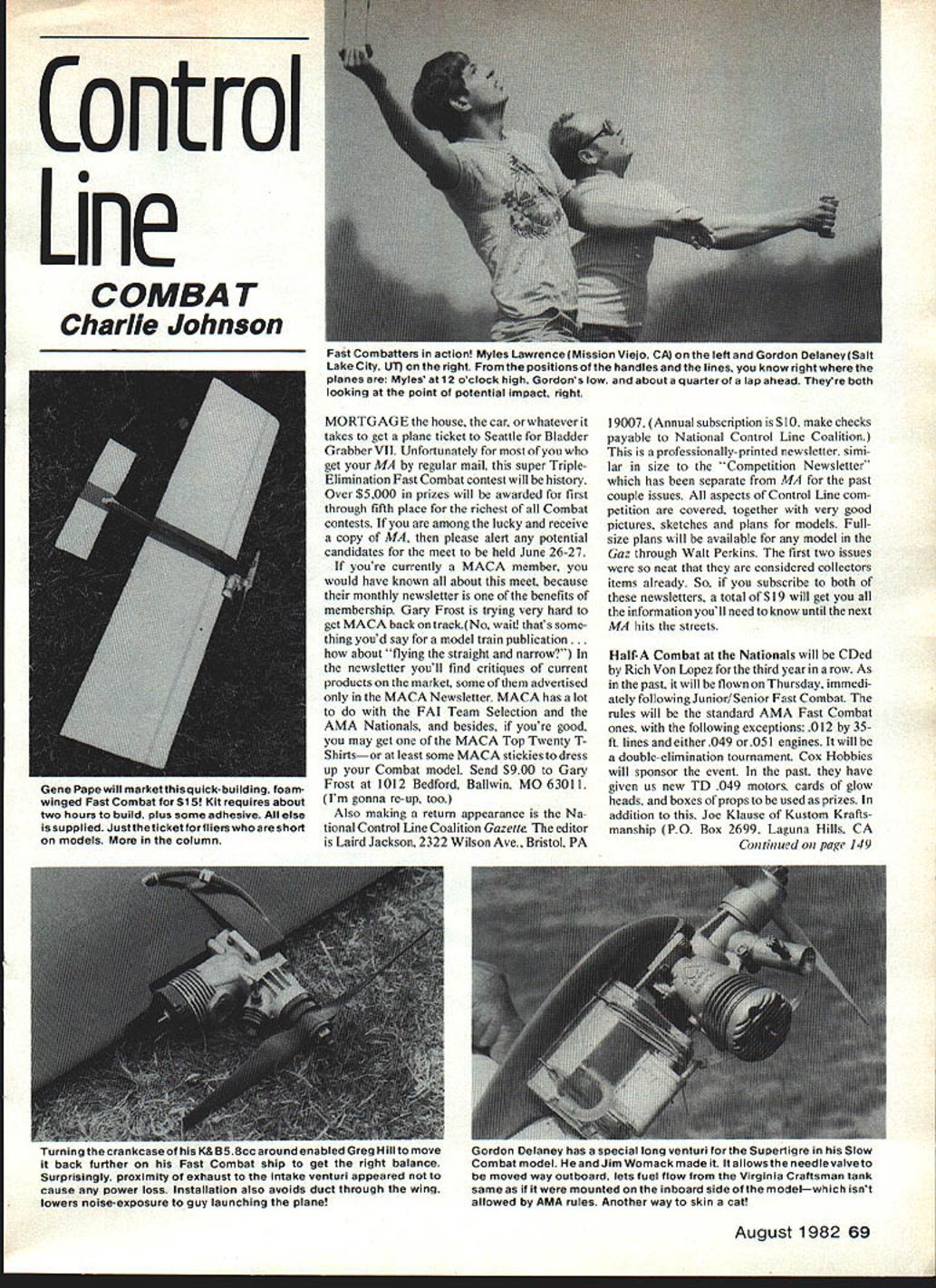
Too good to be true? A 400 sq. in. (10 in. by 40 in.) foam Fast Combat model for $15 complete! That's your total investment in the plane—except for a little adhesive and about two hours of your time. The kit includes the foam cores, spars, bladder tube, control system, hardware, and even the engine-mounting screws. That's right—sheet metal screws. I tried them on my model, and they work as well as anything else; they're cheap and require less precision than a blind-mounting-nut system.
The pine center section is notched for spars, cut out for the bellcrank, and extends back as the tail boom with the stab bushing already installed. No more excuses for crooked stabs. It takes about an hour to glue it together and about another hour to cover with the FasCal supplied and to fuel-proof the center section. (I figure that mounting the engine and last-minute adjustments should be made in the car on the way to the contest. It's even easier if you're not doing the driving.) Trim adjustments can be made while you're pitting during your first match. An inexpensive, easy-to-build model isn't such a deal if it's a plug, but this model at 400 sq. in. and 20 oz. will give you a lot of performance. That foam leading edge can't be ignored for its ability to snag off opponents' streamers.
These models are for flying Combat and not for fun flying every weekend, so don't expect one to last forever! A couple of center sections and a whole bunch of foam cores would get you through many flying sessions. Gene Pape is the designer/manufacturer of this Combat flyer's dream. You can reach him at 4528 Souza St., Eugene, OR 97402. Gene hopes to supply the whole Northwest (where he doesn't have to mail kits) and then spread out to the rest of the country. For that reason, I'd give Gene a call at (503) 689-1623 before sending off for your first dozen models. Being greedy, I'd normally not let out this secret, but I'll have taken delivery of my 10 models before this goes to print! So, invest some coin and give Gene a call.
Notice the trick-looking, extra-long venturi in the picture of Gordon Delaney's Slow Combat model. The spray bar is slightly outboard of the tank and gives the same effect as having an inboard tank with conventional needle location. This particular venturi has a .320 hole in it, and even with the spray bar running across, it still gives you a lot more area than a stock assembly. I've sent a picture to Dick Tyndall of Virginia Craftsman, so possibly he'll make some of these items for the Fox, too. Dick mentioned in a recent letter to me that he hasn't gotten any feedback from modelers on his products. Could be they squawk only when something doesn't work. The experience with the tank inserts and remote needle assembly he sent me was that it all worked as expected. Let Dick or me know how these things work out! One last thing on the long venturi — inboard tanks and large venturis cause critical needle settings, so be forewarned.
The other picture is of Greg Hill's Fast Combat model powered with a .58 K&B having the case turned around so the exhaust goes forward. There seems to be no measurable loss of power, even though the exhaust flows over the venturi. This sure helps in getting the engine back in the wing for good balance and simplified construction, because you don't have to route exhaust through or around the wing. An added benefit is for the launcher, because the noise level is much less than with a rear-engine exhaust or even conventional side-exhaust.
One of the new Hoffelt carbon fiber props is also in place on the motor. The props will cost an arm and a leg, or about $12—whichever you prefer. The higher-than-normal cost is because the prop will come finished and ready to install on your motor. The majority of fiberglass or carbon fiber props are hacked up so much that they don't perform as well as a stock wood prop. Only a handful of people are able to work up one of these props correctly, so the rest of us never see the performance gain offered by such a prop, and we chalk up the usual $5 or $6 we've paid to experience.
Maybe by next column I'll be able to give you a date when the props will be ready for distribution. (I said that last column. Well, time flies.)
Charlie Johnson 3716 Ingraham St., San Diego, CA 92109.
Transcribed from original scans by AI. Minor OCR errors may remain.

