
Control Line: Combat
Charlie Johnson
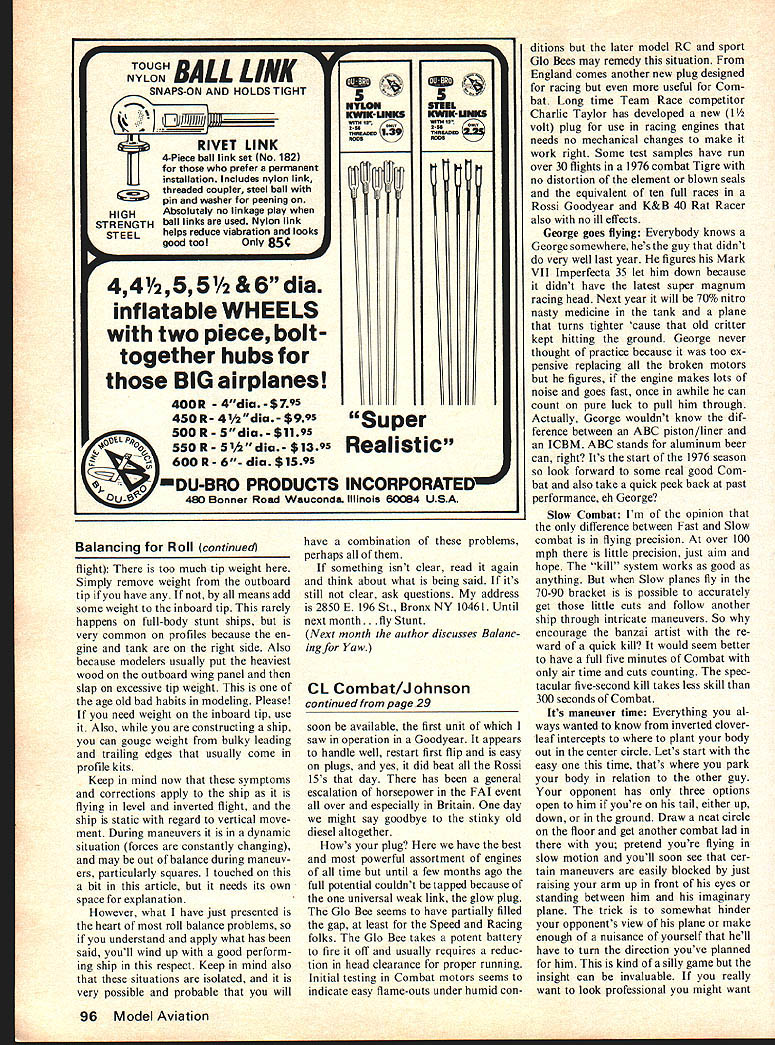
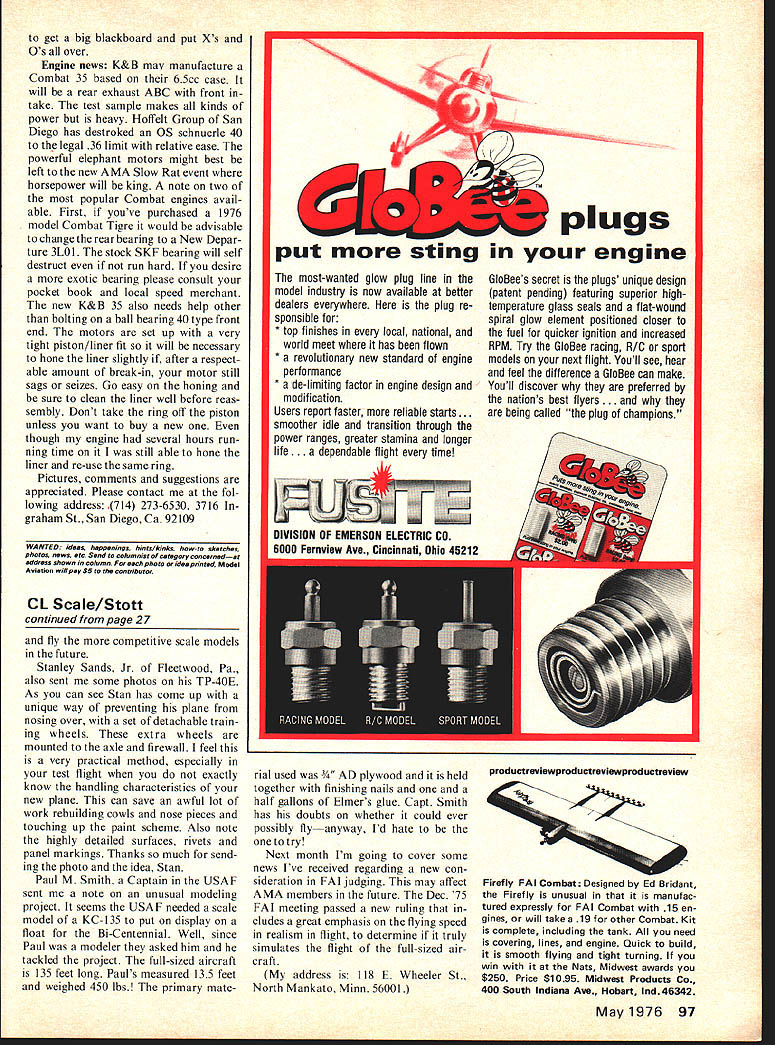
THE GRAND EXPERIMENT proved to be a success. The Special Pro Combat Association held its first contest on December 7 with four rounds for each invited contestant, plus two more rounds for the finalists. With over 60 matches there were only four mid-airs and no matches were won or lost due to line entanglements. The exclusion of fliers who continually mid-air and tangle lines seems to be the only solution to the problem. All the contestants agreed that the meet was the finest ever in Southern California and wondered why it took us so long to find a solution to our problems.
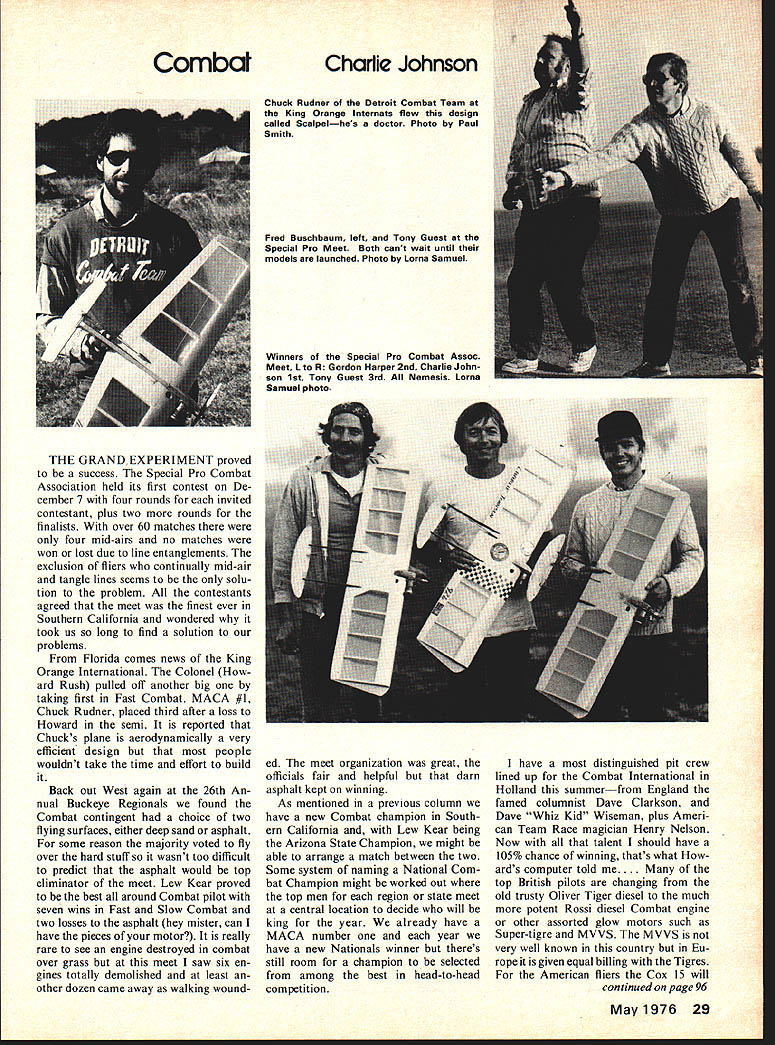
From Florida comes news of the King Orange International. The Colonel (Howard Rush) pulled off another big one by taking first in Fast Combat. MACA #1, Chuck Rudner, placed third after a loss to Howard in the semi. It is reported that Chuck's plane is aerodynamically a very efficient design but that most people wouldn't take the time and effort to build it.
Back out West again at the 26th Annual Buckeye Regionals we found the Combat contingent had a choice of two flying surfaces, either deep sand or asphalt. For some reason the majority voted to fly over the hard stuff so it wasn't too difficult to predict that the asphalt would be top climacter of the meet. Lew Kear proved to be the best all around Combat pilot, with seven wins in Fast and Slow Combat and two losses to the asphalt (hey mister, can have pieces of your motor?). It is really rare to see an engine destroyed in combat over grass but at this meet I saw six engines totally demolished and at least another dozen came away as walking wounded.
The meet organization was great, the officials fair and helpful but that darn asphalt kept on winning.
As mentioned in a previous column we have a new Combat champion in Southern California with Lew Kear being the Arizona State Champion; we might be able to arrange a match between the two. Some system of naming a National Combat Champion might be worked out where the top men from each region or state meet at a central location to decide who will be king for the year. We already have a MACA number one and each year we have a new Nationals winner but there's still room for a champion to be selected from among the best in head-to-head competition.
I have a most distinguished pit crew lined up for the Combat International in Holland this summer — from England the famed columnist Dave Clarkson, and Dave "Whiz Kid" Wiseman, plus American Team Race magician Henry Nelson. Now with all that talent I should have a 105% chance of winning, that's what Howard's computer told me... Many of the top British pilots are changing from the old trusty Oliver Tiger diesel to the much more potent Rossi diesel Combat engine or other assorted glow motors such as Super-tigre and MVVS. The MVVS is not very well known in this country but in Europe it is given equal billing with the Tigres. For the American fliers the Cox 15 will Some are available, the first unit of which I saw in operation in a Goodyear. It appears to handle well, restart first flip and is easy on plugs, and yes, it did beat all the Rossis' 15s that day. There has been a general escalation of horsepower in the FAI event all over and especially in Britain. One day we might say goodbye to the stinky old diesel altogether.
How's your plug? Here we have the best and most powerful assortment of engines of all time but until a few months ago the full potential couldn't be tapped because of the one universal weak link, the glow plug. The Glo Bee seems to have partially filled the gap, at least for the Speed and Racing folks. The Glo Bee takes a potent battery to fire it off and usually requires a reduction in head clearance for proper running. Initial testing in Combat motors seems to indicate easy flame-outs under humid conditions but the later model RC and sport Glo Bees may remedy this situation. From England comes another new plug designed for racing but even more useful for Combat. Long time Team Race competitor Charlie Taylor has developed a new (1/2 volt) plug for use in racing engines that needs no mechanical changes to make it work right. Some test samples have run over 30 flights in a 1976 combat Tigre with no distortion of the element or blown seals and the equivalent of ten full races in a Rossi Goodyear and K&B .40 Rat Racer also with no ill effects.
George goes flying: Everybody knows a George somewhere, he's the guy that didn't do very well last year. He figures his Mark VII Imperfecta 35 let him down because it didn't have the latest super magnum racing head. Next year it will be 70% nitro nasty medicine in the tank and a plane that turns tighter 'cause that old critter kept hitting the ground. George never thought of practice because it was too expensive replacing all the broken motors but he figures, if the engine makes lots of noise and goes fast, once in awhile he can count on pure luck to pull him through. Actually George wouldn't know the difference between an ABC piston/liner and an ICBM. A B&C stands for aluminum beer can, right? It's the start of the 1976 season so look forward to some real good Combat and also take a quick peek back at past performance, eh George?
Slow Combat: I'm of the opinion that the only difference between Fast and Slow combat is in flying precision. At over 100 mph there is little precision, just aim and hope. The "kill" system works as good as anything. But when Slow planes fly in the 70-90 bracket it is possible to accurately get those little cuts and not allow the ship to shrug through intricate maneuvers. So why encourage the banzai artist with the reward of a quick kill? It would seem better to have a full five minutes of Combat with only air time and cuts counting. The spectacular five-second kill takes less skill than 300 seconds of Combat.
It's maneuver time: Everything you always wanted to know from inverted cloverleaf intercepts to where to plant your body out in the center circle. Let's start with the easy one, the simple, that's where you park your body in relation to the other guy. Your opponent has only three options to expose on to him if you're on his tail, either up, down, or in the ground. Draw a neat circle on the floor and get another combat lad in there with you; pretend you're flying in slow motion and you'll soon see that certain maneuvers are easily blocked by just raising your arm up in front of his eyes or standing between him and his imaginary plane. The trick is to somewhat hinder your opponent's view if his plane cannot get enough of a nuisance of yourself that he'll have to turn the direction you've planned for him. This is kind of a silly game but the insight can be invaluable. If you really want to look professional you might want to get a big blackboard and put X's and O's all over.
Engine news: K&B may manufacture a Combat 35 based on their 6.5cc case. It will be a rear exhaust ABC with front intake. The test sample makes all kinds of power but is heavy. Hoffelt Group of San Diego has destroked an OS schnuerle 40 to the legal .36 limit with relative ease. The powerful elephant motors might best be left to the new AMA Slow-Fast event where horsepower will be king. A note on two of the most popular Combat engines available. First, if you've purchased a 1976 model Combat Tigre it would be advisable to change the rear bearing to a New Departure 3L01. The stock SKF bearing will self-destruct even if not run hard. If you desire a more exotic bearing please consult your pocket book and local speed merchant. The new K&B 35 also needs help other than bolting on a ball-bearing 40 type front end. The motors are set up with a very tight piston/liner fit so it will be necessary to hone the liner slightly if, after a respectable amount of break-in, your motor still sags or seizes. Go easy on the honing and be sure to clean the liner well before reassembly. Don't take the ring off the piston unless you want to buy a new one. Even though my engine had several hours running time on it I was still able to hone the liner and re-use the same ring.
Pictures, comments and suggestions are appreciated. Please contact me at the following address: (714) 273-6530, 3716 Ingraham St., San Diego, Ca. 92109.
Transcribed from original scans by AI. Minor OCR errors may remain.

