
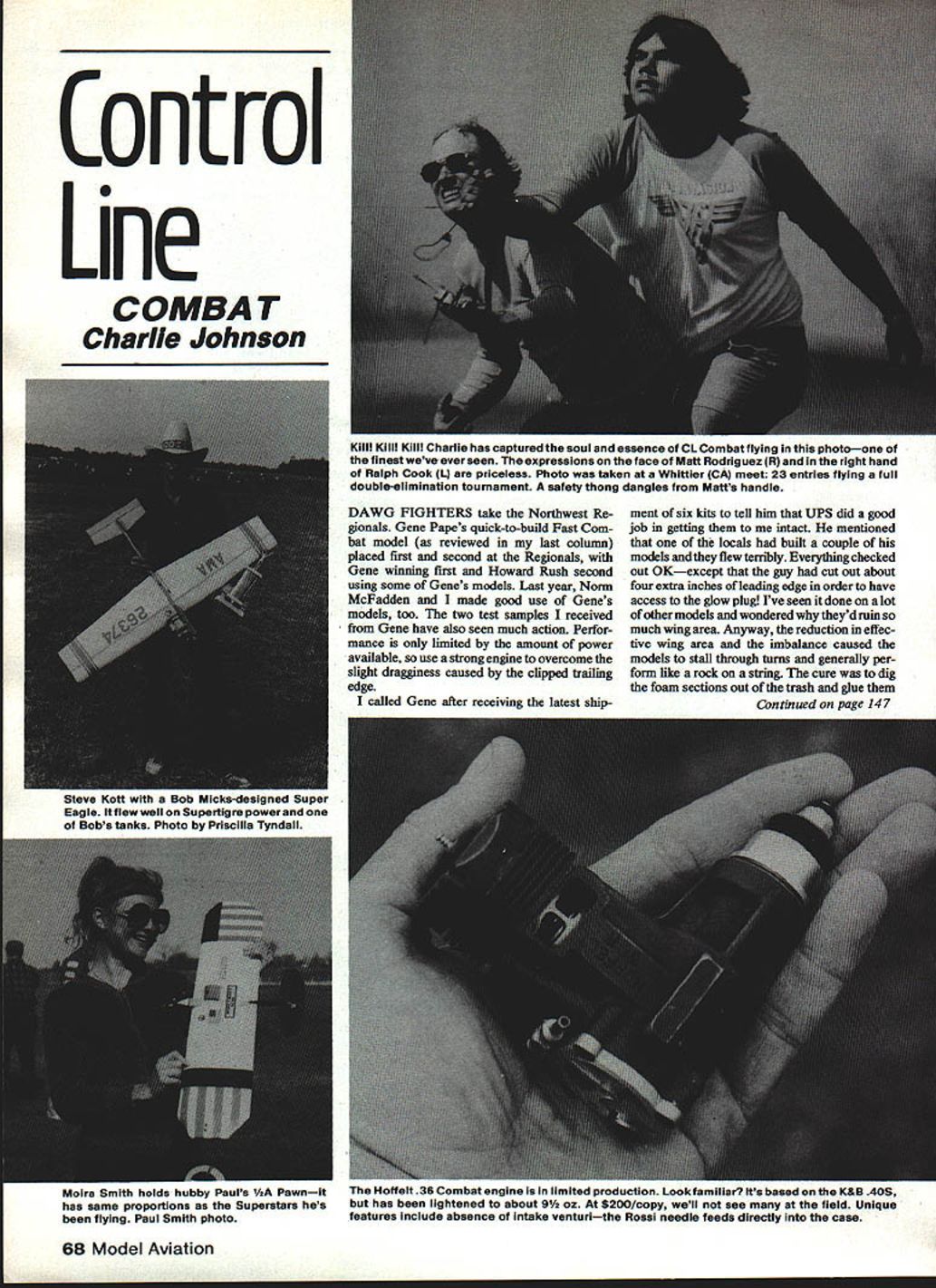

Control Line: Combat
Charlie Johnson
Dawg Fighters
DAWG FIGHTERS took the Northwest Regionals. Gene Pape's quick-to-build Fast Combat model (as reviewed in my last column) placed first and second at the Regionals, with Gene winning first and Howard Rush second using some of Gene's models. Last year, Norm McFadden and I made good use of Gene's designs, too. The two test samples I received from Gene have also seen much action. Performance is only limited by the amount of power available, so use a strong engine to overcome the slight drag caused by the clipped trailing edge.
I called Gene after receiving the latest shipment of six kits to tell him that UPS did a good job getting them to me intact. He mentioned that one of the locals had built a couple of his models and they flew terribly. Everything checked out OK—except that the guy had cut out about four extra inches of leading edge in order to have access to the glow plug! I've seen this done on a lot of other models and wondered why they'd ruin so much wing area. The reduction in effective wing area and the imbalance caused the models to stall through turns and generally perform like a rock on a string. The cure was to dig the foam sections out of the trash and glue them back in place. Presto! Class A Dawg Fighter again.
I've been showing off the kits that Gene sent me, and one of the San Diego fliers copied the idea but used very light wood and really cut out the foam, which added up to an 18½-oz. plane (2 oz. less than the stock kits). Dawg Fighters are meant to be quick and dirty, so let's keep them that way.
Bladder Grabber VII
Bladder Grabber VII also turned out to be a super success. The meet was a full triple-elimination Fast Combat contest with $5,000 worth of stereo prizes from Carver Corporation. The top finishers were:
- 1st: Phil Granderson (just edging out Howard Rush by one match)
- 2nd: Howard Rush
- 3rd: John Salvin (having an exceptional weekend)
I promise to give you more warning the next time they throw one of these meets so the rest of you will have a chance at the goodies.
Hoffelt .36R engine
The Hoffelt .36R is what all Combat engines should be, except for one thing—the price! The engine is based on the K&B .40S but de-stroked to .36. The one-piece case is exceptionally strong and is under-stressed as a .36-size Combat engine compared to the duty it did as a Pylon Racing Formula I power plant. The really bad thing about many Pylon engines is that they are generally pretty heavy. An extra ounce or two is nothing to a Formula I, whereas extra strength is everything. Hoffelt's engine went on a real diet and came out weighing 9¼ ounces, about the same as a Fox .36.
A limited number of these handmade engines will be available for about $200 each, but they are really only for an exhibition model. The current engines will have K&B pistons (while the supply lasts), but future engines will use pistons made by Tim Gillott (of Shark Rat Racer fame), as well as his rings. You'll notice the lack of a venturi in the picture, since the Rossi needle assembly feeds directly into the case. Without the venturi, it is possible to fit the engine much farther back in the model without having to dodge a protruding venturi, and it saves weight.
The rear-mounted direct-injection system provides the very broad needle setting you'd expect from a ringed engine of this type, plus it's out of the way of the prop and (heaven forbid!) the ground. Claimed output is 500 rpm more than his best Fox on equivalent props (you fill in the rpm). We all know about the killer “losing” engines and inflated claims, but I'd give this engine a better chance of living up to expectations because of the original good design and precision fits.
Tactical flying and rules
Tactical flying may be a new term to some of you, but it's a way of life to the FAI competitor in Europe. To do it right, you must work every rule to the max—including model specifications, flying style, pit work, and judges. A tactical flier will never give you an advantage due to sportsmanship. If you want to see the latest in this sort of thing, have a look at the rules changes that are supposed to plug the loopholes or make a sportsman out of you.
One proposed FAI rule would give air points to the flying model (in case of a line tangle) only when it's flying upright and level. As it stands now, if you get in a line tangle and your opponent goes in the ground, it is to your advantage to keep him from untangling the lines because you're getting the air points and he's getting minus points.
The "wrap and punch" man of past years has been replaced by the mid-air artist and the circle specialist. The latter was put out of business by the new method of starting combat when the models are about 180° apart. With every rule there's a plus and a minus side, and the tactical flier sees a benefit in the new rule. I saw a match won at the World Championships in 1978 by a pilot who took his time trying to get separated from the other pilot. Each time he took off he stayed right on the guy's tail until the circle marshal chased him off. Then, as the whistle sounded to begin combat, he just landed. Three such flights and he had the 45 air points he needed to wrap up the match without giving his opponent a chance at his streamer.
It's harder to do this now in FAI because of the minus points—but very easy in Slow and Fast. It seems like the more rules we have and the tighter they're worded, the more chance there is to get around them. As we used to say: "There's only one rule—and nobody knows what it is." This philosophy sure would save on printing costs for the rule books, too.
Venturis, tanks, and performance tricks
It took about a week for everyone to get onto Gordon Delaney's trick long venturi. This sure beats the intent of the rule about having an inboard tank. What they needed was a rule about having an outboard venturi/spraybar, which is what it's about, anyway. The old inboard tank changed the lateral balance of the model, too, requiring additional tip weight if you didn't want the model visiting you in the center of the circle.
The latest rules allow you to notch the wing to clear the tank so a 5-in. nose moment can be retained with a sufficient quantity of fuel for the five minutes, and the fuel is outboard of the fuselage center line to aid line tension. Probably a choke of some sort should be used to make the ground running a little more consistent.
By using a bag tank and a wide-open venturi, it may be possible to see real 100 mph times in Slow Combat and also increase the possibility of the event becoming as popular as Slow Rat (that's an inside joke for you other seven Slow Rat fliers left in the country). If you're going to experiment with venturis, I figure the best area to start with is the .320 size—but with several holes through the venturi so you can put the spraybar at different heights. That's a lot easier than trying to add or remove shims from under the tank! If you tap each set of holes, you can use short threaded plugs to seal off the openings not being used. I guess the ultimate will be a threaded venturi for infinite adjustment.
Charlie Johnson 3716 Ingraham St. San Diego, CA 92109.
Transcribed from original scans by AI. Minor OCR errors may remain.

