
Control Line: Combat
Charlie Johnson
New Covering
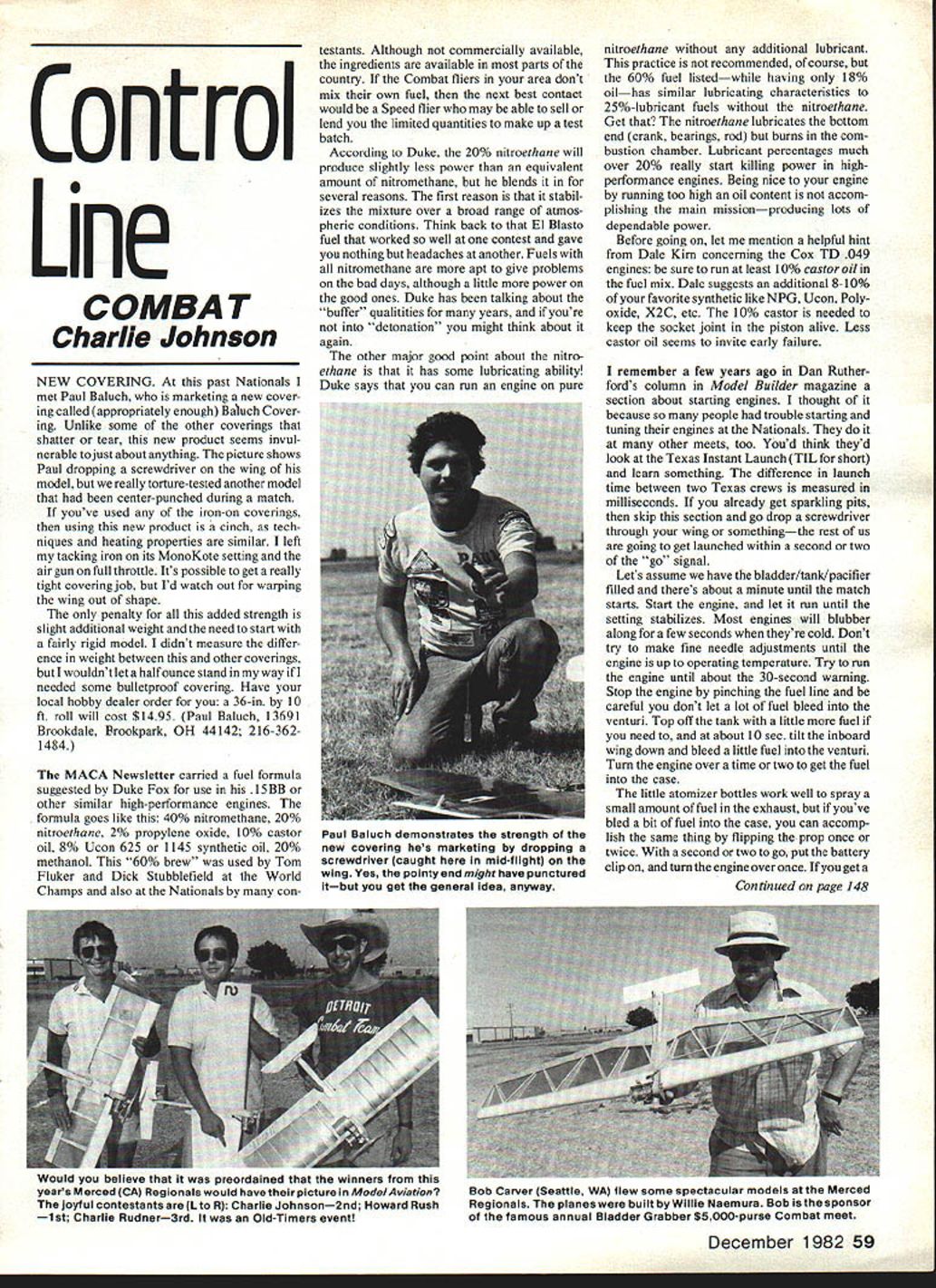
At this past Nationals I met Paul Baluch, who is marketing a new covering called (appropriately enough) Baluch Covering. Unlike some other coverings that shatter or tear, this new product seems invulnerable to just about anything. The picture shows Paul dropping a screwdriver on the wing of his model, but we really torture-tested another model that had been center-punched during a match.
If you've used any of the iron-on coverings, using this new product is a cinch, as techniques and heating properties are similar. I left my tacking iron on its MonoKote setting and the air gun on full throttle. It's possible to get a really tight covering job, but watch out for warping the wing out of shape. The only penalty for all this added strength is slight additional weight and the need to start with a fairly rigid model. I didn't measure the difference in weight between this and other coverings, but I wouldn't let a half-ounce stand in my way if I needed some bulletproof covering.
Have your local hobby dealer order for you: a 36-in. by 10 ft. roll will cost $14.95. (Paul Baluch, 13691 Brookdale, Brookpark, OH 44142; 216-362-1484.)
Fuel Formula
The MACA Newsletter carried a fuel formula suggested by Duke Fox for use in his .15BB or other similar high-performance engines. The formula is:
- 40% nitromethane
- 20% nitroethane
- 2% propylene oxide
- 10% castor oil
- 8% Ucon 625 or 1145 synthetic oil
- 20% methanol
This "60% brew" (40% nitromethane + 20% nitroethane) was used by Tom Fluker and Dick Stubblefield at the World Champs and by many contestants at the Nationals. Although not commercially available as a premix, the ingredients are available in most parts of the country. If the Combat fliers in your area don't mix their own fuel, contact a Speed flier who may be able to sell or lend you the limited quantities to make up a test batch.
Why include nitroethane?
According to Duke, the 20% nitroethane produces slightly less power than an equivalent amount of nitromethane, but he blends it in for several reasons:
- It stabilizes the mixture over a broad range of atmospheric conditions. Fuels with all nitromethane are more apt to give problems on bad days, though they may give a little more power on good ones. Nitroethane acts as a "buffer" against detonation issues.
- It has some lubricating ability. Duke says you can run an engine on pure nitroethane without additional lubricant (not recommended), and the 60% fuel listed—while having only 18% oil—has similar lubricating characteristics to a 25%-lubricant fuel without the nitroethane. Nitroethane lubricates the bottom end (crank, bearings, rod) but burns in the combustion chamber.
Remember: lubricant percentages much over 20% really start killing power in high-performance engines. Being "nice" to your engine by running too high an oil content defeats the main mission—producing lots of dependable power.
Cox TD .049 engines (Dale Kim tip)
Be sure to run at least 10% castor oil in the fuel mix for Cox TD .049 engines. Dale suggests an additional 8–10% of your favorite synthetic (NPG, Ucon, Poly-oxide, X2C, etc.). The 10% castor is needed to keep the socket joint in the piston alive; less castor seems to invite early failure.
Starting and Launching Techniques
I remember a section about starting engines in Dan Rutherford's column in Model Builder magazine, and I thought of it because many people had trouble starting and tuning their engines at the Nationals. You'd think they'd watch the Texas Instant Launch (TIL) crews and learn something—the difference in launch time between two Texas crews is measured in milliseconds.
If you already get sparkling pits, skip this section. For the rest of us, here is a reliable pre-launch routine assuming the bladder/tank/pacifier is filled and there's about a minute until the match starts:
- Start the engine and let it run until the setting stabilizes. Most engines will blubber a bit when cold. Don't try fine needle adjustments until the engine is up to operating temperature.
- Try to run the engine until about the 30-second warning.
- Stop the engine by pinching the fuel line, being careful not to let a lot of fuel bleed into the venturi.
- Top off the tank with a little more fuel if needed.
- At about 10 seconds, tilt the inboard wing down and bleed a little fuel into the venturi. Turn the engine over a time or two to get fuel into the case.
- Small atomizer bottles work well to spray a tiny amount of fuel in the exhaust; if you've bled fuel into the case, you can also flip the prop once or twice to accomplish the same thing.
- With a second or two to go, put the battery clip on and turn the engine over once. If you get a good "bump," you have a good chance for a one-flip start.
Notes:
- A warmed-up engine will start and run better but is more prone to flooding—so go easy on the priming. A cold engine will start eventually, but a hot, flooded engine will start only when it feels like it. For flooded situations you may need to really smack the prop over.
- Some fliers use a prime bottle with a very high percentage of oil to help give a good piston seal with loose engines. I've poured a good deal of 3-in-1 oil into stubborn engines myself.
Additives, Oils, and Plugs
Additives such as propylene oxide change the starting and running characteristics of fuels. I had trouble with Ucon 731 trying to get restarts because it caused my engine to either want to run backwards or just pop back and forth. Changing only the oil cured the problem.
There are many combinations of factors involved, so it's almost impossible to predict exactly how an engine change will react. Be aware that part of the secret of engine starting is having the right fuel in the tank that works under field conditions.
As you change fuels, you may need to change brand and heat range of glow plugs, too. An assortment of fuels, plugs, shims, and gaskets should keep you testing for months—and just think how much starting practice you'll get!
Charlie Johnson 3716 Ingraham St. San Diego, CA 92109
Transcribed from original scans by AI. Minor OCR errors may remain.

