

Control Line: Combat
Charlie Johnson
Buckeye Regionals and the Eagle model
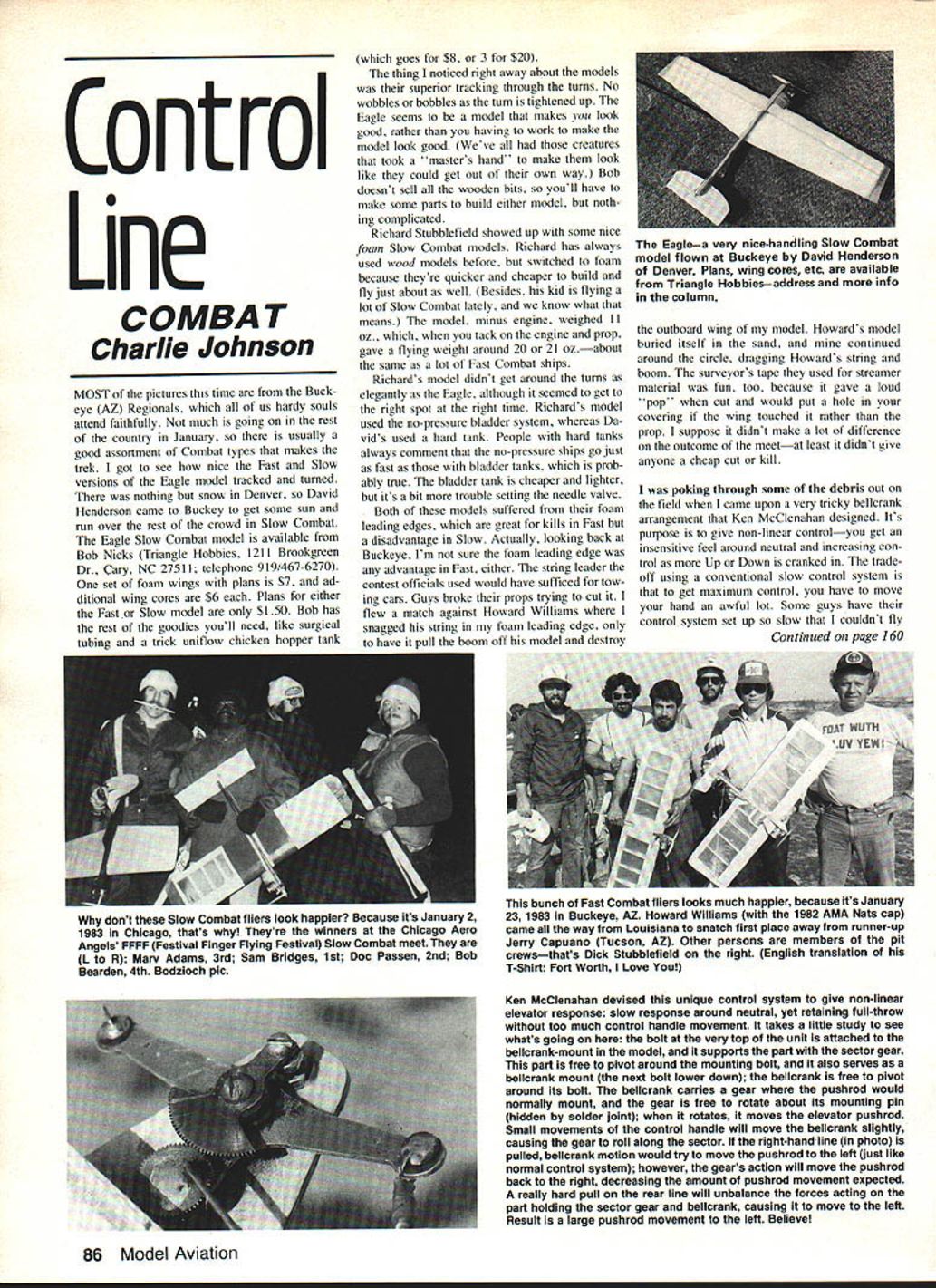
Most of the pictures this time are from the Buckeye (AZ) Regionals, which all of us hardy souls attend faithfully. Not much is going on in the rest of the country in January, so there is usually a good assortment of Combat types that makes the trek. I got to see how nicely the Fast and Slow versions of the Eagle model tracked and turned. There was nothing but snow in Denver, so David Henderson came to Buckeye to get some sun and run over the rest of the crowd in Slow Combat.
The Eagle Slow Combat model is available from Bob Nicks (Triangle Hobbies, 1211 Brookgreen Dr., Cary, NC 27511; telephone 919/467-6270). Pricing and items available:
- One set of foam wings with plans: $7
- Additional wing cores: $6 each
- Plans for either the Fast or Slow model: $1.50
- Other items: surgical tubing and a trick uniflow chicken-hopper tank ($8 each, or 3 for $20)
Bob doesn't sell all the wooden bits, so you'll have to make some parts to build either model, but nothing complicated.
The thing I noticed right away about the models was their superior tracking through the turns. No wobbles or bobbles as the turn is tightened up. The Eagle seems to be a model that makes you look good, rather than you having to work to make the model look good. (We've all had those creatures that took a "master's hand" to make them look like they could get out of their own way.)
Foam Slow Combat and comparisons
Richard Stubblefield showed up with some nice foam Slow Combat models. Richard has always used wood models before, but switched to foam because they're quicker and cheaper to build and fly just about as well. (Besides, his kid is flying a lot of Slow Combat lately, and we know what that means.) The model, minus engine, weighed 11 oz., which, when you tack on the engine and prop, gave a flying weight around 20 or 21 oz.—about the same as a lot of Fast Combat ships.
Richard's model didn't get around the turns as elegantly as the Eagle, although it seemed to get to the right spot at the right time. Richard's model used the no-pressure bladder system, whereas David's used a hard tank. People with hard tanks always comment that the no-pressure ships go just as fast as those with bladder tanks, which is probably true. The bladder tank is cheaper and lighter, but it's a bit more trouble setting the needle valve.
Both of these models suffered from their foam leading edges, which are great for kills in Fast but a disadvantage in Slow. Actually, looking back at Buckeye, I'm not sure the foam leading edge was any advantage in Fast, either. The string leader the contest officials used would have sufficed for towing cars. Guys broke their props trying to cut it. I flew a match against Howard Williams where I snagged his string in my foam leading edge, only to have it pull the boom off his model and destroy the outboard wing of my model. Howard's model buried itself in the sand, and mine continued around the circle, dragging Howard's string and boom.
The surveyor's tape they used for streamer material was fun, too, because it gave a loud "pop" when cut and would put a hole in your covering if the wing touched it rather than the prop. I suppose it didn't make a lot of difference on the outcome of the meet—at least it didn't give anyone a cheap cut kill.
Ken McClenahan's non-linear bellcrank
I was poking through some of the debris out on the field when I came upon a very tricky bellcrank arrangement Ken McClenahan designed. Its purpose is to give non-linear control—you get an insensitive feel around neutral and increasing control as more Up or Down is cranked in. The trade-off using a conventional slow control system is that to get maximum control, you have to move your hand an awful lot. Some guys have their control system set up so slow that I couldn't fly.
Ken McClenahan devised this unique control system to give non-linear elevator response: slow response around neutral, yet retaining full throw without too much control-handle movement. It takes a little study to see what's going on here: the bolt at the very top of the unit is attached to the bellcrank-mount in the model, and it supports the part with the sector gear. This part is free to pivot around the mounting bolt, and it also serves as a bellcrank mount (the next bolt lower down); the bellcrank is free to pivot around its bolt. The bellcrank carries a gear where the pushrod would normally mount, and the gear is free to rotate about its mounting pin (hidden by a solder joint); when it rotates, it moves the elevator pushrod.
Small movements of the control handle will move the bellcrank slightly, causing the gear to roll along the sector. If the right-hand line is pulled, bellcrank motion would try to move the pushrod to the left (just like a normal control system); however, the gear's action will move the pushrod back to the right, decreasing the amount of pushrod movement expected. A really hard pull on the rear line will unbalance the forces acting on the part holding the sector gear and bellcrank, causing it to move to the left. Result is a large pushrod movement to the left. Believe!
They fly their models very well. I always wondered how their wrists and arms were jointed. Ken's system still gives you the slow control around neutral (which makes for precise maneuvers) but also provides full control for tight turns without extreme arm motion.
Flying technique and tangles
If you haven't noticed it, the "arm" fliers are the ones who get in the majority of line tangles and can't get back out of them again. Having to wave your arm around wildly to get full control may look cool to the judges when you're doing Swan Lake, but all that motion usually catches the other guy's arm or lines.
The reason the British used to be so great at flying in-line tangles was that they flew with their wrists. Richard Evans was the greatest flier I'd seen using this technique, and it was common for him to fly the full four minutes of FAI Combat with half a dozen wraps on his opponent's lines, if the other guy was anywhere near Richard's skill level. (What all this has to do with tow-rope streamers and non-linear bellcranks, I don't know.)
Contest calendar and Nationals
About this time of year, the contest calendar really perks up. You still have some time to get ready for the big meets coming up over Memorial Day weekend. There are the usual big-time meets, like the Northwest Regionals and Houston, where all categories of Combat are flown. Chances are, there is a double- or triple-A meet somewhere near you.
I haven't gotten the official word yet, but I'm sure AMA Combat will be flown at the Nationals this summer, after last year's phenomenal success. For an unofficial contest, it will probably be the biggest-drawing Combat event if its popularity increases as in previous years. There were TD engines, props, plugs and all kinds of goodies for prizes, so for a couple of bucks for entry, there's a lot of fun to be had.
Latest on the Hoffelt 36R
Latest update on the Hoffelt 36R: if you have a spare $260 lying around, this is the engine to have. Based on the K&B .40S case, this stroker will run faster than your best-stroked smoker and not self-destruct. The engine features a chrome liner with an aluminum piston and a special ring. Everything has a proper fit, so the engine doesn't tear itself apart.
How well it continues to run after a few ground-poundings we'll soon find out, because a limited number of these engines should be out by the Memorial Day meets. As the message on Howard Rush's fuel says, "10% more nitro than your fuel," the same can be said about this motor. In tests, it is faster on any number of props than anything else—but then the real world is a harsh place for Combat equipment.
Charlie Johnson 3716 Ingraham St., San Diego, CA 92109.
Transcribed from original scans by AI. Minor OCR errors may remain.

